
Where it started
Vilicus Farms began with a search for land rather than an inheritance. Doug Crabtree grew up on his family's farm near Urbana, Ohio, and the farm's own history says that farm was lost in the farm crisis of the 1980s. Without a family farm to return to, he and Anna Jones-Crabtree spent years looking for a way back into farming. In 2005 they saw an opening in the growing organic market and began drafting a plan for a model organic farm built around conservation.
Both came to the project with long careers in agriculture and land management. According to the Organic Trade Association, Doug studied agricultural economics at Purdue, earned a master's degree in plant science at South Dakota State, worked for five years as an independent organic inspector and joined the Montana Department of Agriculture in 2001 as its organic certification manager. Anna, who holds a PhD in civil engineering with a focus on sustainable systems, worked for the Forest Service. She appears in the People directory of these resources for her work at Vilicus.
In 2009 the couple bought 1,280 acres of Northern Great Plains prairie on the open market, using 20 years of savings, about 35 miles north of Havre and just south of the Canadian border. The farm's story page says they used USDA beginning farmer loans for land, equipment and operating capital, and that for the first seasons both kept their full time jobs and drove about ten hours each weekend from their home in Helena to farm. The name comes from the Latin word for a steward of the land. Anyone weighing a similar start can read how FSA microloans and beginning farmer loans work today.
What they changed
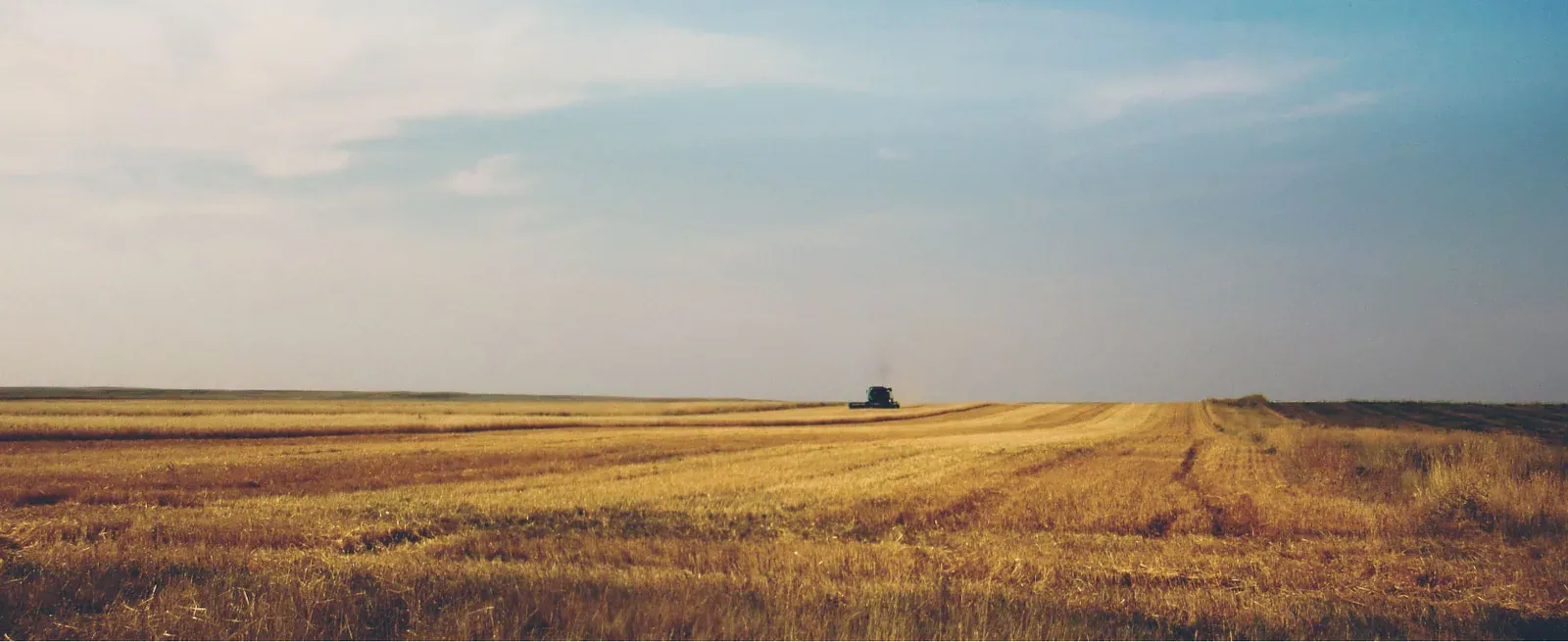
The farm sits in a landscape the farm itself describes as dominated by chemical fallow wheat monoculture. Vilicus set out to farm that ground differently, and its layout is the clearest sign of it.
Fields are divided into 240 foot wide cultivated strips separated by conservation buffers 20 to 30 feet wide. Working with the Xerces Society, the farm planted many of those buffers with native wildflowers and grasses for pollinators and other wildlife. The stewardship page says the buffers also cut the risk of wind erosion and catch winter snow, which adds moisture on dryland ground. Over 26% of the farm is kept in non-crop conservation and habitat, and the farm's Bee Better Certified profile reports that more than 400 acres have been seeded to native pollinator habitat. The approach is close to the idea behind prairie strips and other forms of pollinator habitat on a working farm.
Inside the strips, the farm relies on rotation and cover crops rather than synthetic inputs. Cover crops, used as green manure, are either a single species such as chickling vetch or a cocktail of eight species, depending on what a field needs. To end a cover crop, Vilicus typically uses a blade plow that cuts roots just below the surface and leaves the plant residue on top as mulch, which the farm says protects soil from erosion, holds moisture and suppresses weeds. It calls this "appropriate tillage": tillage is still part of soil, cover crop and weed management, and the farm describes its approach as minimum disturbance tillage.
The farm also built a training program into the business early. In 2013 it launched a beginning organic farmer apprenticeship to help new farmers establish themselves on the Northern Great Plains.
How it works today
Vilicus has grown far beyond its first purchase. Its own site describes growth from 1,280 to 9,600 acres, and more recent outside sources give a larger figure: Bee Better Certified lists 12,000 certified acres, and Montana Public Radio described the farm in July 2025 as 12,000 acres of organic dryland farmland. The farm's Bee Better profile credits that growth to USDA beginning farmer programs, extensive conservation practices and risk sharing relationships with food companies and land investment firms.
The farm grows over 20 crops a year in a rotation of five to seven years. The Regenerative Organic Alliance's directory lists barley, buckwheat, durum, spring and winter wheat, Kamut, lentils, peas, flax, millet, oats, rye, safflower and triticale, along with radishes, turnips, vetch and sweet clover. The Real Organic Project notes integrated grazing in its rotation, and says the farm sells whole grains wholesale to various mills, distillers and ingredient buyers. A long, diverse rotation like this follows the logic of the principles of crop rotation.
Its certifications appear in the certifiers' own directories as checked in October 2026. The Regenerative Organic Alliance lists Vilicus at Regenerative Organic Certified Silver. It has been Bee Better Certified since 2019, and the farm says it received Real Organic Project certification in 2020. It is also certified organic.
Vilicus has also found a way to be paid for stewardship directly. Through its Community Supported Stewardship Agriculture program, supporters buy shares at levels from $100 to $5,000. The farm presents the program as a more transparent alternative to carbon credits and other ecosystem service payments, funding conservation work that crop sales do not cover. Montana Public Radio reported that Vilicus sells these stewardship shares at $100 per acre.
Training continues as well. The farm's Bee Better profile says that the Vilicus Training Institute has hosted more than 11 apprentices since 2013, along with interns, and the farm's apprenticeship page lists an eight month New Agrarian apprenticeship offered in partnership with the Quivira Coalition's New Agrarian Program.
What it shows
Vilicus is useful mainly as proof of scale. Much of the public picture of regenerative agriculture comes from small, diversified farms that sell direct. Here the same ideas, diverse rotations, permanent habitat and cover crops, are applied across thousands of acres of dryland grain sold through wholesale channels. The farm's choice to give over a quarter of its land to non-crop habitat is a large, visible commitment, and it shows that conservation can be designed into the field layout itself rather than added at the edges. It fits the long view behind thinking long-term.
It also shows how much of that model depends on finance as much as farming. The start relied on personal savings, USDA beginning farmer loans and off-farm salaries, and later growth involved partners such as land investment firms. At the 2025 summit covered by Montana Public Radio, Anna Jones-Crabtree said some crop insurers view organic farms as too risky and that organic farmers can struggle to get loans, on top of volatile markets. The same report noted that organic farms typically produce lower crop yields. The stewardship shares are a direct response: a way to pay for conservation work that the grain market does not reward.
The trade-offs are stated plainly. "It's a little harder to farm this way, it's not a recipe," Jones-Crabtree said at the summit, as reported by Montana Public Radio. The system also still relies on tillage, used lightly but not eliminated. And the newest acreage figures come from certifier and press sources rather than from the farm's own site, so its exact size depends on the date and the source.
What stands out is the combination: an organic grain farm at a scale most people associate with conventional wheat, certified by three different programs, that also trains new farmers and asks the public to fund its habitat directly. For anyone looking at how to heal the soil on large dryland acreage, it is a clear, well documented working example.