
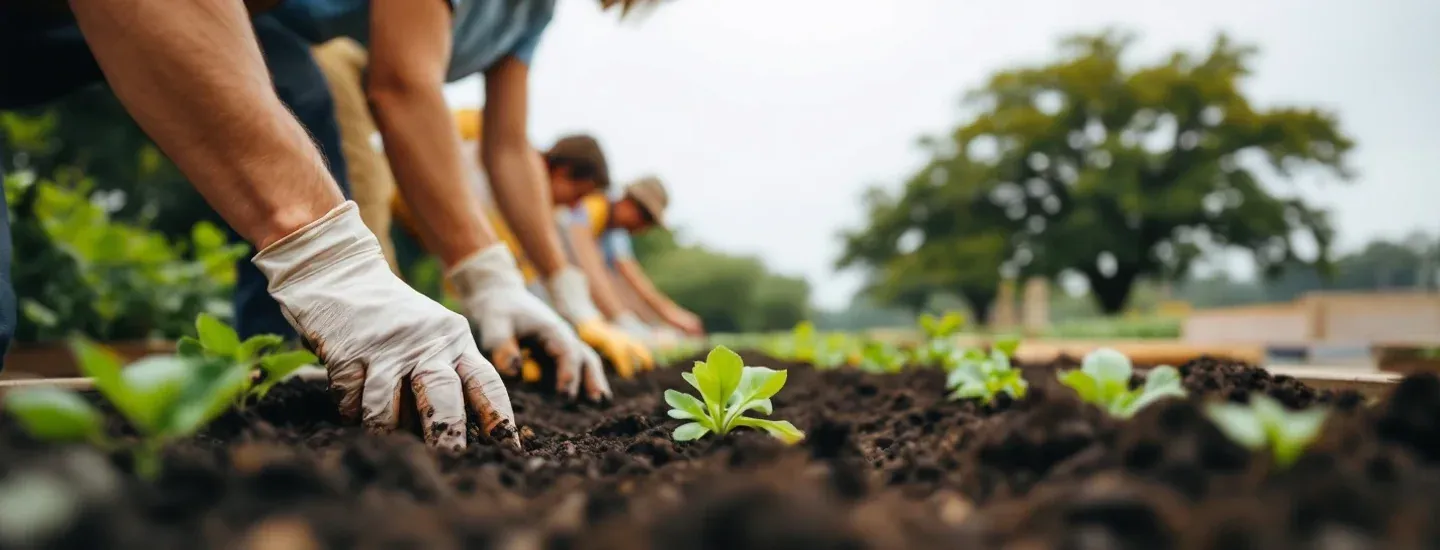
As the world grows smaller and more connected, it is easier than ever to reach people of every age, background and belief. That connectivity brings real benefits. Yet many of us have lost touch with what exists closer to home, and our sense of community has thinned.
At Ashfount, we believe the farms and food businesses we work with do best when they are embedded in the communities they serve. A farm that sells at the Saturday market, supplies the school cafeteria and opens its gates for a harvest day becomes part of local food security and of a local economy that can carry itself. When neighbors work together to improve their own community, the effect ripples outward.
That is why we care about locally resilient economies: building local food security, encouraging a sense of community, and growing economic networks that can support themselves. It takes participation from every business involved, from treating its crew fairly to backing community efforts.
When we take on work, one of the first questions we ask is how a farm or food business is rooted in the place where it operates. We help our clients tell that story and build the channels that keep them close to their customers, so they can cope with whatever the coming years bring.
Globalization and the loss of community
We live in an age of individualization, and nowhere more than in the United States. Being self-made is often seen as the highest form of success. The cost is that we have lost some of our ability to support one another, to share our successes, and to believe that real change can happen when we rely on each other.
The paradox is that the internet gives us more ways to stay connected than ever. The world feels smaller, yet we have forgotten the neighbors just around the block. The New York Times has described our time as an age of loneliness, despite all our tools for talking to each other.
Local food is one of the simplest ways back. A farmers market in a small town is a place where people meet the person who grew their food, and where a farm becomes a familiar face. We encourage every client to treat that kind of presence as part of the business.
Shared rewards, shared risks
Too often a business is built around the gain of a single person. When it does well, the owner reaps the benefits. When it fails, the losses are shared by everyone around it.
This imbalance shows up in the numbers. According to the U.S. Census Bureau, the highest-earning 20% of U.S. households received 52.2% of all household income in 2024. And according to OECD data reported by the Pew Research Center, income inequality in the U.S. is the highest among the G7 nations.

We believe the burdens and the rewards should be shared by everyone who makes a business work: owners, crews, partners and the community that buys from them. Models built that way hold up better over time, and we recommend them when we advise clients. Producer cooperatives that pool their products to reach bigger buyers are one example of such a supportive, shared network.
We are not speculators. We work with our clients at a truly collaborative level, through good seasons and hard ones, and we favor growth that is slow, organic and planned for the long term. The aim is working together for the common good, so that food security and healthy communities last for generations.
Giving the power back to the community
We also believe in local autonomy. The principle of subsidiarity holds that matters should be handled at the most local level that can handle them well, and that a central authority should do only what cannot be done closer to home. It places responsibility on the people who live with the results.
For the farms and food businesses we advise, that means being actors of their own change and a source of support in their towns. Our part is to give them the tools, the story and the confidence to take the first step, and then let them lead. It is the same conviction behind our belief that you should act local.
Empowering local actors builds local resiliency. It connects the people who shape a community, from growers and shop owners to teachers and cooks, and it builds a future that rests on the support of the people who live there.
Community wellbeing

A sense of togetherness does not appear by itself. It is cultivated by people who are willing to take part. When a farm sells to the local school district, hosts a field day or joins a local food network, it lays the foundation for a true community spirit that benefits everyone over time.
Disagreement is part of any community. We believe a farm or food business earns its place by listening, respecting the diversity of the people around it, and treating the land and its neighbors well. Our directory of organizations lists farmer networks and local food groups that are a good place to start looking for allies close to home.
Understanding our agency
Our society has grown more individualized as the world has globalized. If we want to keep the great advances that came with it, getting involved in the community is exactly what we need. Each of us has a different role, and each role adds to a shared sense of agency and support.
For us, that means getting our hands dirty. We get to know the people behind every farm and food business we work with and learn how they fit into their towns. Then we put our writing, video and strategy work behind them, because that is what we do: support the change-makers who keep good food close to home.