
Where it started
EPIC Provisions began in a home kitchen in Austin, Texas. Its co-founders, Taylor Collins and Katie Forrest, were competitive athletes, and before EPIC they ran a vegan food company. In a 2016 interview with FoodNavigator, Forrest said the couple "went from being vegans to carnivores pretty much overnight," and they let the earlier business go to focus on meat. The brand's own account of its origin is shorter: it credits a single bite of a burger with prompting questions about where meat comes from and how it is raised.
The company launched in 2013 with a meat, fruit and nut bar. The early lineup included Bison Bacon Cranberry, which is still sold today and which the brand calls its perennial bestseller. The idea did not land easily. Forrest recalled that a retail buyer called it "the worst idea ever." EPIC went ahead anyway, and it grew fast: FoodNavigator reported that revenue tripled to $6.8 million in 2014 and tripled again to $20 million in 2015.
In January 2016, General Mills announced that it had acquired EPIC. The release placed the brand within General Mills' Annie's business, said EPIC would keep its Austin location and that both founders would stay with the business, and did not disclose the terms. By then the bars were sold in natural food stores such as Whole Foods, Sprouts and Natural Grocers, at REI and in some conventional grocery stores. General Mills still lists EPIC among its brands today, and EPIC appears in the food brands directory.
What they changed
From the start, EPIC framed meat as a land question as well as a nutrition question. The brand became a sponsor of the Savory Institute, the nonprofit network built around Holistic Management, and its site says it seeks partnerships with ranchers it deems EPIC and rewards them for healing the land. The practices it points to are those of holistic land management, including rotational grazing in which ranchers track how long a herd stays on each paddock. The Savory Institute is listed in the organizations directory.
The more concrete step came through the Savory Institute's Land to Market program, which verifies products against Ecological Outcome Verification, or EOV: monitoring of soil health, biodiversity and ecosystem function on the land where the animals are raised. In November 2018, White Oak Pastures announced that EPIC's Sweet and Spicy Sriracha Beef Bites were the first product to carry the new consumer-facing Land to Market seal. The beef came from White Oak Pastures in Georgia, a long-running regenerative operation that the post described as EPIC's first supplier in the program. The same post said EPIC had received the Savory Institute's Frontier Founder Award that year for its regenerative sourcing commitment.
In March 2021, General Mills introduced the Beef Barbacoa-Inspired Bar, the first bar to carry the Land to Market EOV seal, again made with White Oak Pastures beef. It launched exclusively at Whole Foods Market and on EPIC's own website at a suggested price of $2.99. In the release, a co-leader of the Savory Institute's Land to Market program called EPIC its oldest brand partner. White Oak Pastures appears in the farms and ranches directory.
How it works today
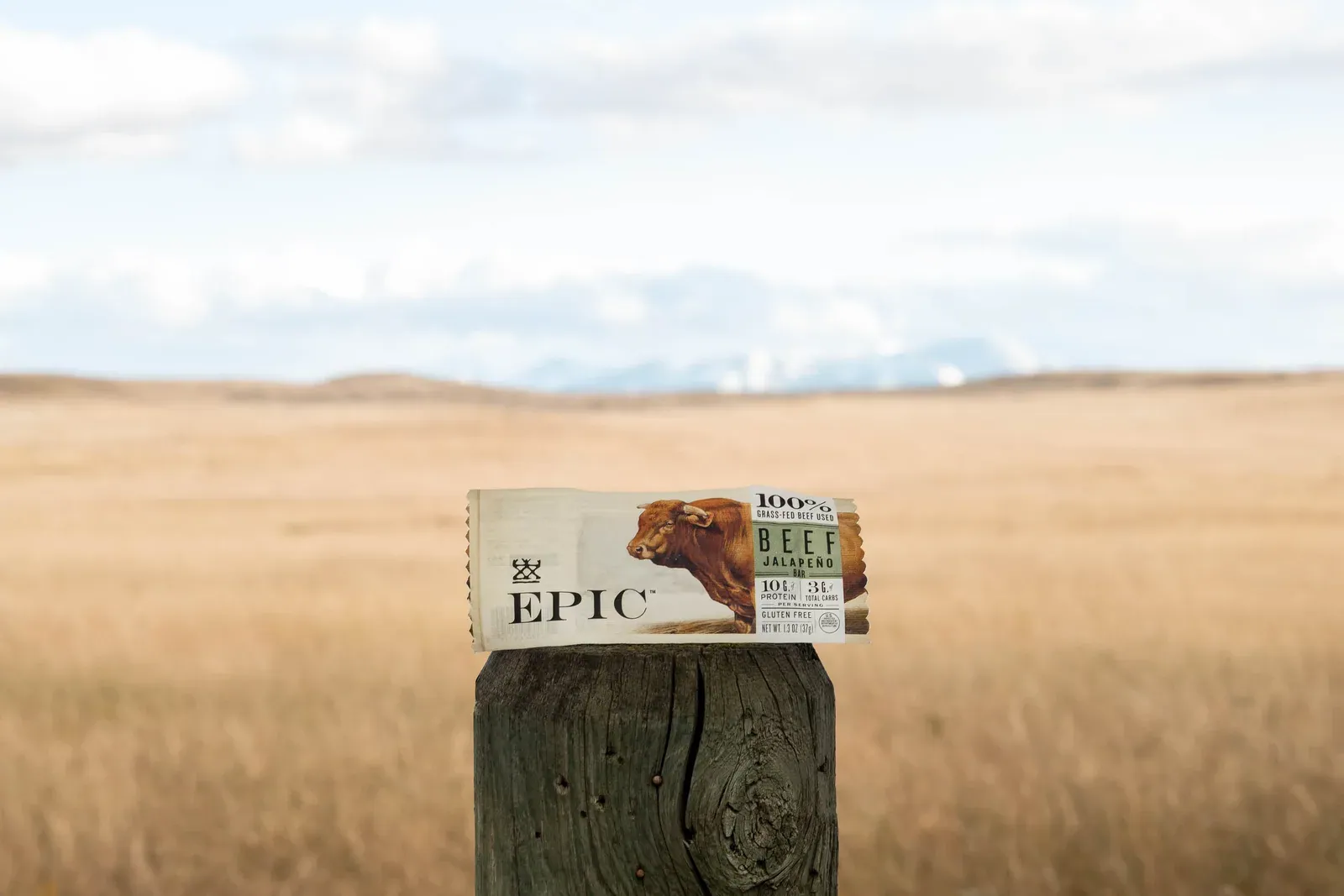
EPIC no longer sells only bars. Its online shop now carries bars, bites, snack strips, bone broth, rendered animal fats, pork rinds and cracklings, topper bits and chicken crisps, made from beef, bison, venison, chicken, pork and salmon. The beef, bison and venison products are labeled 100% grass-fed; the chicken and pork lines are described as free-range or raised without antibiotics. The bone broth, the brand says, uses bones that might otherwise go to waste.
The Land to Market thread is still visible. The current page for the Beef Barbacoa-Inspired Bar describes it as 100% grass-fed and Land to Market verified, and the Sriracha Beef Bites are described as made with Land to Market verified beef. EPIC's carbon page names White Oak Pastures as its beef supplier for the Barbacoa bar and cites a third-party life cycle assessment which found that the farm offsets 80% of its emissions across all ten livestock species it raises, through practices such as composting and converting degraded cropland to perennial pasture. EPIC also remains on Land to Market's current member list.
Two other commitments sit alongside the sourcing. Since mid-2022, EPIC has sent 1% of every purchase on its website to Stripe Climate for carbon removal projects. And its shop sorts products by Whole30, keto-friendly and non-GMO labels. EPIC sells through its own site, with subscriptions, through retailers it lists in a store locator, with the Barbacoa bar sold only at Whole Foods Market and on the website, and through a B2B channel.
What it shows
EPIC is a useful case because it is a brand, not a ranch. It does not raise animals; it buys meat, and its leverage is in what it chooses to buy and how it labels it. That makes it a different model from a farm that sells its own beef by the half or quarter. The question for a brand like this is whether its purchasing changes anything on the ground, and the clearest answer EPIC can give is the Land to Market seal, because it rests on monitored outcomes on named land rather than on a description of practices. Readers comparing labels will find more on how EOV differs from other programs in Regenerative Certifications Compared and Honest Labels: Grass-Fed, Pasture-Raised and Regenerative.
The limits are just as visible. The verified products are a small part of a wide range, and the rest of the range carries grass-fed and raised-without-antibiotics claims rather than an outcome verification. A 2018 High Country News article, first published by New Food Economy, questioned parts of the brand's story. It reported that Tanka Bar, made on the Pine Ridge Reservation in South Dakota and based on the traditional Lakota food wasna, had launched a bison and fruit bar in 2007, years before EPIC. It also reported that EPIC could not source enough grass-fed bison, and quoted Collins saying that about half of its bars were then labeled grass-fed, up from 10% in earlier years. EPIC's own story page says it "can't say for sure" that it made the world's first 100% grass-fed meat, fruit and nut bar, and its current bison products are labeled 100% grass-fed.
The case also shows what scale brings. Under General Mills, EPIC put a verified regenerative product on national retail shelves, and General Mills had its senior soil scientist speak for the 2021 launch. A single farm like White Oak Pastures gains a buyer that can carry its beef into stores far from Georgia. The open question, as with scaling any food brand, is whether verified supply can grow as fast as the shelf space, and EPIC's own product pages suggest that so far it has grown in a few products, not across the whole line. For readers interested in what verified grazing is meant to do for the land itself, Heal the Soil sets out the goal that programs like Land to Market try to measure.