
Two weeks from now the specialty food trade gathers in Las Vegas. The 49th Winter Fancy Food Show runs January 19 to 21 at the Las Vegas Convention Center, trade only, with buyers from Whole Foods, Sprouts, Kroger, Albertsons, Thrive Market and Dot Foods on the confirmed list, according to the Specialty Food Association's announcement. Natural Products Expo West follows in Anaheim in March.
For a farm that has turned a crop into a sauce, a granola or a jerky, the winter shows raise the question every growing brand hits sooner or later. How do you make more than your own kitchen can make, sell it through people you have never met, and still keep a margin at the end?
This article walks through the four pieces: the co-packer, the label and the barcode, the distributor's arithmetic, and the cash that growth quietly eats. If you are still at the first product, start with our guide to turning a crop into a value-added product. If the farm itself is still becoming a business, start with turning a hobby farm into a business and come back here when the orders outgrow the kettle.
When a co-packer makes sense
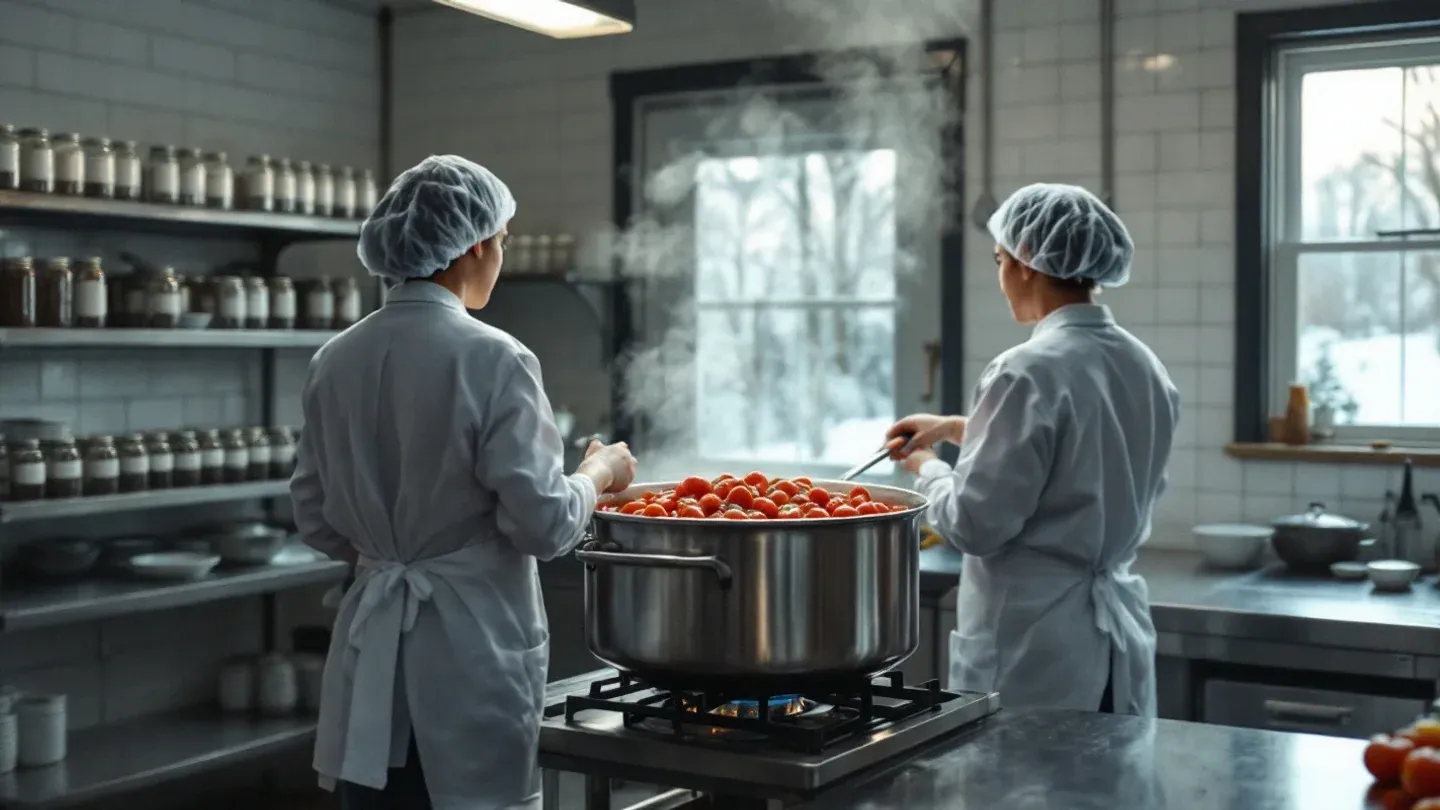
A co-packer is a manufacturer that produces, packages or labels a product for other companies, usually under the client's own brand. The University of Florida's extension factsheet lists the upside plainly: lower financial risk, access to professional help, savings in time and storage, and support with regulatory compliance. The downside is just as plain: you lose control over the product and the schedule, and you share your recipe with a plant that may run similar products for other clients.
NC State Extension adds the economic logic. Equipment and buildings are expensive, so a co-packer lowers the start-up cost, makes overhead easier to predict and shortens the time to market. The same publication warns that the co-packer has to recover all of its overhead and profit from your price, so co-packed product is not cheap per unit. You trade capital risk for a thinner margin.
The practical signs are familiar. You turn down orders because you cannot make enough. Your slots in a shared-use commercial kitchen no longer match demand. You spend more hours making product than selling it. And one or two products sell steadily, not a dozen that sell a little. A co-packer run is a bet on one recipe, so simplify the line before you scale it.
How to vet a co-packer
The Florida factsheet is specific about what to bring to the first conversation: a business plan that settles the order size, detailed process instructions, and specifications for ingredients, packaging and labeling. NC State says the same in fewer words: bring your specifications and your checklist of needs. A co-packer cannot quote a job it cannot picture.
Then ask the hard questions the Florida factsheet lists: minimum runs, the total cost with no hidden fees, whether the plant can follow your ingredients and methods, certifications such as organic or gluten-free, the food safety system in place and the latest inspection report, how a rush order in the holiday season is handled and at what cost, capacity to scale, and help with ingredient ordering and storage. NC State adds references from current clients and a straight question about whether the plant can meet your volume in peak season, not just in a quiet month.
Two warnings. Confidentiality first: Florida suggests a confidentiality agreement before you hand over the formulation, and NC State is blunter. Formulations and specifications must be shared, so confidentiality can never be assured, and most co-packers will not sign a noncompete. Choose a plant you trust, not a contract you hope will protect you.
Second, the contract. Get it in writing and have an attorney read it. NC State's minimum list covers services, testing, who buys which ingredients, processing requirements, acceptance criteria, labeling, delivery, payment terms, what happens to rejected product, recall plans and confidentiality. Ask for a guaranteed price for at least a year, and expect roughly 10 percent down with the remainder on delivery. Florida notes that many co-packers want production confirmed a month or more ahead, which matters for the cash flow section below.
On the regulatory side, the co-packer's plant is the facility registered with FDA and the one running the food safety plan under the FSMA preventive controls rule. That is a relief, not a transfer of responsibility: your name is on the jar, so a recall is your recall. Ask to see the plan.
Finding candidates is easier than it used to be. The Cornell Food Venture Center keeps a state-by-state list of shared kitchens and co-packers, several other state extension programs keep their own, and our directory of service providers and manufacturers lists firms working with regenerative producers.
The label on a co-packed jar
Federal rules care who made the food. Under 21 CFR 101.5, the label must carry the name and place of business of the manufacturer, packer or distributor, and where the named company did not manufacture the food, the name must be qualified with a phrase such as "Manufactured for" or "Distributed by". Your co-packed sauce can carry your farm's name, but it carries it with that phrase.
The rest follows the FDA Food Labeling Guide, whose chapters walk through the name of the food, the net quantity of contents, the ingredient list, allergen labeling and nutrition labeling. The panel uses the updated format with added sugars, actual amounts of vitamin D, calcium, iron and potassium, and larger type for calories; manufacturers under $10 million in annual food sales had until January 1, 2021 to switch, so a label designed today starts there.
Small brands have one real exemption. FDA's small business nutrition labeling exemption covers a product from a company with fewer than an average of 100 full-time equivalent employees that sells fewer than 100,000 units of that product in the United States in a 12-month period. You file a notice with FDA every year, and the exemption disappears the moment the label makes a nutrition claim such as "low sodium". Many buyers want the panel anyway, so budget for a nutrition analysis.
Allergens are not optional. FDA lists nine major allergens: milk, eggs, fish, crustacean shellfish, tree nuts, peanuts, wheat, soybeans and sesame, the last added by the FASTER Act and effective since January 1, 2023. A co-packer that runs a sesame product on your line is a labeling question, not just a cleaning question. For the marketing side of the label, our piece on honest labels covers the claims that get farms into trouble. The packaging itself is worth a look through our guide to reducing plastic as a food business.
One barcode per item
Distributors and retailers expect a UPC on every item. Barcodes in the United States come from GS1 US. A single GS1 US GTIN costs $30 with no renewal; a GS1 Company Prefix covering ten items costs $250 up front and $50 a year, and the 100-item tier costs $750 and $150 a year. Every flavor and every size needs its own number, so count your items honestly before you pick a tier, and get the codes before the show rather than after the first purchase order.

The distributor's arithmetic
This is where farm brands lose money without noticing. The culprit is the difference between markup and margin, which Penn State Extension explains with one example: an item that costs $1.00 and carries a 30 percent markup sells for $1.30, but the 30 cents is only 23 percent of the sale price. A true 30 percent margin needs a price of $1.44. Retailers and distributors talk in margin on their own selling price, and they set their price by dividing, not multiplying.
So work backward from the shelf. Ask each buyer what margin they work to, then do the arithmetic in that direction. If a store says it needs a 40 percent margin on a jar it will sell for $8.00, it will pay $4.80 for the jar. If the distributor that delivers to that store wants 25 percent of its price, you receive $3.60. Promotions, free cases, broker commissions and spoilage allowances come out of your side, not theirs.
Now put your own numbers under that. Penn State's Food for Profit worked example uses a barbecue sauce with $4.30 of variable cost per bottle. At $3.60 from the distributor, that sauce loses money on every unit before fixed costs are even counted. The same guide shows the way out: the contribution margin (price minus variable cost) divided into monthly fixed costs gives the break-even volume, and the price, the recipe cost or the channel has to change until that volume is realistic. Penn State's pricing guide puts the rule in four words: never price below your cost of production. The co-packer quote and the distributor's margin have to be read together, on one sheet, before either contract is signed.
Slotting fees and the price of a shelf
Big grocery chains often charge for shelf space. When the Federal Trade Commission held a workshop on slotting fees in 2000, trade coverage recorded fees reported as high as $25,000 per item per store, estimates of $9 billion a year in total, and a small bakery saying it simply could not afford them. The same report noted that Costco did not charge them, that one large chain ran a program waiving them for small suppliers, and that a 27-store regional chain used itself as a proving ground for local producers.
That picture still points the way for a farm brand. Start with the independents and regional chains that buy on taste and story, ask every buyer in writing what fees and free product they expect, and treat a national listing as something you earn with regional sales data rather than buy with cash you do not have. It is the commercial version of acting locally. The brands in our food brands directory mostly grew that way.
The cash flow trap
Here is the timeline that sinks profitable brands. You confirm a co-packer run a month ahead and put 10 percent down. You buy ingredients and packaging weeks before the run. You pay the balance on delivery. The pallets go to a distributor, then to stores, and the invoice is paid weeks after that. The Small Business Administration describes the gap in its accounting basics: a sale made in January and paid in February is January revenue on an accrual statement and February cash in the bank.
Each bigger order widens that gap, because the deposit, the ingredients and the balance all scale with the order while the money arrives on the same old schedule. Growing too fast does not mean selling too much; it means selling more than your working capital can carry.
Two federal programs are built for exactly this. USDA's Value-Added Producer Grants include working capital grants that may pay eligible post-harvest operating costs, which 7 CFR 4284.925 lists as salaries of employees who process, market and deliver the product, part of the additional commodity inventory, a marketing campaign and food safety certification. Grant funds cover up to 50 percent of project costs and no recipient may receive more than $500,000 in total under 7 CFR 4284.928. Separately, the Farm Service Agency's operating microloans provide up to $50,000 per loan, with marketing costs among the listed purposes and terms of one to seven years. We explained how to apply in our piece on FSA microloans and beginning farmer loans.
Whichever tool you use, build a monthly cash flow projection before the first large run, and keep it honest about payment dates. Our farm business plan guide has the template. If the plan says the brand can only grow at the pace its cash allows, that is a result, not a failure: it is what thinking long term looks like on a spreadsheet. Some farms close the gap by pooling with neighbors instead, which we cover in producer cooperatives.
Working the winter shows
The Las Vegas show has built a path for exactly this stage of brand. The announcement describes a Debut District for first-time exhibitors and startups, afternoon Spark Showcase pitch sessions where early-stage makers present to an expert panel, and Ask the Experts appointments with industry advisers. Even as a walking attendee you can use the floor to meet distributors, compare shelf prices and ask co-packers what their minimums really are.
Go with one sheet in your bag: your cost per unit from the co-packer quote, your price to a distributor, your price to a store, the suggested shelf price, your UPCs and a compliant label. Give every buyer the same price list. Nothing damages a young brand faster than two buyers in the same region comparing notes, and consistency is the whole of a reputation in wholesale. Then follow up within the week; the brands that win accounts are the ones that keep the customers they already have.
A short checklist before you scale
Before you sign with a co-packer or a distributor, make sure you can tick every line.
- One or two products with steady sales and a recipe you can specify on paper.
- A written co-packer quote with no hidden fees, a one-year price guarantee and a contract your attorney has read.
- A label that names the co-packing relationship correctly, carries the nine allergens and either a Nutrition Facts panel or a filed exemption notice.
- A UPC for every flavor and size.
- One sheet that runs the margin arithmetic backward from the shelf price to your door, with the co-packer's cost underneath it.
- A monthly cash flow projection that shows the deposit, the balance and the payment date of every order, and a plan for the gap.
Scaling a food brand is mostly arithmetic and patience. The arithmetic is learnable in an afternoon. The patience is the part that keeps the farm.