
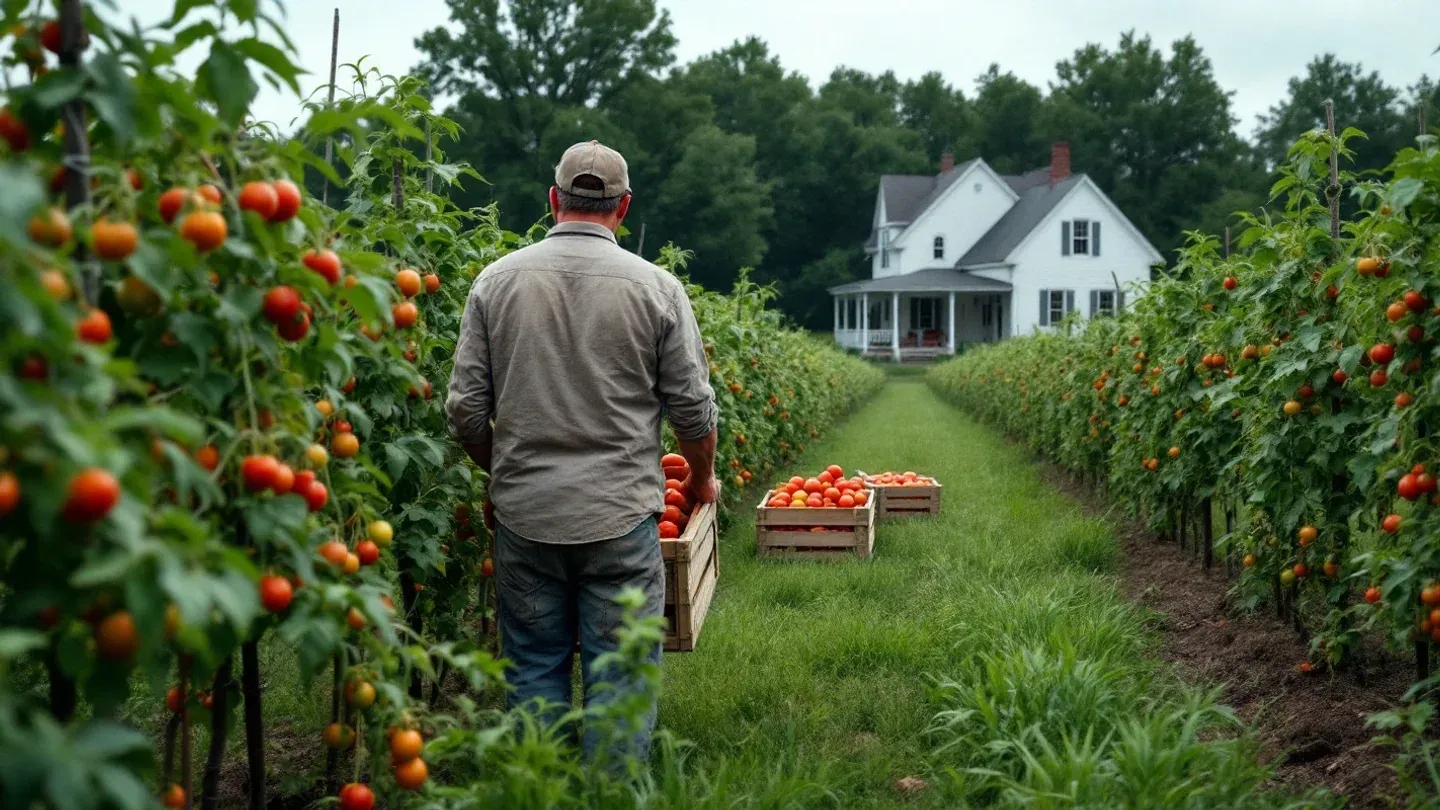
Late August is when the tomato question arrives. The vines are loaded, the market table is full, the neighbors have stopped answering the door, and somebody at the stall says what they say every year: "You should bottle this." National Farmers Market Week came and went two weeks ago, August 6 to 12, recognized for the first time by a Senate resolution, and a lot of growers walked away from it with the same idea. A sauce line. A salsa. Something with a label that sells in January when the field is bare.
It is a good idea more often than not. It is also the point where a farm stops being only a farm and becomes a food business, with a second set of rules. This article walks through what sits between the surplus crate and the shelf: the math, the recipe, the process authority letter, the label, and the decision about whose kitchen the product gets made in.
What "value-added" means, and why the definition matters
USDA has a working definition, because it funds this kind of work. Under the Value-Added Producer Grant rules, a product qualifies when the commodity has undergone a change in physical state, is produced or marketed in a way that enhances its value, is physically segregated, becomes farm-based renewable energy, or is aggregated and sold as a locally produced food. The second half of the definition is the part farmers skip: the result must expand the customer base and leave a greater portion of the revenue with the producer.
Hold that second test up against your own plan. A jar of sauce that reaches new customers and keeps more of the dollar on the farm is value added. A jar that takes forty hours of your August to produce and sells to the same twenty people who already buy your tomatoes is a hobby with glass in it. Both can be fine, but only one is a business, and the difference is the subject of our belief page on thinking long-term.
Start with the math, not the recipe
Do this part before you buy a single case of jars. Penn State Extension's Food for Profit series separates price (the number on the jar) from pricing (the work of arriving at it), and lays out the two routes: competition-based, where you price against what similar products fetch, and cost-based, where you add every cost per unit and then your profit. Their worked example is worth copying onto a sheet of paper. A bottle that sells for $8.00 with $4.30 in variable costs leaves a contribution margin of $3.70. Against $925 a month in fixed costs, that is 250 bottles a month to break even and 291 bottles to clear a modest $150 profit. If 291 bottles a month sounds like a lot, you have learned something valuable for the price of a pencil.
Two things are easy to miss on that sheet. The first is your own labor and the labor of the people who will cook, fill, label and deliver. Put a real hourly figure on it. The second is the tomatoes themselves. Surplus feels free in August, but a sauce line that works will need tomatoes every year, including the years when you could have sold them fresh for a good price. Cost them at what they would have earned on the table.
NCAT's ATTRA program has written the plainest overview of this trade-off, and it is frank about the margins: food manufacturing is a mature industry, the growth is in niche products, and the niche is where a small producer can charge prices 30 percent or more above mainline markets. That premium is the whole case for a farm product. If you cannot tell a buyer in one sentence why your sauce earns it, go back to the sheet. We say more about cost of production as the foundation of every price in our guide to knowing your costs before you set a price, and about the wider logic of adding income streams in how to diversify farming income.
Scaling the recipe: weigh everything
A family recipe is a set of volumes and habits. A commercial recipe is a set of weights and controls. Penn State's guidance for commercial jams and fruit butters applies to any cooked farm product: consistent results come from measuring ingredients by weight, not volume, and batch size has to be planned around how much fruit is on hand and what the kettle can actually boil. Standards of identity also exist for some products. A jam, for example, must be concentrated to at least 65 percent soluble solids, and a fruit butter to at least 43 percent. Your sauce may not have a legal standard, but the lesson stands: write the recipe as a formula, in grams or pounds, with the fill temperature and the pH of the finished product recorded on every batch.
ATTRA's warning is blunt: multiplying the ingredients of a home recipe by ten often does not reproduce the product. Their advice is to contract a state-approved facility for a larger test run before you commit to equipment, because the formula will change at scale and a co-packer can help you change it. This is the "simplify" principle at work, and it is the reason our always simplify belief sits so close to the kitchen door: one product, one jar size, one formula you can repeat.
The process authority letter
Here is the part no farmers market customer sees and no sauce line can skip. Most farm sauces, salsas, relishes and pickles are what FDA calls acidified foods: low-acid foods to which acid or acid foods are added, with a water activity above 0.85 and a finished equilibrium pH of 4.6 or below. A tomato sauce with onions, garlic and peppers in it usually lands in that category. Whether yours does is exactly the question a process authority answers.
Federal rules require that the scheduled process for an acidified food, meaning the pH, fill temperature, hold time and every other critical factor that keeps it safe on the shelf, be established by a qualified person with expert knowledge of acidification. In practice that is a process authority at a land-grant university or a private lab. You send the exact batch formulation and your processing steps, they evaluate the product, and they issue a letter that sets the limits you must follow. NC State's Entrepreneur Initiative for Food lists the full sequence for a new acidified processor: training, a scheduled process from a process authority, equipment to measure every critical factor, FDA registration and process filing, then your state department of agriculture for its own requirements.
Three more pieces follow from that letter. First, the person supervising production must have attended a school approved by FDA covering pH controls and the critical factors of acidification. The usual route is a Better Process Control School, run by universities such as the University of Georgia, which also offers an online version covering only the acidified foods portion. Second, the establishment must register with FDA on Form 2541 within 10 days of starting to pack acidified foods, and the scheduled process must be filed on Form 2541e within 60 days of registration and before any new product is packed. Third, separately from the canning rules, any facility that manufactures, processes, packs or holds food for sale in the United States must register as a food facility with FDA and renew every other year. The FSMA preventive controls rule then applies, with modified requirements for very small businesses, defined as averaging less than $1 million a year in human food sales, adjusted for inflation.
None of this is as frightening as it reads. A process authority evaluation, a few days of school and two FDA forms are the price of admission to a product that can sit on a shelf for a year. The farms that get into trouble are the ones that treat a pH meter as optional.
Labeling basics
FDA does not pre-approve labels, which means you own every word on the jar. The agency's Food Labeling Guide is the reference, and Penn State's summary of it is the shorter read. Every package needs four things: the name of the food, the net quantity in both US and metric units on the lower third of the front panel, the name and full address of the business, and an ingredient list in descending order by weight. If a co-packer makes it, the label says "manufactured for" or "distributed by" with your name.
Allergens get their own line. Since January 1, 2023, sesame has joined milk, eggs, fish, crustacean shellfish, tree nuts, peanuts, wheat and soybeans as the ninth major food allergen, and every one present in your product must be declared. Check the sesame question on any spice blend you buy in.
Nutrition Facts are where small producers get a break. A business with fewer than an average of 100 full-time equivalent employees that sells fewer than 100,000 units of a product a year in the United States can claim the low-volume exemption by filing a notice with FDA. The exemption disappears the moment the label makes a nutrient content or health claim, so "low sodium" or "heart healthy" costs you a nutrition panel. Marketing words like "grass-fed" and "regenerative" have their own rules, which we unpick in our guide to honest labels.
Your kitchen or a co-packer's?
This is the decision that sets the shape of the business. There are three lanes. Cottage food laws let some products be made in a home kitchen and sold directly, but acidified sauces are usually outside them; see what you can sell from a home kitchen. A licensed on-farm or shared-use commercial kitchen puts production in your own hands, with the process authority, training and filings above, and is the subject of our piece on shared-use kitchens. The third lane is a co-packer: an established food company that processes and packages your product to your specification. Penn State's summary of the trade is honest. You are out of the kitchen, you gain their expertise and your own time for selling, and in exchange costs are higher and there are a limited number of them to choose from.
A simple rule of thumb: if the sheet from the pricing section says you need a few hundred jars a month and you already have a kitchen you can license, make it yourself and learn the product. If the sheet says thousands of jars, or you would rather spend August in the field than at the kettle, interview co-packers before you buy a single pot. Ask about minimum runs, who owns the formula, which certifications they hold and whether they will do a test batch. Our directory of service providers and manufacturers lists some of the people who do this work. Scaling a food brand with co-packers and distributors covers the next stage.
Whichever lane you choose, insure the product. Penn State's advice is to buy product liability cover before the product reaches the market, not after the first retailer asks for a certificate, and to assume your farm or homeowner's policy does not cover a food business. ATTRA notes that many markets and most retailers require it, commonly at $1 million to $2 million. Our older piece on what insurance a farmer needs is the farm-side companion.
Money: the Value-Added Producer Grant
USDA Rural Development's Value-Added Producer Grant is built for exactly this step. The fiscal year 2023 notice, published in the Federal Register on March 17, estimated about $31 million available, with planning grants up to $75,000 for feasibility studies, business plans and marketing plans, and working capital grants up to $250,000 to run the venture. Every grant dollar needs a matching dollar in cash or eligible in-kind contribution. Ten percent of the funds are reserved for beginning, veteran and socially disadvantaged farmers and ranchers, another ten percent for mid-tier value chain projects, and requests under $50,000 may use a simplified application.
That round closed on May 11 for electronic applications and May 16 for paper, and the notice gives September 30, 2023 as the anticipated award date, so applicants should hear in the coming weeks. If you missed it, the program recurs and the notice is where the next deadline will appear. A planning grant is the honest place to start: it pays for the feasibility study you should do anyway, and the application forces you to write the business plan we argue for in farm and agriculture business plans. For a wider view of which federal programs reward a small farm's time, see USDA grants worth a small farm's time.
The market stall is your test lab
The best thing about starting at a farmers market is that it tells you the truth cheaply. Put the sauce on the table beside the tomatoes it came from, price it at the number the sheet demands rather than the number that feels comfortable, and watch who buys and who comes back. A product that sells at the stall can be scaled; a product that only sells when you discount it cannot. Setting up a market stall that sells covers the table itself. The brands in our food brands directory are a useful study in how small producers tell their story on a label.
This is also why we hold to acting local. A sauce line built for the people who already know the farm has a customer base before it has a bar code. Growth, if it comes, comes from there.
A practical close
Before the next crate of surplus goes soft, do these in order:
- Fill in the pricing sheet with real labor and real tomato costs, and decide whether the break-even volume is one you can sell.
- Rewrite the recipe by weight, record the finished pH and fill temperature, and keep that record for every batch.
- Send the formulation to a process authority and book a seat at a Better Process Control School.
- Register the facility and file the scheduled process with FDA, then call your state department of agriculture.
- Draft the label with the four required elements, the allergen line and, if you qualify, the small business nutrition notice.
- Decide between your own licensed kitchen and a co-packer on the numbers, and buy product liability insurance before the first jar leaves the farm.
- Put the Value-Added Producer Grant on the calendar and start the planning grant application in winter, when there is time to write it.
Done in that order, a sauce line is a sound piece of consistent farm business rather than an August impulse. Done out of order, it is a shed full of jars. The tomatoes are the easy part.