
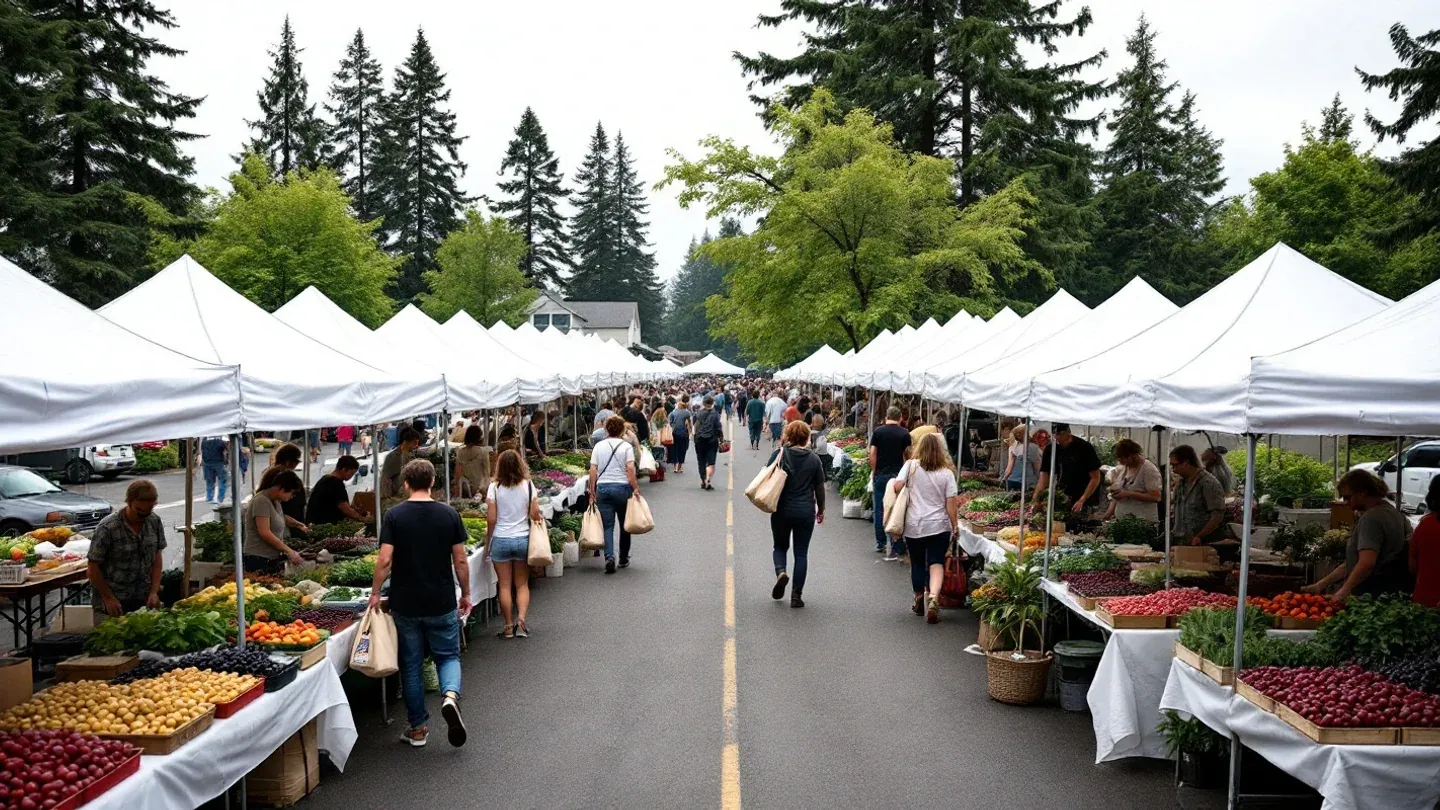
Memorial Day weekend is when a lot of American farmers markets come fully alive. Northern markets that have run thin since April fill in with the first strawberries and greens, and in Lexington, Kentucky, the market's weekly radio report called this weekend the unofficial beginning of summer. If this is your farm's first season behind a table, the next few Saturdays will teach you more than a whole winter of planning did. This article is meant to shorten the lesson.
Markets are a real business, not a hobby outlet. USDA's 2020 Local Food Marketing Practices Survey counted $9.0 billion of food sold through direct marketing by 147,307 operations, and $2.95 billion of that went straight to consumers through farmers markets, farm stands, CSAs and similar channels on 113,400 farms. The same survey found that 78 percent of farms selling directly made every sale within 100 miles of home. That is the economy we care about at Ashfount, and it is why we act local.
The money at a market is not spread evenly, though. USDA's 2019 National Farmers Market Manager Survey put total sales on a peak-season market day at an average of $11,615 per market, with about 780 households shopping. Western markets averaged $17,951 a day and southern markets $5,284; rural markets drew 315 households against 891 in cities. Divide a market day by its vendors and you see the point: the stall that sells is the one that wins a bigger share of a fixed crowd. Here is how to be that stall.
Pick the market before you pick the table
Start with the USDA National Farmers Market Directory, which lists markets with two or more farm vendors along with their hours, product mix and the forms of payment they take. Then go as a shopper, twice, before you apply. Count the produce vendors. Notice who has a line at 9 a.m. and who is packing up early. Watch where people park and which end of the market they enter from.
Ask the manager four plain questions: what the stall fee and the rules are, whether anyone already sells what you grow, whether sampling is allowed, and whether the market runs a central token system for SNAP. The 2019 survey found that half of all markets accept at least one federal nutrition program, and that 68 percent of vendors come back from one season to the next. A market with a loyal vendor roster is a market where customers have habits, which is exactly what you want to borrow. The groups in our organizations directory can point you to state market associations that know every market in their area. If your town has no market at all, that is a different project, and we will cover it in Starting a Farmers Market in a Small Town.
Get the display off the ground
Penn State Extension's Brian Moyer puts it as rule number one: no products on the ground. Nobody wants to buy food that sat on the pavement, even in a clean lug. His general rule is that displays should sit between knee height and shoulder height. UNH Extension's guide for market vendors says at least six inches off the ground, with containers tilted toward the shopper so the produce can be seen from a distance, and portable shelving that brings the best of it to between elbow and eye level.
Height is only half of it. The same UNH guide asks for contrasting colors, sizes and shapes next to each other: red tomatoes beside green kale beside yellow squash, not three crates of the same thing in a row. Bring a range of container sizes, because the crate that looked abundant at 8 a.m. looks picked over at 11. Moyer's fix is simple: when an item no longer fills a bushel basket, move it into a smaller container so the display still reads as full.
Always put up the canopy, even on a clear day. It is your store, it keeps the produce cool and clean, and it marks your space from twenty yards away. Weight the legs with sandbags; a canopy in a gust is the fastest way to ruin a neighbor's morning.
Signs that answer the question before it is asked
Shoppers at a market are already stepping outside their routine. Do not make them work harder by asking the price. Moyer's list for every sign: clear handwriting, the price, the name of the item, and what is different about it, whether that is an heirloom variety, a special flavor, or a note that it is hot, mild or sweet. UNH's version is to post a product and price sign above every single container, or on one blackboard that covers the table. A small whiteboard for what is new this week or on special lets you change your mind without reprinting anything.
Then tell your story in one glance: a framed board with a few photographs of the farm, a short flyer with what you grow and how to reach you. Shoppers want to know the person behind the food, which is an advantage no supermarket can copy. We wrote about this years ago in How to Market a Farm, and it is still true.
The product mix: anchors, impulse buys and one surprise
Think about how a shopper moves through your space. Moyer suggests placing the register at one end so customers pass every item on the way to it, with staples like sweet corn, tomatoes and potatoes at the far end and impulse items, the berries and the herbs and the jar of something, next to the checkout. People came for the anchors. They leave with the extras.
Leave room for one thing nobody else at the market has. The 2019 survey found that nearly 22 percent of vendors sold from its "other food products" and "miscellaneous" categories: mushrooms, nuts, fermented and pickled foods, foraged goods, prepared foods, soap and crafts. And in the 2020 USDA survey, value-added products made up 48 percent of direct-to-consumer sales. A jam, a dried herb blend or a bunch of cut flowers can carry a slow produce week; we will go deeper on that in Turning a Crop Into a Value-Added Product That Sells. The caution runs the other way too. A first-year stall with thirty items and a little of each looks confused. Six things done well, deep and fresh, is the better table, and it fits our belief that you should always simplify.
Pricing, and the scale the law expects
Price from your numbers, not from nerves. Know what a bunch of kale costs you to grow, harvest, wash and drive to town before you decide what to charge for it; we will walk through that arithmetic in Know Your Cost of Production Before You Set a Price. Then check what other markets in your region charge, so you are neither the bargain stall nor the one nobody understands.
How you price also decides whether you need a scale. Nebraska Extension's weights and measures guide is blunt that the rules apply to all sales, however small or seasonal the vendor. Produce may be sold by weight, by count or by measure. Selling by count (six ears for a price, a bunch, a head) keeps you out of scale territory entirely. Selling by weight at the table means a commercial scale that your state weights and measures office has certified; home postal scales, diet scales and other portion-type scales cannot be certified, no matter how precise they look. Pre-weighed bags need a label with the net weight, and because produce loses water after harvest, the bag you fill on Tuesday has to still make weight on Saturday. A dry quart is a legal 67.2 cubic inches, filled and struck level, not a basket heaped however you feel like heaping it. UNH's packing list puts it in one line: a licensed scale, if you choose to sell by weight.
Sampling without a visit from the health department
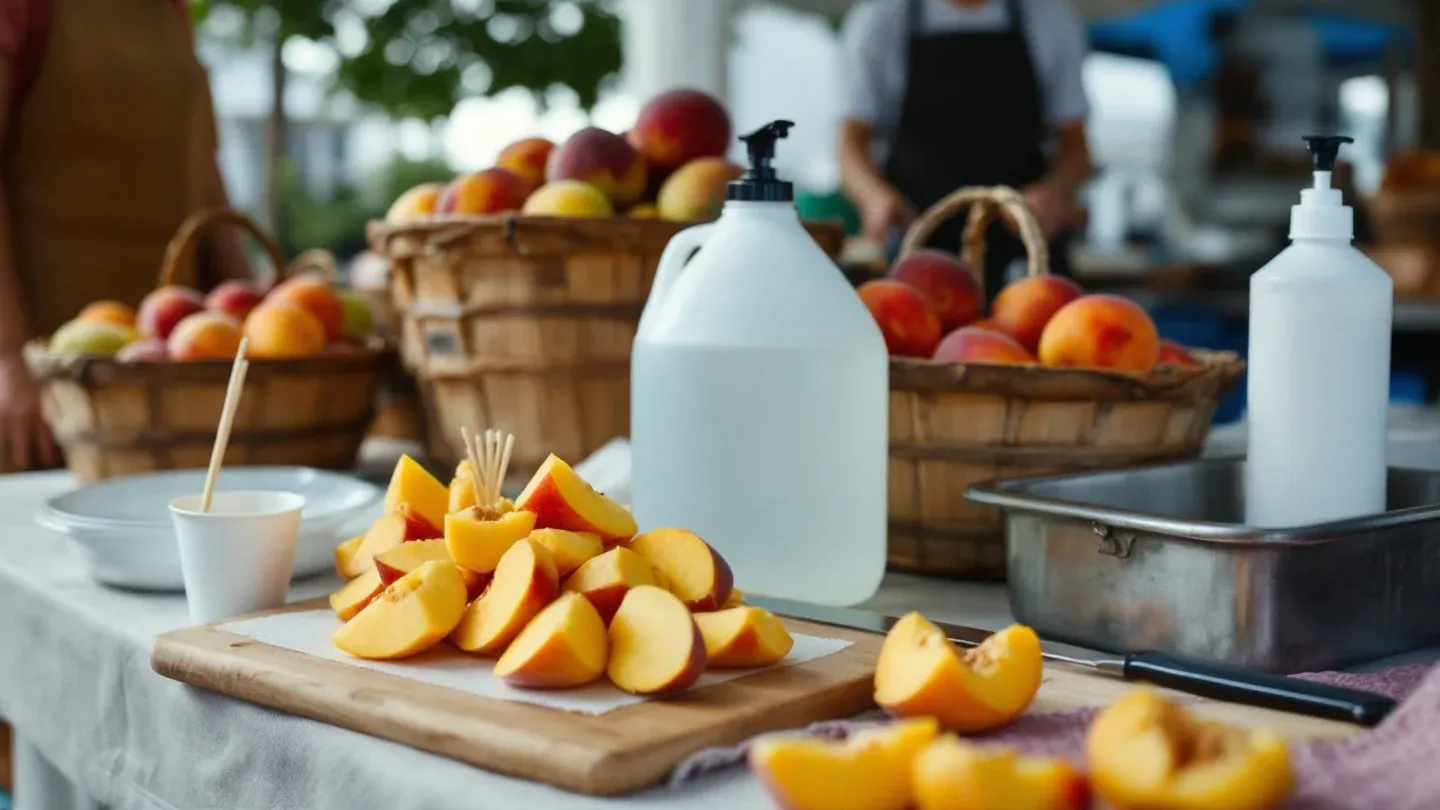
Samples sell, and they are the first thing a new vendor gets wrong. Each market decides whether sampling is allowed at all, so ask first. SDSU Extension's guidelines, adapted from the state health department, show what inspectors look for: samples cut on site or in a licensed kitchen, produce rinsed in clean water before cutting, clean sanitized knives and boards swapped every two hours, cut produce held at or below 41 degrees and thrown out after two hours, everything covered, and a hand-washing setup within reach. Serve from toothpicks or single-use cups so no customer touches another customer's sample, and keep different foods in separate containers because of allergens. Foods that need temperature control for safety, like dairy and prepared meat, are off the sample table altogether, and a hot food of that kind can only be sampled if it comes out of a licensed kitchen. Your state's rules will differ in detail, but not in spirit.
Taking the money
UNH's packing list includes a cash box with change and plenty of small bills, and a first-season stall runs out of fives by ten o'clock more often than you would think. Most shoppers now expect to pay by card as well, and a card reader that plugs into a phone has made that cheap for a one-table operation.
Then there is SNAP. The AMS handbook on accepting SNAP at farmers markets explains that a market can hold a single FNS license for all its eligible vendors, run one central terminal, and hand shoppers tokens or paper scrip to spend at any stall; that token system is the most common arrangement. A vendor can also be authorized on their own, and the MarketLink program supplies SNAP-authorized farmers and markets with a free card reader and a free first year of a point-of-sale app, with no transaction fees for SNAP. With half of markets already accepting nutrition benefits, this is a customer base, not a chore. We will look at the policy side in SNAP at the Farmers Market.
The first-season mistakes most vendors make
Every market manager has watched the same handful of mistakes.
- Produce on the ground and no canopy. Both say "temporary" to a shopper.
- Permits left to the last week. Moyer's advice is to sort out any local, county or state health permits before the season, because waiting can keep you out of market on opening day.
- Selling out by ten and going home. Bring more than you think, and give the table a sense of bounty from open to close.
- A different face every week. The shopper who liked talking to you comes back for you. UNH asks that your crew knows the farm and every product on the table; sending the same knowledgeable person each week is the farm-stall version of our belief that you should be consistent.
- A cooler without a thermometer. Meat, eggs and anything perishable belong at 41 degrees or below, and the thermometer is what proves it.
- No way to stay in touch. Collect emails at the table from day one; we will cover that in Keeping Customers: Email Lists and Repeat Buyers.
- Treating one slow Saturday as a verdict. A market is a habit you build in customers over a season, not a day.
What Washington is doing this spring
Two federal moves this spring matter to market vendors, even if neither writes a check to a single stall. The Farmers Market Promotion Program's 2023 round closed to applications on May 2, with about $15.4 million on offer for capacity-building projects of $50,000 to $250,000, training and technical-assistance projects of $100,000 to $500,000, and a new streamlined "turnkey" marketing option. Applicants have to put up a 25 percent match, and the eligible list includes agricultural businesses and cooperatives, producer networks, farmers market authorities, nonprofits and local governments. Awards come later in the year. If your market has no website, no signage budget and no SNAP terminal, the next round is a conversation to have with your manager.
Earlier this month USDA also named the lead organizations for twelve new Regional Food Business Centers, one for every part of the country, to offer technical assistance and coordination to small and mid-sized farm and food businesses trying to reach new markets. In the Northeast, for example, the NASDA Foundation received $38.4 million to run a center serving eleven states, with the state departments of agriculture as partners. Three years ago we argued that farmers selling locally were not getting enough help. This is a start.
The Saturday checklist
Load the truck the night before with this list beside you: canopy and sandbags, tables and crates to get everything between knee and shoulder, tablecloths, a range of container sizes, a sign for every item with the price on it, a whiteboard, a cash box with small bills, the card reader and its charger, the certified scale if you sell by weight, a cooler with a thermometer, hand-washing water and soap, sampling supplies if the market allows them, bags, a clipboard for emails, and a stool for the slow hour.
Then show up every week, in the same spot, with the same face and the best six things you grow. The farms in our farms and ranches directory built their customer base exactly that way, one Saturday at a time, and the stall that sells is almost never the fanciest one. It is the one that was ready.