
Mid-January is a quiet week on most farms and a loud one in the farm office. The seed order is in, the winter plan has a crop list and a calendar, and the next question is the one that decides whether the plan pays: who is going to buy all this? The easy answer is "more people," and a lot of farms spend February chasing it with new markets, new wholesale accounts and a bigger social media push. The cheaper answer is sitting in last season's sales records. The customer who already bought from you is the one most likely to buy again, and the one who costs the least to reach.
This article is about that customer: how to get her onto a list, what to send her, how to treat a CSA member differently from a half-beef buyer, and how to measure whether it is working. The mechanics are the same for a food brand selling jam or granola.
Why retention beats reach
The business case is old and well documented. Writing in Harvard Business Review, Amy Gallo summarized the research: depending on the study and the industry, acquiring a new customer costs five to twenty-five times as much as keeping an existing one, and work by Frederick Reichheld of Bain & Company found that raising retention by five percent lifts profits by anywhere from twenty-five to ninety-five percent. Those are corporate numbers, but the logic holds on a two-acre market garden. A new customer has to find you, trust you and learn how to cook what you grow. A returning one already did all three.
The local food market makes the point sharper. USDA's Economic Research Service reported that local food sales reached $11.8 billion in 2017, but that most of the growth came through intermediaries, institutions and retailers, while direct-to-consumer sales had plateaued. ERS also noted research suggesting that shoppers are not willing to pay a premium for local food at a farmers market compared with a grocery store. The number of farmers markets, meanwhile, grew from 2,746 in 1998 to 8,687 in 2017. More tables, flat spending: that is a crowded room, and in a crowded room the lever you actually control is how many of this year's customers come back next year.
There is good news in the same ERS research. In USDA's national household food purchase survey of 2012 and 2013, households that bought fruits and vegetables both from direct outlets and from stores spent $28.36 on produce in the survey week, against $16.53 for households that shopped only at stores. The customer who finds her way to a farm stand is a heavy produce buyer. She is worth keeping.
The CSA retention problem, in numbers
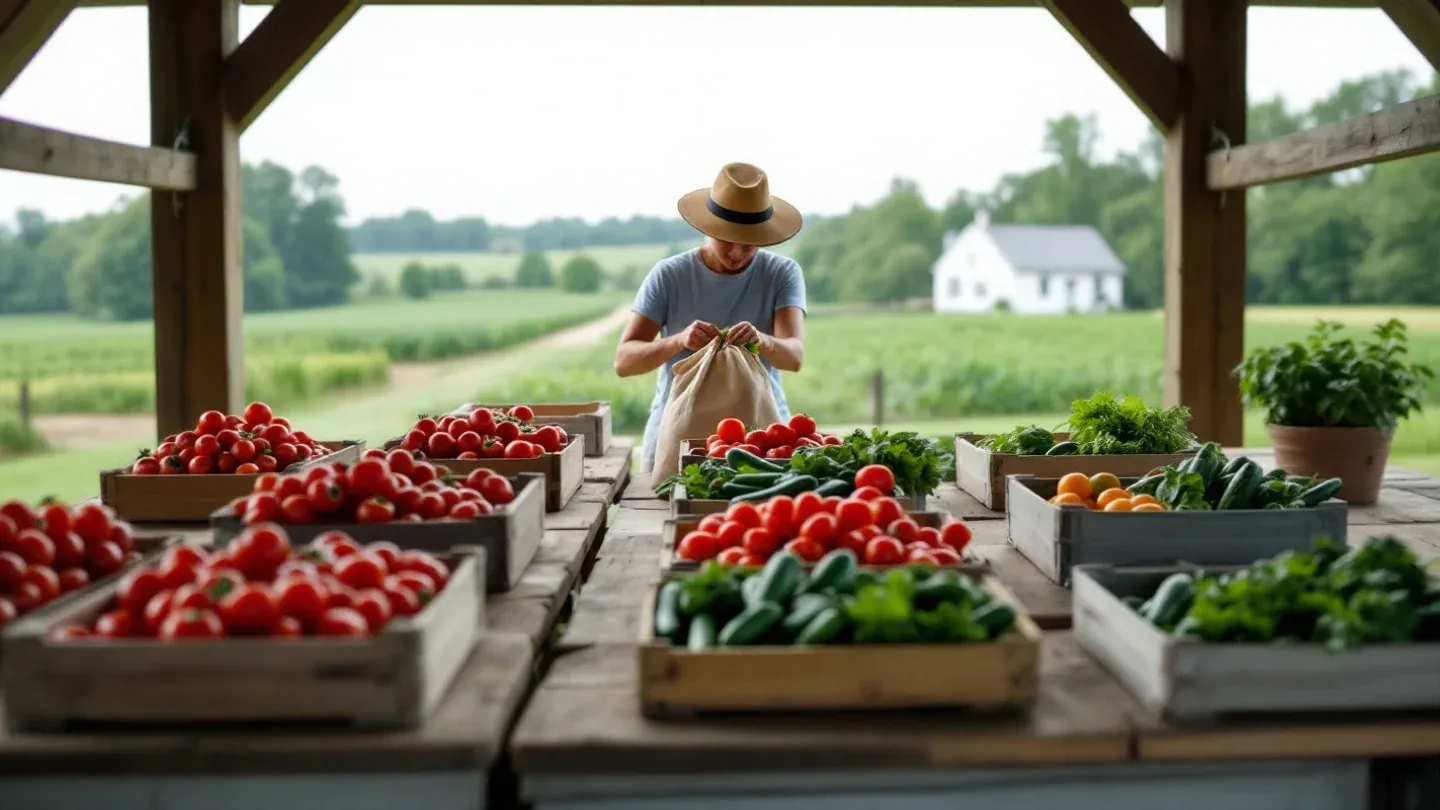
Nowhere is retention more visible than in a CSA, because every member either renews or does not. NCAT's ATTRA program, in its CSA publication, puts year-over-year retention at only around 45 percent, citing an analysis by Simon Huntley of the CSA software company Harvie. The same publication reports that a CSA on average brings in only about half of a farm's sales, and that the number one reason members do not return is a lack of choice in what lands in the box.
At 45 percent, a 100-member CSA has to recruit 55 new households every single winter just to stand still, and that recruiting eats the weeks that should go to planning. Penn State Extension's CSA guide says it plainly: retaining members is much easier than recruiting new ones each year. Its advice is practical. Survey members during the season rather than only at the end, so problems can be fixed while there is still a season to fix them. Contact everyone who does not renew and ask why. Give members ways to feel part of the farm, from berry picking to canning demonstrations. If the honest answer to "why did you leave" is "too much kale and no say in it," that is a share design problem, and no newsletter will fix it.
Build the list where the customers already are
A farm does not need a marketing funnel. It needs a sign-up sheet at the point where somebody is already handing over money. Penn State Extension's note on collecting customer data lists the realistic ways a farm market gathers contacts: short surveys at checkout, loyalty programs, event registrations, point-of-sale systems that store purchase history, and email newsletters themselves. Four things do most of the work:
- A clipboard and a pen on the market table or at the roadside stand, with one line of plain text about what people get: "a Thursday note on what we are picking this week." People sign up for a reason, not for "updates."
- A QR code on a small card that opens the same form, for the customer who would rather type on her phone than write on your clipboard.
- The checkout prompt in your card reader or online store. If a customer gives an email address for a receipt, the same screen can ask whether she wants the weekly note. Keep the box unticked and let her tick it.
- The CSA sign-up form, where every member has already given an address. The job there is to ask what else she wants to hear about: meat bundles, bulk tomatoes for canning, winter storage shares.
What not to do is as important. Do not buy a list, and do not add people who did not ask. Under the CAN-SPAM Act, a commercial email must carry a valid physical postal address, a clear way to opt out, and the sender must stop within 10 business days of an opt-out request. Any reputable email platform handles the mechanics, but the duty is yours. If you text customers, the bar is higher: marketing texts sent with automated systems need prior express written consent under the FCC's rules, and a reply of "stop" has to be honored. A signed line on the sign-up sheet that says the customer agrees to receive texts is the minimum; a verbal "sure" at the stand is not.
The sender rules that arrived in 2024, and why a farm should care
The timely piece of this planning season is a set of rules the big mailbox providers started enforcing two years ago. Starting February 1, 2024, Google's email sender guidelines require every sender to Gmail addresses to authenticate mail with SPF or DKIM and to keep the reported spam rate below 0.3 percent. Senders of 5,000 or more messages a day face more: SPF and DKIM and DMARC, a one-click unsubscribe in the message header, and a visible unsubscribe link in the body, with unsubscribe requests processed within two days. Yahoo enforces the same standards from the same month. Microsoft followed for Outlook: from May 5, 2025, mail from domains sending more than 5,000 messages a day without SPF, DKIM and DMARC goes to the Junk folder.
A farm with 600 subscribers will never hit 5,000 a day. The baseline rules still apply, and the practical consequences are three:
- Send from your own domain, not from a free webmail address. Authentication is tied to the domain.
- Set up SPF and DKIM for that domain inside your email platform; every major platform has a page that walks through it, and it takes an afternoon once. Add a DMARC record with a "none" policy while you are there, so you can see reports.
- Treat spam complaints as the number that matters. The 0.3 percent threshold is the same for everyone. Sending only to people who asked, and making it trivial to leave, is how a small sender stays under it.
What to send, and how often
The best farm newsletters read like a note from a neighbor, because that is what they are. Penn State's CSA guide suggests the contents that work: what is in this week's share, what is coming in the next few weeks, a recipe or two, announcements and a calendar. ATTRA's direct marketing publication adds recipes in the box, storage tips for the customer who cannot eat everything in a week, and a members-only farm event, which it notes works well for meat and egg CSAs because customers get to see the animals. Once a season is enough.
On frequency, the rule is the one we hold ourselves to: be consistent. A short weekly note through the season, sent on the same day at the same hour, beats a long monthly one that slips. In winter, every two weeks is plenty, and the content shifts to planning: what you are growing, when sign-ups open, what changed since last year. Our other rule applies too: always simplify. One subject line that says what is inside. One photo, taken that morning. One thing you want the reader to do. A reply address that reaches a human, because the replies are where the best customer research happens.
Avoid the two failure modes: silence from October to May, after which the first email of the season reads like a stranger, and the blast with nothing in it but a discount, which teaches customers to wait for the next one.
Segmenting: CSA, bundles and market regulars
On a farm, segmenting means three or four tags in your email platform, applied at sign-up and updated once a season:
- Current CSA members, who get the weekly share note, an early renewal window and, because NCAT found that lack of choice is the number one reason members leave, a real say in the box: a share size that fits, and the weekly choice of contents that many CSAs now offer.
- Lapsed CSA members, who get a two-question email in January ("what would bring you back?") and nothing else until they answer.
- Meat and bundle buyers, who do not want a recipe for radishes. They want to know the processor date, how much freezer space a quarter beef takes and when to put a deposit down.
- Market and stand regulars, who want the opening date, the week the strawberries come in, and the day you are not at the market because of a storm.
Each segment gets one message a week at most. The point is not to send more mail. It is to make sure that every email a customer opens is about something she buys.
Measuring repeat rates
What gets measured gets managed, and this is easier than it looks. Three numbers cover it:
- Repeat customer rate: of everyone who bought in the last twelve months, the share who bought two or more times. Your online store, card reader or CSA software already has the purchase history; Penn State notes that integrated point-of-sale systems track purchase history and frequency of visits on their own.
- CSA renewal rate: members who renewed, divided by members eligible to renew, counted when the sign-up window closes. Write down this year's number against ATTRA's 45 percent and set a target.
- Revenue from repeat buyers: the share of total direct sales that came from people who had bought before. This is the number that tells you whether the list is paying for the time it takes.
Open rates are a weak signal. Clicks, replies and orders in the days after a send are better. To go a step further, Cornell's Guide to Marketing Channel Assessment offers tools to evaluate how well each of your markets performs and whether it is the most profitable one for your business, so that "the market is busy" turns into a number. Pair that with your cost of production and pricing gets easier. Keep the customer data in a file you own and can export, not only inside one platform; who owns your farm data is not a theoretical question.
A January checklist
- Export last season's customers from every system you have: card reader, online store, CSA software, the clipboard sheets. Put them in one spreadsheet with a column for the segment.
- Pick one email platform, send from your own domain, and set up SPF, DKIM and a DMARC record before the first send of the year.
- Write the sign-up line for the clipboard and the QR card now, so they are printed before the first market.
- Email the lapsed CSA members this month with two questions and a reply address.
- Decide the rhythm, put it on the farm calendar, and keep it. Weekly in season, every two weeks in winter.
- Count the three numbers above today, and again in July and in December.
A farm that does this will not need a marketing department. It will have a few hundred households who know what is coming in the box this week, who tell their neighbors, and who are still there in January when the next plan gets written. That is what acting local looks like in the farm office. It is where How to Market a Farm and our early look at farm-to-door CSAs both ended up: the relationship is the asset. For the platforms and card readers that carry it, see our service providers directory.