
Late February is sign-up season for community supported agriculture. The CSA Innovation Network has run a CSA Week in February since 2021, when it stretched the one-day CSA Day that Small Farm Central used to lead into a full week of farms promoting shares together. If you sell a share, these are the two weeks to push it. We wrote about the model when the supply chain cracked in 2020, in Farm to Door CSAs May Be the Answer to Food Supply Breakdowns. The definition kept by the USDA's National Agricultural Library still holds: a CSA is a community of individuals who pledge support to a farm operation, with growers and consumers sharing the risks and benefits of food production.
A roadside stand is the other direct channel, and it asks for none of that commitment from the customer. It also asks for a different kind of planning from you. The 2022 Census of Agriculture counted 116,617 farms selling directly to consumers, for $3.3 billion, 16 percent more money than in 2017. Plenty of those sales happen at a table by the road. Plenty of those tables also lose money quietly, because nobody counted the hours, the shrink or the signs. Here is how to build one that pays for itself, decided now, while the ground is still frozen.
Start with the road, not the stand
The stand is the easy part. The road decides whether anyone stops. NCAT's ATTRA program puts it bluntly in its roadside stand tip sheet: location is critical, and the trade-off of the channel is lower volume at a higher price per unit, with no transport cost and very little advertising.
Oregon State's farm-direct marketing guide, one of the most thorough extension treatments of the subject, says on-farm sales do best within a few miles of a town or a resort, on a well-traveled road, visible from that road, with a safe way in and out. Sharp curves, hill crests and fast highways are the sites to avoid. A long, level stretch, or the outside of a broad curve, gives a driver time to see you, decide and slow down. Drivers skip a turnoff that feels even slightly dangerous.
Then there is parking, which is where many stands fail without knowing it. Oregon State suggests about 15 spaces for every 100 cars you expect in a day and roughly four square feet of parking for every square foot of selling space. Mark spaces with paint on blacktop or with rope and chalk on gravel. Keep the approach wide and clear of anything that hides a car pulling out. Penn State Extension adds the test every farmer should run before building anything: spend time watching the traffic for its type and volume, ask whether drivers have time to slow down and turn in, and check that cars entering and leaving have clear visibility both ways.
One more thing Penn State says that is easy to forget: a market near the farm reassures customers that they are getting fresh product. Oregon State adds that being near other farm-direct businesses helps rather than hurts: a group of stands in one area creates what it calls a cluster effect, and each stand complements the others.
Signs that get a car to slow down
A sign has one job, and it is not to list your products. Penn State's guidance is that a sign should be readable from a distance and placed early enough that a driver can decide to stop and turn in safely. Directing people to the stand matters more than naming every item on it. Plan on three plain signs at least, one well ahead of the stand in each direction and one at the entrance, rather than one elaborate sign at the gate.
Before you plant a post, two sets of rules apply. Your town or county may require a permit for roadside signs and even for a new driveway cut; Penn State flags both. And the shoulder of a public road belongs to the state or the county, so Oregon State's advice is to check right-of-way rules with the road agency before you widen a pull-off or set anything in it.
If you are on a rural road and want an official sign, ask your state transportation department about tourist-oriented directional signs, the small white-on-blue panels at intersections. The federal Manual on Uniform Traffic Control Devices limits those signs to rural highways and to businesses that draw the major portion of their income or visitors from road users who do not live in the area, and it lets states include businesses involved with seasonal agricultural products. Each state that uses them adopts its own policy with its own rules, so the state transportation department is the place to ask.
Check the zoning before you build
ATTRA's first rule on permits is the right one: make sure local zoning allows a roadside market at all, then ask the state department of agriculture about licenses and the health department about anything processed. Two states show how differently this can go.
Massachusetts gives farm stands a statutory shield. Chapter 40A, section 3 of the General Laws says no zoning bylaw may prohibit, unreasonably regulate or require a special permit for facilities for the sale of produce, wine and dairy products on land used primarily for commercial agriculture, provided that during June through September, or the harvest season of the primary crop, at least 25 percent of what is for sale was grown by the owner or lessee of that land. There is a second route for stands that sell mostly other Massachusetts farms' products: at least 25 percent grown on the land and a further 50 percent grown elsewhere in Massachusetts. Towns may limit the exemption to parcels of five acres or more, or two acres if the parcel grosses at least $1,000 an acre. Read that proviso twice if you plan to buy in produce to fill the table: the shield depends on how much of what you sell you grew yourself, and on where the rest was grown.
New York works through its agricultural districts. Section 305-a of the Agriculture and Markets Law says local governments shall not unreasonably restrict or regulate farm operations within agricultural districts unless public health or safety is threatened, and the state's definition of a farm operation includes the practices that contribute to marketing crops and livestock products, which is what a stand is. A farmer in a district can ask the Department of Agriculture and Markets in writing to review a local law. The Department's own guidance says it tests whether the law is unreasonably restrictive on its face or as applied, then whether public health or safety is actually threatened, and if the law fails that test it notifies the town and tries to reach a resolution, with further steps if the town refuses. Outside a district, ordinary zoning applies.
Wherever you are, carry a comprehensive farm liability policy. ATTRA calls it the baseline, and notes that a stand selling products not grown on the farm may need commercial business insurance on top. We cover the liability side of visitors on the farm in Agritourism Basics: U-Pick, Farm Stays and Liability.
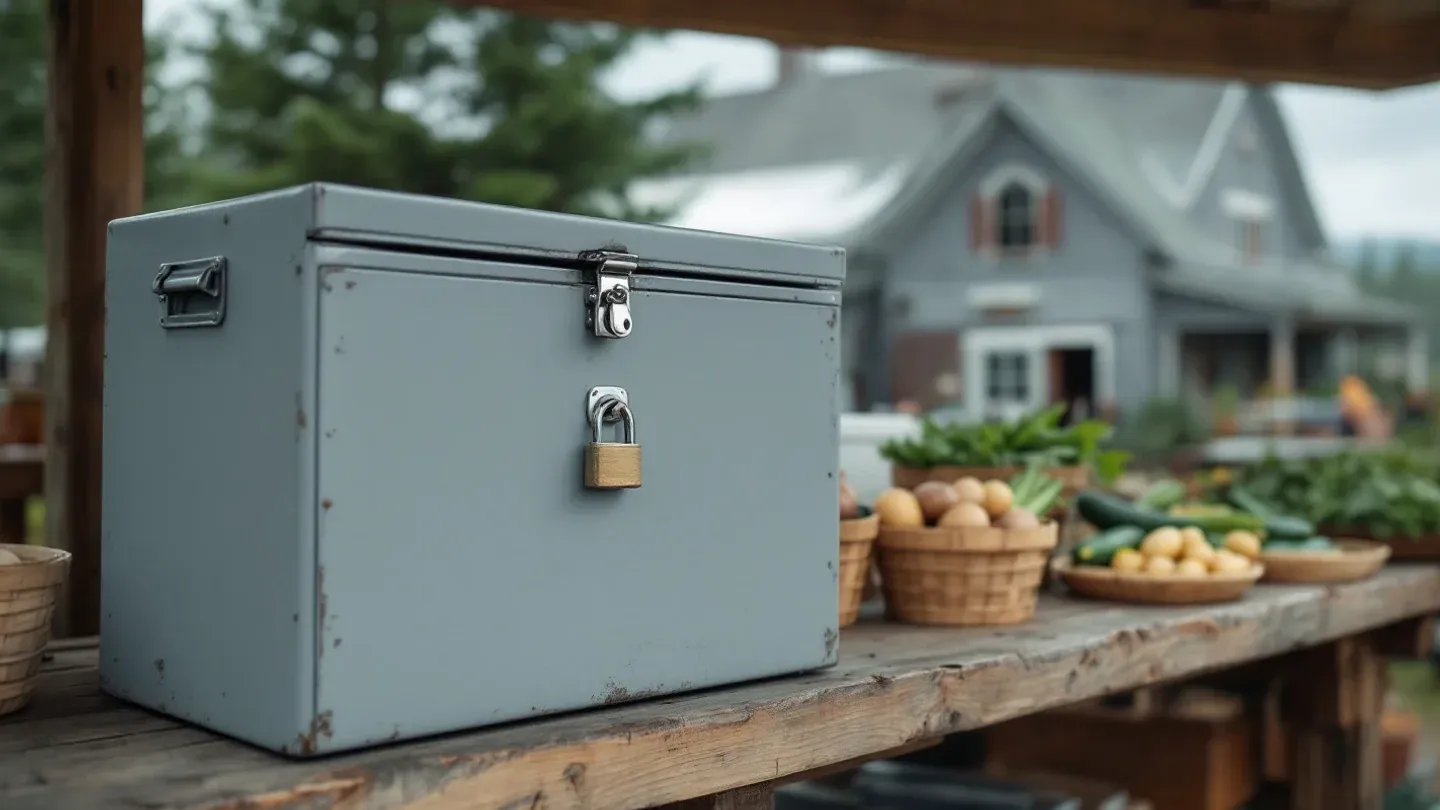
Honor box or staffed hours
The honor box is one of the oldest payment systems in American farming, and it still works. Oregon State reports that many producers run a self-service stand, especially when it sits near the house, and that operators with stands close to home report few losses. ATTRA's version is a secure container for payment and an unstaffed table, which keeps overhead close to zero.
Losses happen anyway. In September 2022 the Bangor Daily News reported on a Bowdoinham, Maine farm whose honor-system stand had cash stolen; the farmer's response was to empty the bucket more often, pull the large bills, and start building a proper farm store with something closer to a register. That is the honest shape of the decision. A self-serve stand trades a little shrink for a lot of saved labor, and it pays as long as you make theft boring: a heavy, locked box bolted to the counter with a slot, not a lid; small bills only, collected several times a day; a camera that you actually check; and a count of what went out against what came in, every evening.
Staffed hours earn their keep when the ticket size justifies them: meat, eggs, cut flowers, plants, anything that needs a scale or a conversation. Penn State's advice on staffing is to build the work schedule around the peak and off-peak selling times, with enough people on hand for the rush, and to keep accurate records of what you produce, sell and discard so that the schedule follows the evidence. A sensible hybrid is staffed Saturday mornings and an honor box the rest of the week. Whichever you choose, post the hours at the entrance. Oregon State notes that posting business hours at the entrance also protects your own time.
The one rule that matters more than the payment method is showing up. A stand that is open the same days at the same hours with the same quality all season builds a habit in passing drivers. One that is open "when we have something" does not. That is our belief that a farm should be consistent, applied to a table by the road.
Pricing that holds up
A roadside stand that sells only by the piece or the basket, because change is easier, often leaves money on the table. University of Maryland Extension's worked example is worth copying into your notebook. A quart of tomatoes sold at $4 is the same tomatoes that, sold at $1.49 a pound and weighing three pounds, bring $4.47. Five broilers sold at $15 each bring $75; the same five birds, weighed at $3.75 a pound, bring $84.38. Over a season those cents are the difference between a stand that pays and one that does not.
Selling by weight requires a legal-for-trade scale, registered and inspected under your state's weights and measures rules; Maryland looks for a Class III designation and an NTEP certificate on the plate, and inspectors can shut a vendor down over an unapproved scale. Selling by count or by a traceable measure, a quart or a peck, is the lawful alternative for uniform items, and it lets you price in whole dollars for the honor box. Use weight for the variable things, count for the uniform things, and price every item on or beside the display so a hurried customer never has to ask.
Behind the price is the cost. Penn State's roadside market guide says to track production costs, selling prices and marketing expenses so that you know your break-even and can tell which products carry the stand. We go deeper on that in Know Your Cost of Production Before You Set a Price. A stand is a retail business with a farm attached, and it deserves the same arithmetic.
Taking money: cash, cards and apps
Cash still rules the honor box, but a growing share of customers carries none. The practical setup for an unstaffed stand is a locked cash box plus a weatherproof card with a QR code that links to a business profile on a payment app, with prices in whole dollars so the app and the box agree. A staffed stand adds a tap-to-pay card reader. Fees vary by provider and change often, so check them before the season, and check whether your state taxes unprocessed food sold at the farm.
The tax reporting side changed this winter. In November 2024 the IRS confirmed that payment apps and online marketplaces must send a Form 1099-K when a seller's total payments through them exceed $5,000 for 2024, $2,500 for 2025 and $600 from 2026. A stand that takes a few thousand dollars through an app will get a form. That changes nothing about what you owe, since all income is taxable whether or not a form arrives, but it does mean the app's total needs to match your books. Keep a separate business profile, reconcile the app, the box and the stock count every week, and hand the whole thing to Schedule F at year end without a scramble.
Products that carry the stand through the season
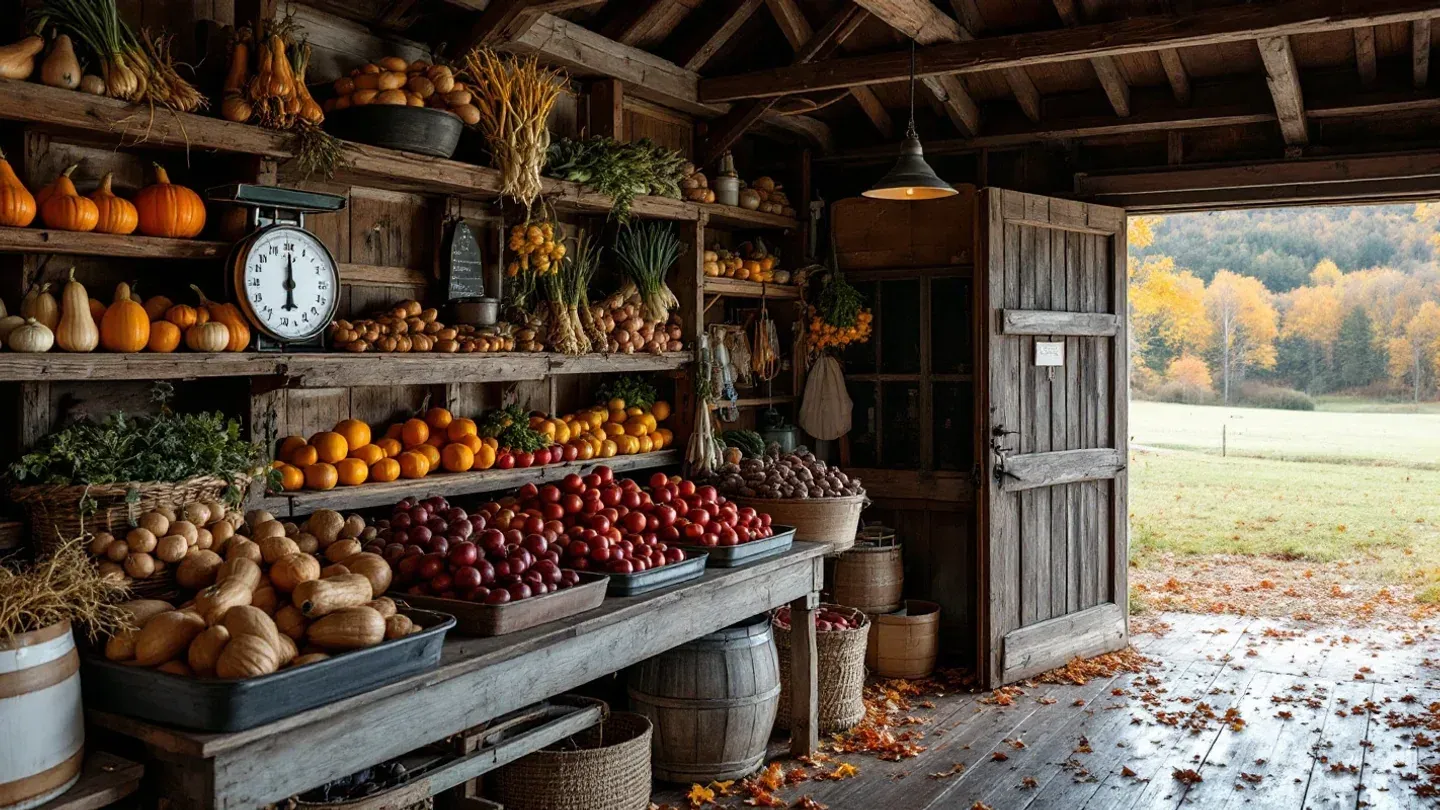
A stand that opens with the first tomato and closes with the last one is open for ten weeks and idle for forty-two. The stands that pay stretch both ends. Penn State's list for the front end is vegetable and bedding plants, seeds and flowers in spring, ahead of the prime late-summer season; for stretching the other end it points to produce bought from other growers or regions, or a marketing cooperative of local farms that shares the costs. Storage crops of your own, squash, onions, potatoes and apples, carry the table into the cold months. Remember the Massachusetts proviso and its equivalents before you fill the table with someone else's crop.
Eggs deserve their own line. They sell every week of the year, they bring people back on a schedule, and right now they are the item customers are hunting for. The Bureau of Labor Statistics' January price report, published last week, showed the index for eggs up 15.2 percent in a single month and 53 percent over twelve months, against 1.9 percent for food at home as a whole. A pastured flock with a cooler at the stand is the best reason a driver has to stop in February. Check your state's egg licensing and labeling rules first.
The rest of the winter shelf is value-added: jam, honey, baked goods, dried herbs, whatever your state's cottage food law allows from a home kitchen, which we cover in Cottage Food Laws: What You Can Sell From a Home Kitchen. Then there is the CSA itself. A stand is the best place on the farm to sign up share members, because the person standing at your counter has already decided to buy from you. A clipboard, a card with the share price and a pickup day at the stand turn February's CSA Week into a year of prepaid revenue, and a sign-up sheet for the email list does the same for the stand; we show how in Keeping Customers: Email Lists and Repeat Buyers.
A short list before opening day
Decide these things before the first seedling goes in, in this order.
- The site: watched for traffic, safe in and out, visible from a long stretch, with parking marked for the busiest day you expect.
- The paperwork: zoning confirmed, sign and driveway permits in hand, the ag district or farm-stand exemption checked, the liability policy updated, the scale registered.
- The signs: three plain ones, far enough out to slow a car, with the hours posted at the entrance.
- The payment system: a locked, bolted box with a slot and small change, a QR code for the app, a card reader for staffed hours, and a weekly reconciliation habit.
- The price list: by weight for variable items, by count for uniform ones, whole dollars at the honor box, and a cost-of-production figure behind each line.
- The season plan: plants and flowers in spring, field crops in summer, storage crops and eggs in the cold months, value-added goods the law allows, and a CSA sign-up sheet all year.
Keep the build small. Oregon State's advice is to start small, in a converted barn or shed if you have one, and expand as customers and volume grow, which is the plainest expression of our belief that a farm should always simplify. The stands in our farms and ranches directory mostly started that way. The suppliers of scales, coolers and point-of-sale gear in our service providers directory can fill in the hardware once the table has proved itself. We first made the case for direct sales in How to Market a Farm. We extended it in How to Diversify Farming Income. A roadside stand remains the cheapest experiment in both: a few boards, a box, a sign and the discipline to be there.