
It is the third week of March. Seed trays are on the heat mats, the CSA sign-up page has been open for a month, and the first pickup day is close enough to count the weeks. If you are still taking orders by text message and a notebook, this is the week to decide what the farm's online store will be for the season, because once harvest starts there is no time to move customers from one system to another.
The case for selling online is no longer a pandemic story. The Census Bureau's quarterly e-commerce report, published on 20 February, put online sales at 15.6 percent of all US retail sales in the fourth quarter of 2023, and at 15.4 percent for the full year, up from 14.7 percent in 2022. The Census definition matters for a farm: an e-commerce sale is one where the order is placed over the internet, by email or on a phone, whether or not the payment happens online. A preorder paid in cash at the market stall counts. That is exactly the kind of sale most small farms are set up to make.
This article is about the software that takes those orders. It is not a ranking. It is a way to work out what your farm actually needs before you open a pricing page, and a list of questions to ask before you sign.
Start with the jobs, not the brands
Local food is a big market made of small channels. USDA's Economic Research Service counted $11.8 billion in local food sales in 2017, and in the earlier benchmark year of 2015 about a third of local food sales went straight from farms to consumers, through farm stores and stands, farmers markets, pick-your-own and mobile markets. A store on the internet does not replace any of those. It feeds them. For most direct-market farms the online store has four jobs:
- Preorders with a cutoff. Customers order by Wednesday night, you harvest Thursday, they collect Friday. The software must close orders at a set time and give you a pick list and a pack list sorted by pickup point.
- Pickup points and delivery zones. The same order form has to offer the farm gate, the Saturday market stall, a church parking lot in town and perhaps home delivery inside a drawn boundary, each with its own day and fee.
- Subscriptions. A CSA share, a monthly meat box or a weekly egg standing order is a recurring charge with its own rules: pauses, swaps, renewals.
- Inventory by harvest. You do not have 400 bunches of kale; you have what came out of the field this morning. The store needs quantity limits per product per cycle, and for meat it needs items sold by weight, with the price settled at the scale.
If your farm sells only shelf-stable goods by mail, honey, jam, grain or wool, you have a simpler problem, and the general tools below are usually enough. NCAT's ATTRA program drew the same line years ago: websites can be used to market CSA shares, non-perishable products and value-added products, and the farm has to research shipping costs, packaging and the extra staff time before it sells that way. Turning a crop into a value-added product covers that side.
Three kinds of platform
Cornell's Small Farms Program drew the useful distinction back in 2019: a farm can run its own online store, or sell through a shared marketplace that somebody else operates. In practice there are three groups.
General shopping carts. Shopify, Square Online and WooCommerce were built for shops that ship parcels. They are polished, cheap to start, and they know nothing about harvest cycles, pickup days or items sold by weight. Each of those jobs needs an add-on, and the add-ons come from third parties who may or may not keep them working. One farmer in Cornell's 2019 article found that Wix's default shipping fee got in the way of event registrations, and that it could not handle meat sold by variable weight. A farm with a few shelf-stable products and a market stall that already runs on a Square reader can be happy here. A vegetable CSA with six pickup sites usually is not.
Farm-specific stores. Local Line, Barn2Door and GrazeCart were built around the four jobs above. Pickup and delivery options, delivery zones, stock limits and subscriptions are part of the product rather than plugins, though some of them sit in higher tiers or cost extra, and GrazeCart lists selling by weight as a standard feature. These are the tools most farms end up comparing against each other.
CSA managers and marketplaces. CSAware, from LocalHarvest, has managed CSA memberships, deliveries and payments since 2010, Farmigo since 2009, and Harvie set itself apart by letting members customize the share box. At the other end sit shared marketplaces: a regional online farmers market where many farms list and one organizer runs the pickup day, or Open Food Network, free and open-source software on which a farm can open its own shopfront and a group of farms can run a hub. In Cornell's 2019 roundup, a college-run marketplace added 15 percent to the farmer's price and in return put the farm's products in front of its shoppers and ran the pickup point, a trade that suits a farm with little time for marketing and a hub nearby. Food hubs explained looks at the wholesale version of that model.
The rule from our 2020 piece on farm management software applies here too: the tool has to fit the farm, not the other way around.
How the fees actually work
Every pricing page has a different shape, and the shape matters more than the headline number. There are four:
- A flat monthly subscription, usually in tiers, with no share of sales. Local Line, Barn2Door and GrazeCart have priced this way, and Barn2Door adds a one-time setup fee.
- A percentage of sales with a monthly minimum. CSAware charges 2 percent of delivery revenue with a $100 monthly minimum; Farmigo charges 2 percent or a $150 monthly minimum, billed only in months you deliver.
- A marketplace commission, which can run much higher. The multi-farm sites in Cornell's 2020 roundup charged anywhere from 3 percent of each completed sale to a 25 percent service fee, and the campus marketplace in the 2019 article added 15 percent to the farmer's price.
- Card processing, which is separate from all of the above and goes to the payment processor. Stripe's standard rate for a US card is 2.9 percent plus 30 cents per transaction, and an ACH bank debit through the same company is 0.8 percent, capped at $5. Nearly every platform passes this cost through, whatever its own fee model.
Run the numbers on your own sales, not on the brochure's example. Say a farm expects $30,000 of online orders over a season. A 2 percent fee is $600, plus the monthly minimum in the slow months. A flat $100 a month is $1,200 a year whether you sell or not, but it does not grow as your sales do. Card fees on $30,000 are $870 before the per-transaction cents, and a platform that lets CSA members pay by ACH can cut that to a fraction. Pick the shape that matches the size and the seasonality of your sales, and remember that the Cornell roundups of 2019 and 2020 quoted different prices for the same tools a year apart. Read the current pricing page, not a blog post, and read it again before renewal.
Subscriptions, renewals and the law
A CSA is a subscription with a story attached, and the software has to handle both halves. The business half is well understood. Penn State Extension's CSA guide makes the point that members who pay before planting take on the risk of a crop failure, which is the whole idea, and it suggests a discount for paying the full share early and a billing fee for installment plans. Your platform should support both without a spreadsheet on the side.
The story half is retention. ATTRA's CSA publication reports that retention rates for CSAs are only around 45 percent, and quotes the finding that the number one reason members do not return is a lack of choice in their shares. The platforms that let members swap items, skip a week or build a market-style share from a list exist because of that number. If your retention has been poor, the ability to customize is worth more than any fee difference.
Then there is the law. If your store charges a card automatically, for a renewing CSA, a monthly meat box or a standing egg order, federal law treats it as a negative option. The Restore Online Shoppers' Confidence Act requires three things before any recurring charge: the material terms disclosed clearly before you take billing details, the customer's express informed consent, and a simple way to stop the charges. A platform whose subscription feature cannot show the terms at checkout or let a member cancel without emailing you is a liability as well as a nuisance. Make the cancel button easy and the renewal reminder honest; that is also the consistent treatment that keeps members for a second year.
Plan for the platform that disappears
Cornell's advice in 2019 was blunt: take the claims of new platforms with a grain of salt, because one company that expected to replace grocery stores ended its farmer sales and delivery platform after a couple of years. Nothing has changed. Farm software is a small market, the companies in it are small, and the prices quoted in that 2019 article had already moved by the time the 2020 list came out. You cannot pick a platform that will last forever. You can make sure that a shutdown is an inconvenience rather than a disaster.
- Keep the customer list outside the store. Export names, emails and order histories every month, and run your newsletter from a separate email tool, so a dead platform does not take the list with it. Keeping customers goes into what to do with that list.
- Own your domain name. Point a shop address on your own domain at the platform rather than using the platform's address, so that when you move, the customers do not have to.
- Hold the payment account in your name. Most platforms connect to a processor account that belongs to you. If the platform holds the money and pays you out, ask how often, and what happens to balances if it closes.
- Check export before import. Before you load 200 products and 300 members, confirm you can get orders, products and customers back out as a spreadsheet. If support cannot show you, assume you cannot.
- Ask the farmers. Cornell's six-point checklist starts with the platform's longevity and with talking to other farmers who use it, and ends with the customer experience: browse another farm's store on the same platform to see what your customers will see. Who owns your farm data covers the contract side in more detail.
This is long-term thinking applied to software: the farm will outlast any vendor, so build the farm's records to outlast them too.
Pickup days are where it succeeds or fails
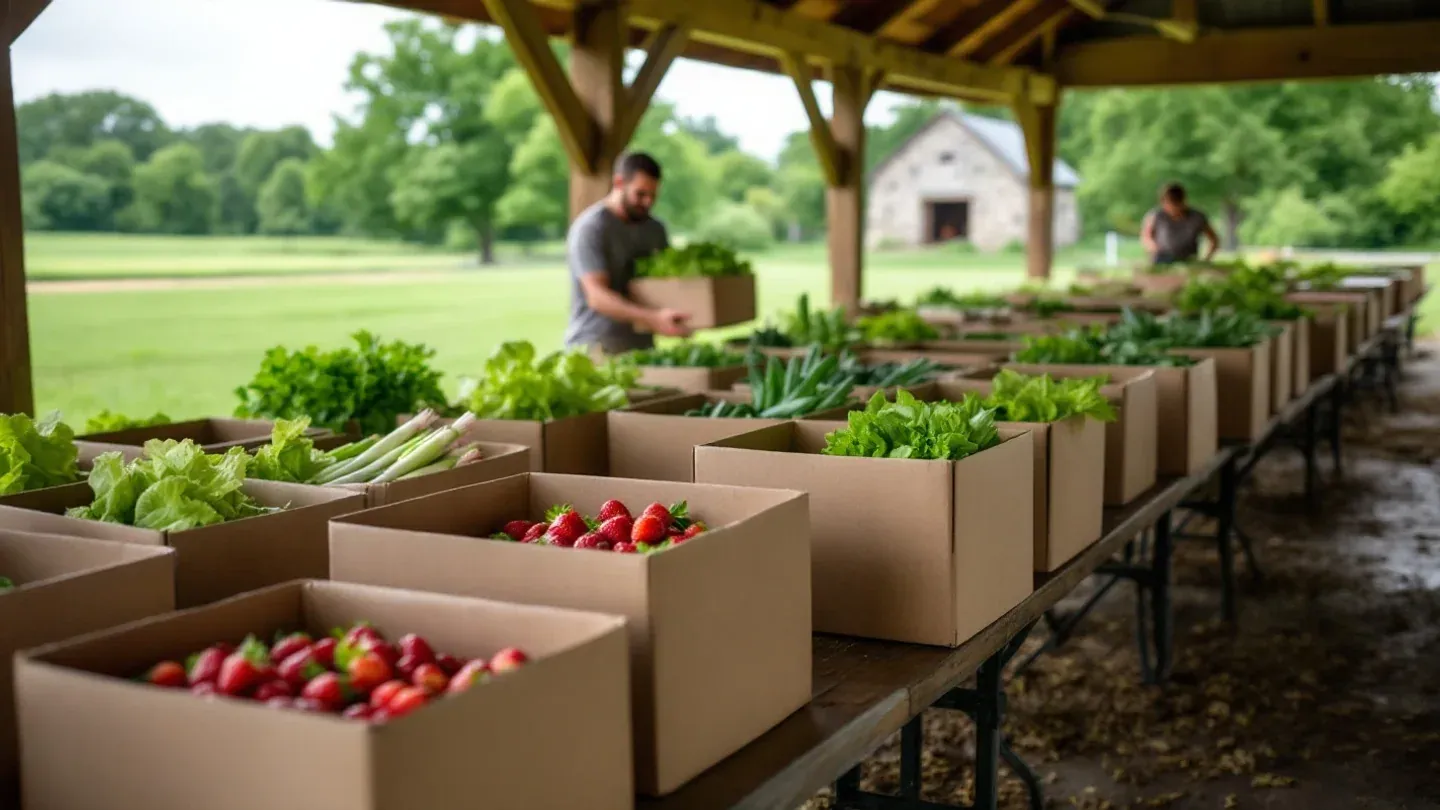
Software takes the order. People hand over the box. Penn State's guide suggests a centralized pickup site such as a farmers market, a church or a community park when the farm is far from town, and reminds you to build the delivery cost into the share price and to say exactly when and for how long someone will be there. The online store should print you a list per site, per day, in the order you pack, and send the customer a reminder with the same details. If your Saturday stall is a pickup point, set it up so preorders have their own table and do not jam the walk-up line. The cold chain runs from pack shed to parking lot; on-farm cold storage is the other half of a preorder system that works.
Two things worth doing this month. List the farm in USDA's Local Food Directories, which include a CSA directory of farms offering subscription shares; Cornell noted in 2020 that farms on regional buy-local directories were getting calls because of the listing. And if you are planning a multi-farm online market rather than a single store, look at USDA's Local Food Promotion Program, which funds planning and implementation projects for local food enterprises and names CSA networks among the eligible applicants.
A short decision path
- Write the four jobs down for your farm: cutoff and pick lists, pickup points and zones, subscriptions, inventory by harvest. Mark the ones you need this season.
- If you need two or fewer, and you already use Square at the stall, try the general cart first. If you need three or four, compare the farm-specific stores. If the CSA is most of your income, compare the CSA managers too.
- Take last season's sales, or the estimate from your winter plan, and work out the yearly cost under each fee shape, card fees included. Cornell's marketing channel assessment guide offers tools for working out which of your markets are actually the most profitable, and an online store is a channel like any other.
- Place a test order on each shortlisted platform as a customer, from a phone, and try to cancel a subscription.
- Confirm the exports, the domain and the payment account before you import a single customer.
- Pick one, open the store, and tell your list. Then stop looking at platforms until next winter.
Online sales are a channel, not a marketing strategy, and a farm store does not need to be clever. It needs to take an order on Tuesday and put the right box in the right hands on Friday, every week, without the farmer standing between the two. Simple wins. More vendors and tools are listed in our directory of service providers and manufacturers, and the extension programs whose work this article leans on are in the organizations directory.