
December is when a cooler gets built. The fields are quiet, the lumberyard is quiet, and the memory of August is fresh: the lettuce that wilted in the truck, the broccoli that went yellow before Saturday, the chef who asked whether you could deliver cold. A walk-in cooler fixes more of those problems than any other single purchase on a produce farm, and a converted room with an air conditioner and a retrofit controller puts it within reach of a farm selling at one market. This article covers the physics, the sizing, the build, the settings by crop, and the federal money now flowing to the states for exactly this kind of equipment.
The clock starts at harvest
A head of lettuce is still alive after it is cut. It breathes, it loses water, and it does both faster the warmer it is. USDA's Agriculture Handbook 66, the standard reference for produce storage, puts the rule plainly: the speed of a biological reaction rises two to three fold for every 18°F rise in temperature. A crate sitting at 90°F in the field is aging several times faster than the same crate at 40°F.
UVM Extension's forced-air cooling fact sheet gives the memorable version: table grapes deteriorate more in one hour at 90°F than in a day at 39°F or a week at 32°F. The handbook's asparagus entry is just as blunt. A four-hour delay in cooling produced a 40 percent increase in toughness. That is the difference between spears a restaurant will reorder and spears it will not.
So the first job is not storage. It is getting the field heat out, fast, and only then holding the crop cold. The two steps need different tools.
Pre-cooling: fast heat removal
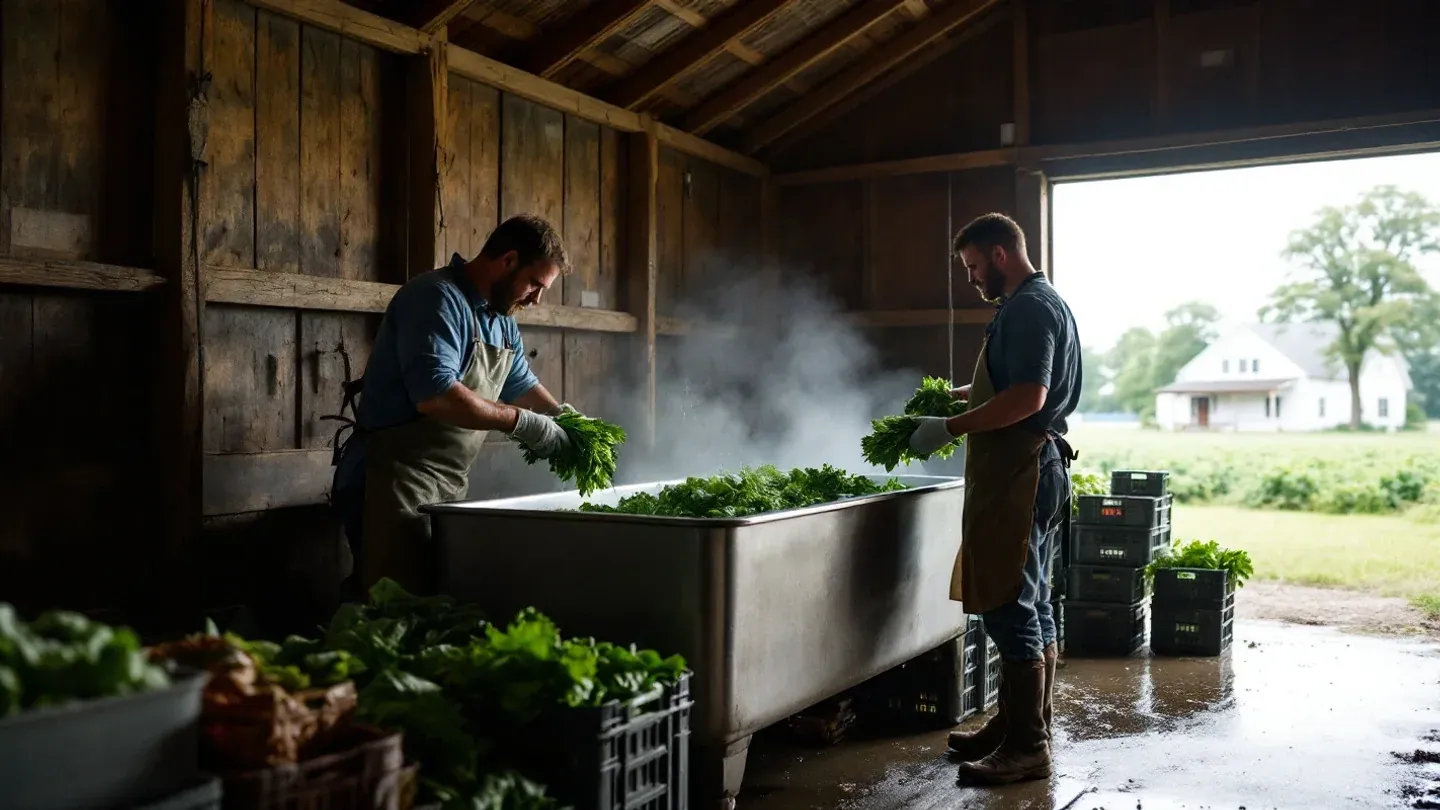
Pre-cooling means moving chilled air or water over the product to pull the field heat out before the crop goes into storage. The On-Farm Infrastructure Toolkit, written by the NC Growing Together project with the Carolina Farm Stewardship Association and hosted by NC State's Center for Environmental Farming Systems, lays out the small-farm options and their typical cooling times. Room cooling, meaning crates set in a cold room, takes 20 to 100 hours. Forced-air cooling takes 1 to 10 hours. Hydro-cooling takes six minutes to an hour. Ice cooling takes under 20 minutes. The toolkit's rule of thumb is to pre-cool a crop for seven eighths of the way to its holding temperature, then move it to storage.
The surprise for most growers is how slow a plain cooler is. UVM's fact sheet notes that produce packed in boxes and stacked on a pallet in a cooler takes a minimum of 24 hours to cool and may take days, because cold air cannot reach the middle of a stack. The cure is a blower. In field trials UVM reported in June 2019, two home-built forced-air coolers made from lumber, plywood plenums, axial blowers and plastic film cooled eggplant, strawberries, zucchini, blueberries, roasting peppers and watermelon 1.2 to 2.2 times faster than the same room without the blower. The plans are free. The sizing rule in the fact sheet is one to three cubic feet per minute of air flow per pound of product, through vented containers, with every large gap in the stack blocked off so the air goes through the crates rather than around them.
Hydro-cooling is faster still for crops that tolerate water: asparagus, snap beans, peas, leafy greens, cucumbers and cantaloupe among them. UW-Madison's Scott Sanford puts hydro-cooling at about five times the speed of air and adds the condition that matters for food safety: water that is recirculated needs a sanitizer in it. Ice is the simplest of all. His handout gives the arithmetic, roughly one pound of ice for every three pounds of produce to bring it from 85°F to 40°F, and lists asparagus, broccoli, green onions, greens and sweet corn as the crops that take it well.
A farm that harvests in the cool of the morning, shades the crates, and gets them under a blower or into a wash tank within the hour has done most of the work before the cooler door closes.
Sizing the cooler
The honest way to size a cooler is to add up the heat it must remove: heat leaking through the walls, floor and ceiling; warm air that enters every time the door opens; the field heat of the crop you put in; and the heat the crop makes by breathing. UVM Extension's heating and cooling load calculator does this arithmetic for you and is the best free tool we know of. Its quick references are worth reading even if you never run it.
For door traffic, UVM suggests one air change per hour for a tight, rarely opened storage room and closer to three for a busy walk-in. For the product load, most produce has a specific heat of about 0.85 BTU per pound per degree, and the calculator defaults to a 24 hour pull-down. Respiration varies enormously by crop: apples in storage give off about 5 milligrams of carbon dioxide per kilogram per hour, lettuce about 21, and winter squash at 50°F about 99. Sanford's handout makes the same point from the other direction: field heat removal is the largest part of the load, but it is short, and it is smaller for fall-harvested crops.
Two cautions come with the result. Refrigeration is normally designed to run about 16 of every 24 hours, so the design load is higher than the bare number. And if you plan to run a window air conditioner with a retrofit controller, the calculator's output is not the size of the unit you need, because those units are derated for this use. Size for the hottest harvest week, not the average one, and give yourself room to grow. This is one place where the belief we call think long term saves money twice.
Building a converted-room cooler
The retrofit controller that made small-farm coolers affordable is the CoolBot, a small device that runs an ordinary window air conditioner as the refrigeration unit for a cold room. The manufacturer's build guide, distributed by the University of Kentucky's MarketReady program, says its customers spend about $3,000 on average for a complete cooler including insulation, against $6,000 to $10,000 for a conventional walk-in with its own compressor. Those are the manufacturer's figures, so price your own materials, but the order of magnitude is right.
The guide's construction advice is sound. Insulate to at least R25, and consider R30 if you will hold the room at 40°F or below. Use rigid foam, at least four inches of polyisocyanurate on walls and ceiling, and never fiberglass batts, which soak up moisture and grow mold. Seal every seam, corner and the gap under the door with spray foam and caulk, and pack pipe insulation around the air conditioner so you can pull the unit later. If the room will run below 38°F, insulate the floor. Do not install a floor drain; it only lets the cold out. Slope the floor toward the door instead.
UVM's "Coolbot on a Shoestring" case study shows how far a careful builder can push the budget. A UVM Extension staffer in a technical support role and Extension engineer Chris Callahan teamed up for two days to build a 6 by 8 foot cooler for a Vermont vegetable grower on a tight budget, on the dirt floor of an existing shed, for about $1,300 including a 12,000 BTU air conditioner and the controller. The walls were two layers of two-inch polyiso faced with OSB, rated R25 or better, built as five panels that unscrew so the cooler can move. The lessons in the write-up are the kind you only learn once: spend the money on insulation, buy foam board from the local lumberyard rather than the big box, dry-fit everything before the adhesive goes on, and close the door before you foam around its frame.
In a northern winter the problem flips: an unheated cooler can drop below freezing, and the same UVM calculator estimates the heating load to keep it above 32°F. This is a job that rewards the plainest design, a square room with one door, which is our belief in always simplify applied to a building. Suppliers of controllers, panels and blowers are listed in our service providers and manufacturers directory.
Temperature and humidity by crop
A cooler has two dials, and most growers only watch one. Maine Extension's storage bulletin, a reprint of a Kansas State publication, gives the frame. Fruits and vegetables generally want 32°F to 55°F and 80 to 95 percent relative humidity, and they fall into three rooms: cold storage at 32°F to 36°F for cool-season crops, cool storage at 40°F to 55°F for warm-season crops, and warmer storage at 55°F to 60°F for sweet potatoes, squash and pumpkins. The table in the bulletin is specific: lettuce at 32°F and 98 to 100 percent humidity, cucumbers at 50°F to 55°F and 95 percent, dry onions and garlic at 32°F but only 65 to 70 percent, winter squash at 50°F and 50 to 70 percent. It also lists the chilling thresholds that catch beginners: sweet peppers suffer below about 45°F and mature-green tomatoes below about 55°F.
Humidity is where converted coolers fall short. Georgia Extension's storage sheet explains why it matters: most produce is more than 80 percent water, and the drier the air, the faster the crop loses it. Sanford's handout shows the mechanism. Refrigeration dries the air, and the bigger the temperature drop across the coil, the drier it gets. At a 32°F room temperature, a one degree drop across the coil holds the air near 96 percent humidity, a five degree drop around 80 percent, and a ten degree drop around 63 percent. A window air conditioner was built to dry the air in a house, which is why the Maine bulletin's advice to keep the coil within 2°F of room air is hard to meet in a retrofit room. The workarounds are old ones: a humidifier, wet floors, liners or perforated bags in the crates, and a hygrometer on the wall so you are measuring rather than guessing.
Ethylene: who shares the room
The third dial is invisible. Ripening fruit gives off ethylene, and ethylene makes other crops age. Georgia's sheet groups crops by compatibility: apples, pears, peaches, plums and cantaloupe sit in a 32°F to 36°F group that produces ethylene, and should not share a room with the greens, lettuce, carrots, broccoli, cabbage and celery that want the same temperature. Handbook 66 describes the damage. Lettuce develops russet spotting, the brown flecks buyers reject, when exposed to ethylene, and should not be stored with apples, cantaloupes, pears or peaches. Carrots, whole or cut, turn bitter. Georgia adds that onions and peppers can pass off-flavors to apples and potatoes.
For a one-cooler farm the practical answer is timing and distance: fruit in one corner for a short stay, greens in the other, and the door open between loads. For a farm that stores apples through the winter and sells salad greens in spring, two rooms are not a luxury.
Cold chain discipline is what wholesale buys
Everything above is about shelf life, and shelf life is what opens the next market. A CSA box or a Saturday stall forgives a crate that was cooled on Friday night. A food hub, a school district or a grocery buyer does not, because their own cold chain starts at your tailgate. UVM's fact sheet cites a survey of farmers market shoppers in which 63 percent ranked quality and 59 percent ranked freshness as highly important in their buying decisions. Wholesale buyers have the same priorities with a receiving dock and a thermometer attached.
Discipline here means the boring things, done every day: harvest early, pre-cool within the hour, hold at the crop's temperature, log the cooler temperature morning and evening, and load cold product into a cold vehicle. It is the belief we call be consistent made physical. The pack line that feeds the cooler is its own subject, covered in our article on designing a wash and pack shed. The temperature log is the habit that makes GAP certification for wholesale a smaller step later. It is the kind of record a food hub will ask about before a first delivery. A school district will ask too. Farms that market directly through CSA boxes gain just as much: fewer complaints, fuller boxes, and the harvest flexibility and lower stress the Vermont case study reports.
Paying for it: RFSI and the 2024 windows
The timely part of this story is the money. In May 2023 USDA announced up to $420 million for the Resilient Food Systems Infrastructure program, according to the federal program inventory, with funds from the American Rescue Plan. The program is run by the Agricultural Marketing Service through cooperative agreements with every state department of agriculture. The program scope document, updated on November 3, 2023, is the one to read. State plans were due to USDA by August 23, 2023, and once a plan is approved the state runs a competitive round of subawards. The award period runs from May 25, 2023 to May 24, 2027.
Two kinds of grant matter to a produce farm. Infrastructure Grants run from $100,000 to $3 million and require a 50 percent match, reduced to 25 percent for historically underserved farmers and for small disadvantaged, women-owned and veteran-owned businesses. Simplified Equipment-Only grants run from $10,000 to $100,000, cover equipment purchases only, and carry no match at all. The scope document names on-farm post-harvest storage and cold storage, freezing equipment, and food safety upgrades among eligible uses. Meat and poultry are excluded; specialty crops, dairy, grains for food and aquaculture are in.
The state rounds will not all open at once. Check your state department of agriculture's RFSI page this winter, get written quotes for the controller, the air conditioner, the panels and a forced-air blower now, and have your farm's business numbers ready. Our winter planning article covers that routine. If a grant round does not fit, the same equipment list is a reasonable use of an FSA microloan. A cooler pairs naturally with a high tunnel that extends the season on the other end. Extension engineering programs that help with design are listed in our organizations directory.
A practical close
If you build one thing this winter, build the room. The order of work:
- List your crops by storage group, cold and wet, cold and dry, cool, or warm, and decide how many rooms that honestly needs.
- Estimate the load with the UVM calculator on your hottest harvest week, then size the air conditioner with the controller maker's chart, not the raw number.
- Insulate to R25 or better with rigid foam, seal every seam, and insulate the floor if you will run below 38°F.
- Build a forced-air blower box from the free plans, or set up a wash tank with sanitizer for the crops that take water.
- Hang a thermometer and a hygrometer, and start a log before the first crate goes in.
- Keep fruit and greens apart, and keep onions away from everything.
- Watch your state's RFSI page, and have quotes in hand before the window opens.
The crop you grew is only worth what reaches the customer. Cold, handled gently and quickly, is how most of it gets there.