
Every farm has a power bill, and most have a south-facing roof, a dry slope or a corner of ground that nobody will miss. That is why solar keeps coming up at the kitchen table: as a way to cut the bill, as a lease offer from a developer who wants forty acres, or as a question about whether sheep can really graze under panels. Three different decisions hide inside the one word, and they deserve to be taken apart.
There is also a date on the calendar. USDA's Rural Energy for America Program (REAP) is in the last of the six quarterly application windows that its March 2023 notice opened for Inflation Reduction Act money. That window closes on September 30, 2024, and the notice lists nothing after it. If you have been circling a project, this is the summer to get the paperwork moving. Here is how to think it through, in the order that saves the most money.
Size the system to the farm, not the roof
Start with twelve months of utility bills, not with a quote. An array earns its keep by replacing electricity you would otherwise buy, so the first number you need is your own consumption, month by month. A dairy with a bulk tank and a vacuum pump, a vegetable farm with a walk-in cooler running from June to October, and a grain farm with a dryer that runs hard for six weeks in the fall each have a different shape of demand. The array that fits one does not fit the others.
Shape matters because of how surplus power is paid. Under classic net metering, every kilowatt-hour you export runs the meter backward at the retail rate, so a generous system still pays. Under the newer tariffs that some states are moving toward, exports earn less than the power you buy, and the economics tilt toward a system that covers your own daytime load and not much more. California is the clearest example: since April 15, 2023, new solar customers of its large utilities take service on a net billing tariff that credits exports at a rate reflecting their value to the grid rather than the retail price.
A good installer asks for your bills or your interval data before quoting. If one leads with panel count and a financing plan instead of your load, keep looking. Ask what the system will produce in January as well as July, where the inverter will sit, what the interconnection application with your utility involves, and who honors the warranty if the installer is gone in ten years. REAP's own rules think the same way: the program defines an energy assessment as a report that starts by analyzing energy bills, and for projects over $80,000 it must be done by a qualified energy assessor or auditor, or by someone they supervise.
If you are building a cooler or a wash shed in the same year, size the two together. We covered those loads in On-Farm Cold Storage. The installers and engineers who do this work for farms are the kind of firms we list under service providers.
REAP: what the grant pays and when the window closes
REAP is the main federal door for a farm that wants to own its system. Under the notice USDA published in March 2023, the agency put $1.055 billion of Inflation Reduction Act money into six quarterly competitions for renewable energy systems and energy efficiency improvements, to be obligated by September 30, 2024. The sixth and last application window in that notice runs from July 1 through September 30, 2024. An application competes in the quarter after it is received, and one that is not funded in a fiscal year's final competition has to be filed again, so a complete file beats a hurried one.
The terms are better than REAP used to offer. With Inflation Reduction Act funds the grant can cover up to 50 percent of total eligible project costs, where the older Farm Bill money was capped at 25 percent. For a renewable energy system the project must cost at least $10,000 and the grant tops out at $1,000,000; for an efficiency project the floor is $6,000 and the ceiling $500,000. A guaranteed loan can be stacked with the grant to cover up to 75 percent of the project. USDA's May 2024 webinar for beginning farmers put the same deal on one slide: grants up to 50 percent, quarterly competitions through September 30, 2024, for agricultural producers and rural small businesses, and listed September 30 among its upcoming application deadlines.
Eligibility is where small farms sometimes stumble. An agricultural producer, in REAP's definition, earns 50 percent or more of gross income from agricultural operations, averaged over the last five years. You must own the project and own or control the site for its useful life. A rural small business has to sit in a rural area, which means outside a city of more than 50,000 and its urbanized fringe; a producer's operation may be in a non-rural area, as long as the project is limited to the agricultural production operation itself. If the income test is a stretch because an off-farm job dominates the household return, talk to your state's Rural Development energy coordinator before you assume you are out.
USDA also pays people to help with the paperwork. Its 2024 technical assistance grants fund organizations in each state to walk producers through REAP applications, with priority for agricultural producers and for projects in distressed communities. Ask the state office who holds that grant where you farm.
We looked at the wider package in The Impact of the Inflation Reduction Act of 2022 on Farming. The conservation side of the same money is in The Conservation Title and the Fight Over IRA Money.
The tax credit on top
A farm business that owns its system can also claim the federal energy investment credit under section 48 of the tax code. The base rate is 6 percent of the system's cost. For a project with a maximum net output under 1 megawatt, which covers nearly every on-farm array, the statute multiplies that by five, to 30 percent, with no prevailing wage or apprenticeship paperwork. Larger projects get the same 30 percent only if they meet those labor rules. The statute adds further percentage points for domestic content and for projects sited in designated energy communities.
Whether a REAP grant changes the basis for the credit, how depreciation applies, and whether your farm has enough tax liability to use the credit in the year the system goes live are questions for the person who prepares your Schedule F. We laid out the basics in Farm Taxes Made Plain. Settle the tax question before you sign the installer's contract, not after.
Net metering is a state question
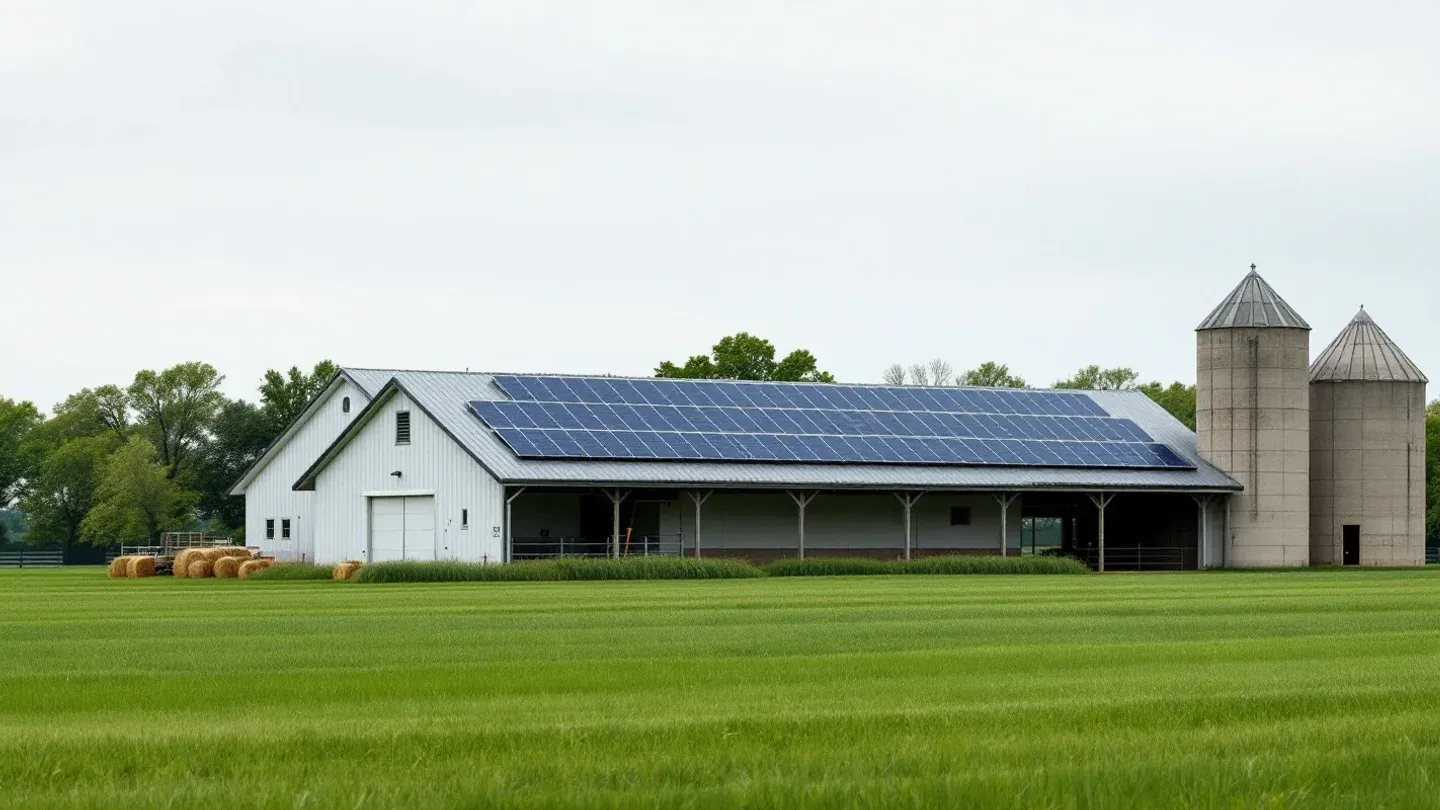
Net metering is set state by state, and within many states utility by utility: how exports are credited, how large a system may be relative to your use, and whether a farm with several meters can share one array's credits across them. The reliable place to check is DSIRE, the database of state incentives and policies that the N.C. Clean Energy Technology Center at N.C. State University has kept since 1995. Filter by your state and read the net metering entry and any farm rebates together, and note which utilities each policy covers.
Three things to ask your utility directly: the export credit rate and whether it is retail or something lower; the cap on system size; and whether the state rule applies to your utility at all. The answers can swing the payback by years, which is why this call belongs before the quote, not after.
Leasing land to a developer: the questions that matter
The second decision is different in kind. A developer who offers to lease part of your farm for a utility-scale array is not selling you panels; they are asking for your land for a generation. The Ohio State University farm law program's Farmland Owner's Guide to Solar Leasing puts the commitment plainly: projects commonly run 20 years or more with automatic extensions of five to ten years, and backing out once signed is close to impossible. Its companion checklist is the best single document to print before any meeting.
What the money looks like depends on where you farm. University of Wisconsin Extension's 2023 fact sheet for landowners says Wisconsin lease rates tend to fall between $500 and $1,200 per acre, paid as annual rent, with the main variable being how close the land is to a substation, and notes that higher-priced electricity markets such as California and New York pay more. One megawatt of panels takes five to seven acres. The Ohio guide says an option period of two to five years is common before anything is built, while the developer studies the site and the grid connection, and that the rent is typically highest once the project is producing power.
The questions that decide whether a lease is good for the farm are mostly not about the rent:
- Who pays for removal and restoration at the end, and is that money in escrow or an irrevocable bond rather than a promise? The Wisconsin sheet says to require one or the other, and the Ohio guide calls escrowed cleanup funds an important provision.
- What happens to your agricultural use-value property tax assessment, and any recoupment penalty, once the ground is under panels? Ohio's CAUV program and Wisconsin's use-value taxation both carry that risk. The Wisconsin sheet notes that establishing a farm use under the array, such as sheep or goats on pasture, can offset it, and the Ohio guide says the lease can make the developer cover the recoupment fee.
- Can you still hay or graze the site, who mows, and can anyone spray if you are organic?
- How is drainage tile protected during construction and repaired afterwards?
- Does the lease sit on your best ground or on the field you would not miss?
- What does a thirty-year commitment do to your succession plan? That is the kind of question we mean by thinking long term.
Hire an attorney who has read solar leases before, and ask the developer to cover the review; the Ohio checklist suggests asking exactly that. Then talk to your neighbors before they hear it from someone else. A lease can be the steadiest income a farm ever sees, in the sense we described in How to Diversify Farming Income, but only if the land comes back to you in the condition it left.
Grazing and growing under panels
Agrivoltaics, the practice of keeping land in production under and between panels, has moved from curiosity to field research. The InSPIRE project, funded by the U.S. Department of Energy's Solar Energy Technologies Office, sorts it into four kinds (grazing, crop production, habitat and greenhouses) and keeps a map that works as a census of U.S. sites. American Farmland Trust's Smart Solar principles ask that solar go first on rooftops and marginal ground, that soils be protected during construction and decommissioning, and that agrivoltaics grow wherever farmland is used. The Department of Energy estimates that more than ten million acres will be needed for solar by 2050, and AFT projects that over 80 percent of that could land on agricultural ground.
Sheep are the proven case. The Department of Energy's Farmer's Guide to Going Solar notes that standard panel heights suit sheep while cattle generally need elevated panels, that wiring should be fully encased, and that local shepherds may be paid for managing the grazing. An Oregon State University trial published in 2021 found that lambs grazed under panels gained weight at the same rate as lambs on open pasture, that the ground under the array grew less forage overall, and that the combined land produced far more than either use alone, with land equivalent ratios between roughly 1.7 and 2.0. The American Solar Grazing Association publishes a best practices guide, a solar grazing checklist and contract resources, and runs in-person training and a certification for farmers who want to turn that into a service business. If you already run a flock, our notes on sheep and goats on pasture and the principles of grazing management apply under panels as much as anywhere.
Crops are further behind but not idle. A University of Arizona study in Nature Sustainability found that panel shade reduced drought stress, raised food production for the crops tested and kept the panels themselves cooler in a dryland setting. The USDA-funded SCAPES project at the University of Illinois is testing row crops, forage and specialty crops between panel rows with partner universities. The design trade-offs are the ones silvopasture already taught us: raising the panels and widening the rows lets more light and equipment in, but costs more steel and produces less power per acre. The AgriSolar Clearinghouse, run by the National Center for Appropriate Technology, collects the practical guides, and NCAT's ATTRA hotline takes farmer questions. These groups and others like them are in our organizations directory.
Before you sign anything
- Pull twelve months of bills and write down your highest month and your lowest.
- Call the utility about export credits and size caps, and check your state's entry on DSIRE.
- Get two quotes that start from your load, not from your roof.
- Confirm REAP eligibility with the state energy coordinator and get the application in before the September 30 window closes.
- Take the tax questions to your preparer before you sign with an installer.
- For a lease offer: print the Ohio checklist, hire a lawyer, and read the decommissioning clause first.
- Decide what the ground under the panels will do, whether hay, sheep, pollinators or crops, and write it into the contract.
Solar is a tool, not a creed. Managed holistically, it can pay a bill, steady an income or keep a pasture in use. Managed badly, it can take the best field out of production for thirty years. The difference is the questions you ask this summer.