
A wash and pack shed is where the Produce Safety Rule stops being paperwork and becomes a building. Water, floors, tables, drains, a hand-washing station and a logbook: that is most of what an inspector will look at, and most of what a food hub or a school district will ask about before a first delivery. Spring 2024 is a sensible moment to get the design right. The rule's general requirements have applied to every size of covered farm since January 2020, the harvest and post-harvest water requirements reached the smallest covered farms this January, and the long-promised rewrite of the pre-harvest water rules is still on FDA's desk. This article walks through who the rule covers, how the shed should flow, what the surfaces and drains need to do, what the water has to pass, how sanitizer and records fit in, and how to get a free walk-through before anyone with a badge arrives.
Find out whether the rule covers you
Start with the sales figure. Under 21 CFR 112.4, a farm is a covered farm if its average annual produce sales over the previous three years exceed $25,000, adjusted for inflation from a 2011 baseline. FDA keeps an inflation-adjusted table of these cut-offs that it intends to update at the beginning of April each year; its line for 2022 puts that threshold just over $32,000, and inflation nudges it up a little every year. Below it, the rule does not apply at all.
Then look at what you grow. Section 112.2 lists produce that is rarely consumed raw and therefore not covered: asparagus, sweet corn, potatoes, sweet potatoes, pumpkins, winter squash, garden beets, collards, eggplant, okra and the dry beans among them. Produce grown for your own household is out. Produce that goes to a processor with a kill step, such as a cannery or a winery, can be exempt too, but only if the paperwork traveling with it says the food is "not processed to adequately reduce the presence of microorganisms of public health significance" and you hold a written assurance from the customer, renewed every year.
The third door is the qualified exemption in section 112.5. A farm qualifies if its average annual sales of all food over the previous three years were under $500,000 adjusted for inflation (on FDA's table the 2022 figure is just under $650,000) and more than half of that food went to qualified end-users: consumers anywhere, or restaurants and retail food establishments in the same state or within 275 miles. A farm selling CSA boxes and a Saturday stall usually clears both tests. What it buys is a lighter set of duties, not a pass. Section 112.6 requires the farm's name and complete business address on the label or, where there is no label, on a sign or a document at the point of sale, and section 112.7 requires records that prove the exemption, reviewed once a year. FDA can withdraw it after an outbreak investigation directly linked to the farm.
Two practical notes. First, the exemption is about enforcement, not about whether your lettuce can carry pathogens, so the design advice below applies to every shed. Second, wholesale buyers write their own rules: a food hub or a school district will ask for the same water test and cleaning log the rule asks for, and a GAP audit will ask for more.
Where the rule stands in April 2024
FDA's compliance table tells the story. The general requirements took effect for large farms (more than $500,000 in produce sales) on January 26, 2018, for small farms ($250,000 to $500,000) on January 28, 2019, and for very small farms ($25,000 to $250,000) on January 27, 2020. The harvest and post-harvest water requirements, which govern the wash tank, had their dates pushed out and then softened: January 26, 2022, 2023 and 2024 for the three sizes, with FDA announcing in July 2022 that it would exercise enforcement discretion for one further year in each case, so until January 26, 2025 for the smallest covered farms. FDA has also said it plans to take an educational posture in the first year after each of those dates, with the emphasis on training, technical assistance and on-farm readiness reviews rather than enforcement.
The pre-harvest water rule is the unfinished piece. FDA proposed on December 6, 2021 to replace the microbial testing criteria for irrigation water with a written assessment of each water system, and in July 2022 proposed compliance dates of nine months, one year and nine months, and two years and nine months after the final rule's effective date. The Fall 2023 regulatory agenda listed the final rule for February 2024; as of mid-April it has not appeared. None of this touches the shed: the proposal leaves the harvest and post-harvest water requirements as they are.
Flow: one direction, dirty to clean
The rule's building section, 112.126, asks for a building "suitable in size, construction, and design", with operations where contamination is likely separated by "location, time, partition, enclosed systems, or other effective means", adequate drainage wherever water is released onto the floor, and attention to contamination from floors, walls, ceilings, pipes, drip and condensate. That is a regulatory way of saying what UVM Extension's agricultural engineers say more plainly in their guide to planning a wash and pack area: "Ideally, flow is in one direction to avoid backtracking (wasted steps) and potential cross contamination". A U-shaped or T-shaped flow works in a tight space. Washed produce moves toward the cooler and away from field-side traffic, the route in from the field avoids the compost pile and the livestock yard, and there are enough doors, wide enough for a loaded tote and, if you use pallet bins, a sliding or overhead door.
Sketch it to scale before you build. Field crates arrive at a receiving spot under a roof. The dirty zone holds the dump tank, the root washer or the bubbler. The clean zone holds the spinner, the drying rack and the packing table. The cooler door opens off the clean zone, and loading happens on the far side. Culls and tops go into a designated container that is emptied every day, because, as UVM notes, a pile of produce waste draws wildlife, and wildlife is itself a produce safety hazard. Section 112.128 makes the same point about pests: a fully enclosed shed must exclude them, a partially enclosed one must stop them settling in, with screens and monitoring.
UVM's case study of Footprint Farm in Starksboro, Vermont, shows the idea at full size. The farm grows 66 kinds of vegetables on 2.5 acres for a CSA, farmers markets and restaurants. Its 36 by 48 foot building gives two-thirds of the ground floor to a wash area of about 20 by 48 feet: an overhead door receives product, 4-foot people doors keep the crew moving, greens are triple-washed in bulk tanks and spun in a modified spinner, and roots are washed outside. The owners report that cull rates dropped sharply and quality rose once the building was in use. It cost about $300,000 with living space above, against contractor estimates near $500,000 for a fully hired-out build. Most of you will build far smaller, but the flow is the same.
Floors, drains, walls and light
Equipment comes first in the rule's logic. Section 112.123 requires tools and equipment of "adequate design, construction, and workmanship to enable them to be adequately cleaned", seams on food contact surfaces that are "smoothly bonded", and cleaning, with sanitizing where appropriate, "as frequently as reasonably necessary". In a small shed that means stainless or food-grade plastic tanks, tables with no cracked plywood, and a packing surface you would eat off.
The floor is the next thing an inspector looks at. UVM's advice is a smooth concrete floor pitched to in-floor drains, which makes the end-of-day wash-down quick. Keep standing water off the floor and hang the hoses off it. Footprint Farm ran a trench drain to its own leach field and reports one regret worth more than any checklist: the slab was not pitched to the drain as precisely as planned, and water still lingers. Settle the slope with the concrete crew before the pour, and make the low point the drain, not the cooler door.
Walls in the wet zone want a surface you can hose. Footprint Farm lined its wash area with corrugated metal roofing at about $1 per square foot, painted everything white and put in bright light. A four-season insulated building costs more and only earns it if you pack through the winter. A three-season pole shed on a slab is honest enough for most direct-market farms. UVM's 2022 poll of Vermont growers put wood-framed sheds or pole barns on a slab at $21 to $50 per square foot, a prefabricated shed at $45 to $50, a shipping container at $15 to $17, a four-season insulated wood-framed building at $37 to $60 and an insulated metal building at $70 to $80. A pop-up tent, at $1 per square foot or less, is where many farms start, and it is not wrong. The belief we call always simplify applies: one roof, one slab, one slope, one drain.
Water: the part of the rule with a number in it
Section 112.44 is the heart of the shed. Water that touches produce during or after harvest, water used for washing or cooling, ice, water that touches food contact surfaces and water for washing hands must all have "no detectable generic Escherichia coli (E. coli) in 100 milliliters", and untreated surface water, meaning a pond or a creek, may not be used for any of those jobs.
How you prove it depends on the source. Water from a public system needs no testing; keep the utility's annual results or certificate on file. An untreated well must be tested at least four times in the first growing season or year, and if all four pass, once a year after that. If an annual sample fails, the rule says to stop using the water for those purposes at once, fix the problem, and go back to four tests a year until a full year comes back clean. A farm that treats its water, for instance with an EPA-registered sanitizer in the tank, must use a treatment that works and monitor it. FDA's summary of the harvest and post-harvest water requirements adds the wash-tank housekeeping: a schedule for changing water that is not single-pass, water held at a temperature "appropriate for the commodity", and visual checks for soil and debris building up.
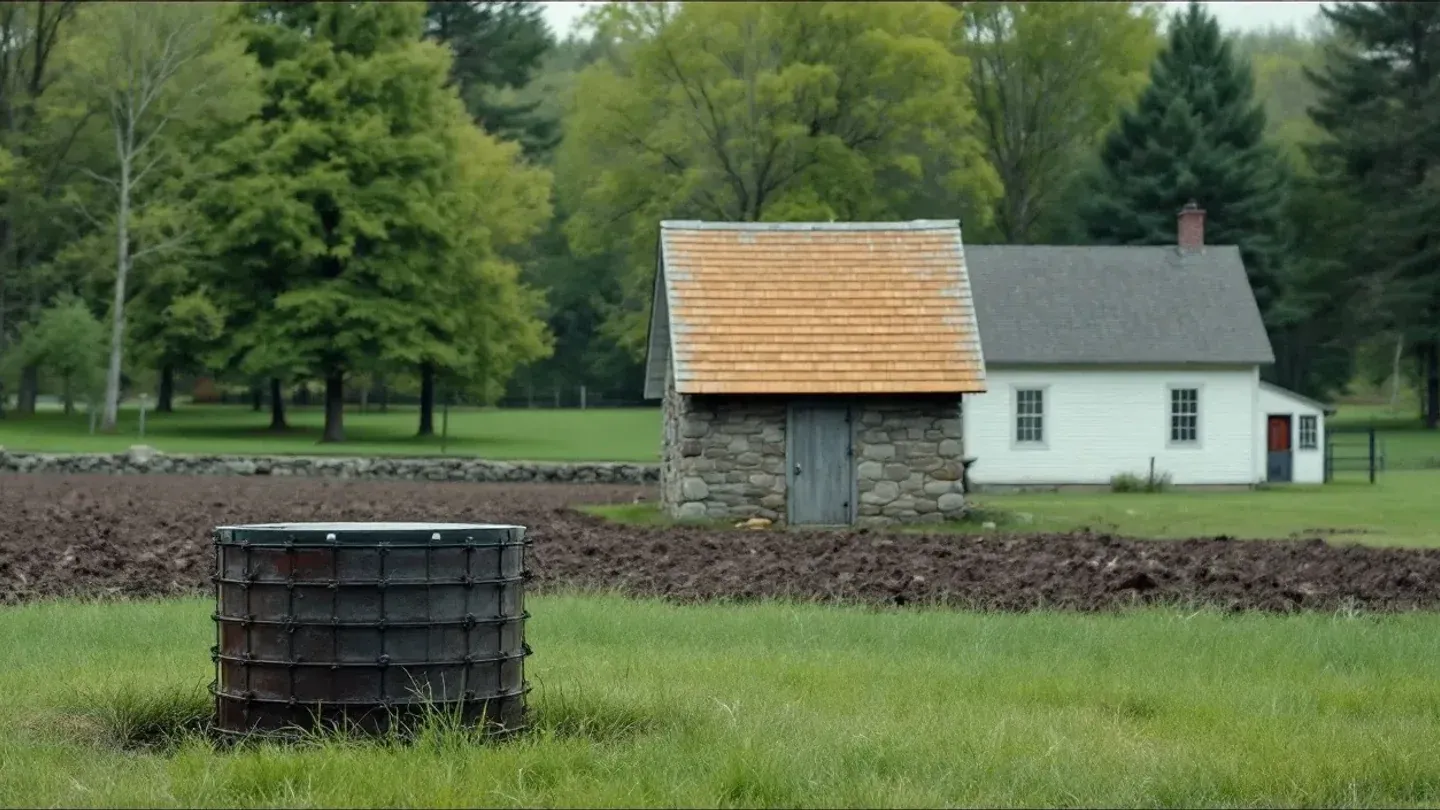
A well that passes should also be protected: a capped casing, a tight pump house and a supply line that does not run past the manure pile. Our article on ponds, wells and water lines covers the plumbing, and our older piece on conserving water on the farm is a reminder that a recirculating tank with a sanitizer in it uses far less water than a hose left running.
Sanitizer, and the order of cleaning
The rule does not say "use chlorine". The Produce Safety Alliance's fact sheet on selecting a sanitizer explains the logic. Sanitizers are antimicrobial pesticides under federal law, every one sold in the US carries an EPA registration number, and the label states what the product may be used for, at what dilution and for how long. The rule does not demand an EPA-labeled product in so many words, but a label is the simplest proof that a sanitizer is fit for the job. Pick a product whose label names fruit and vegetable wash water or nonporous food contact surfaces, check that it is registered in your state, and follow the label to the letter. UVM's sanitizer dose calculator turns a target concentration and a tank size into a measured dose of product for household bleach and several branded produce sanitizers.
Surfaces have their own order of operations, laid out in the Alliance's cleaning versus sanitizing sheet: remove the debris, scrub with a detergent, rinse with water that meets the E. coli standard, then apply the sanitizer and let the surface air dry. A dirty surface cannot be sanitized, so cleaning always comes first. Two details save trouble later. Do not use a pressure washer in the shed, because it spreads whatever is on the floor across the tables; and color-code brushes and squeegees so that floor tools never touch a food contact surface. Organic growers should ask their certifier whether a potable rinse is wanted after the sanitizer.
The logbook
A shed that meets the rule has a clipboard by the door. Section 112.140 requires a record of "the date and method of cleaning and sanitizing of equipment" used in harvesting, packing and holding. Section 112.30 requires training records with the date, the topics and the names. The water sections require the test results, the utility's certificate, the treatment monitoring and the findings of water system inspections. Section 112.7 requires the receipts and the annual review that prove a qualified exemption. Section 112.161 says what every record must carry: the farm's name and location, the actual values and observations, the date and time, created when the activity happens, dated and signed or initialed by the person who did it. Keep them for two years.
In practice that is four sheets: a wash-water log (sanitizer concentration, water changes, temperature), a cleaning log (what, how, who, when), a training log, and a water-test file. Filled in every day, they are the belief we call be consistent written down, and they are what makes the step up to wholesale a short one.
People: training and the hand-washing station
Section 112.22 requires everyone who handles covered produce to be trained in hygiene and the parts of the rule that touch their job, harvest crews to be trained to recognize produce that must not be picked and to inspect their containers, and "at least one supervisor or responsible party" to have completed training "at least equivalent to that received under standardized curriculum recognized as adequate by the Food and Drug Administration". The Produce Safety Alliance Grower Training is that curriculum: a single day of about seven hours, seven modules running from worker hygiene through postharvest water and sanitation to writing a farm food safety plan, and a certificate from the Association of Food and Drug Officials. The Alliance lists upcoming courses, in person and online.
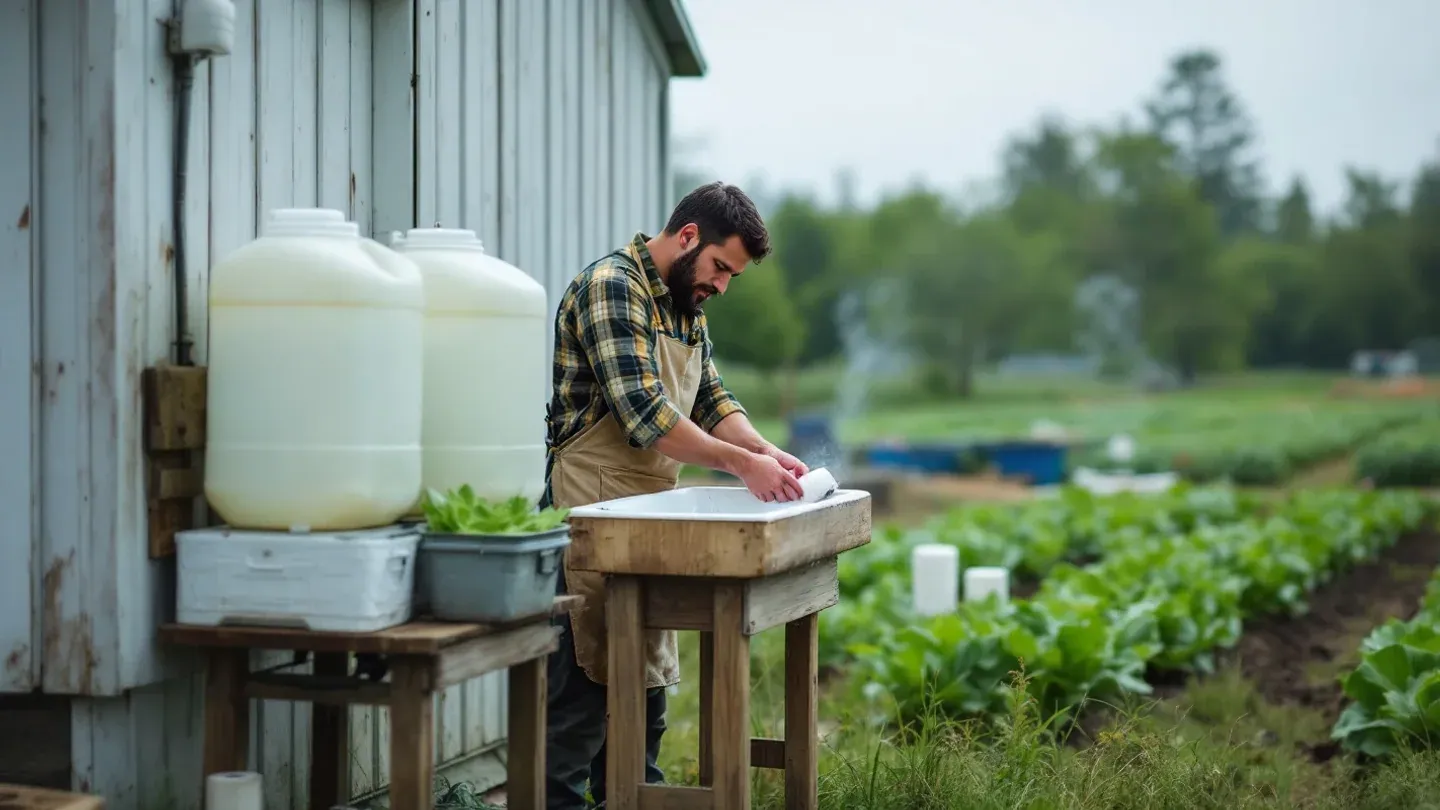
The hand-washing station is the cheapest fix in the shed and the one most often missing. Section 112.130 requires soap, running water that meets the E. coli standard, a drying device such as single-use towels, and a way to dispose of the gray water and the towels. UVM's touchless station uses two 5-gallon totes, a foot pedal on a spring-loaded spigot and a foot-operated bin, with the basin top at 34 inches; the materials came to $146 on a wooden stand and $186 on a wire cart. A crew that can wash for 20 seconds without touching a tap is a crew you have looked after, which is part of what we mean by nurture families. Our articles on finding and keeping farm employees and on protecting a crew from heat belong in the same folder.
Before the inspector: ask for a readiness review
State produce safety programs, which run with FDA funding, offer On-Farm Readiness Reviews. Vermont's description gives the flavor: a free, non-regulatory check of how ready a farm is for inspection, one and a half to three hours long, led by the state produce program's staff with a UVM Extension produce safety specialist, walking the harvest, wash, pack and storage areas and talking through the food safety plan. The reviewers are not auditing or inspecting, and their notes stay with the farm. Request one the season before you expect a first inspection, or the season after you build.
Money for the build follows the same channels as a cooler. USDA's Resilient Food Systems Infrastructure program, run through state departments of agriculture, offers simplified equipment-only grants of $10,000 to $100,000 with no match and names equipment that ensures food safety and post-harvest cleaning among eligible uses; our cold storage article has the detail, and an FSA microloan covers a slab and a tank when a grant round does not fit. The farmer networks in our organizations directory are the right people to ask who built a shed recently and what they would change, and the small-farm tool suppliers in our service providers and manufacturers directory are where the carts, crates and hose reels come from.
A practical close
- Do the coverage arithmetic with three years of sales receipts and FDA's inflation table, and write the result down, especially if you claim the qualified exemption.
- Draw the shed to scale with one direction of flow, dirty to clean, and the cooler at the clean end.
- Pour a smooth slab pitched to a drain, and finish the wet-zone walls in something you can hose.
- Test the well four times this season, or file the utility's certificate, and keep surface water out of the shed.
- Choose a labeled sanitizer, print the label rates, and buy test strips.
- Put a hand-washing station at the door and a clipboard beside it.
- Send one person to a Produce Safety Alliance course and book a readiness review.
A shed built this way is not built for the inspector. It is built so that the salad mix you sell on Saturday is the salad mix you would serve your own children, which is the standard that mattered long before the rule and will matter long after it. That is thinking long term in concrete and stainless steel.