
August is a good month to think seriously about a high tunnel. The federal fiscal year turns over on October 1, state NRCS offices are lining up their fiscal year 2024 application periods, and fall is the easiest season to set posts and pull plastic before the ground freezes. If you have had a hoop house catalog on the kitchen table for two years and wondered whether the USDA cost share is real, it is. Here is what the NRCS High Tunnel Initiative pays for, what it asks of you in return, and what a few extra weeks of harvest on each end of the season are worth.
Where the program came from
NRCS launched its Seasonal High Tunnel pilot in December 2009 as a three-year test inside the Environmental Quality Incentives Program (EQIP). In the first year the agency put more than $13 million into 2,422 tunnels in 43 states. The pilot capped a funded tunnel at 2,178 square feet, five percent of an acre.
By the summer of 2014 the count had passed 13,000 tunnels and $61 million, the practice had become an established conservation practice standard, and the federal size cap was gone. States may still set their own limits by area or by dollars, so ask yours.
That is the shape of the program today: a standard EQIP practice, funded state by state, that pays a set rate per square foot toward a tunnel you buy as a kit and put over your own soil. We covered how EQIP contracts work in our guide to EQIP and CSP payments; this article is about the tunnel practice itself.
Who qualifies
The practice standard applies to "land capable of producing crops" where sun, wind or a short season limits what you can grow. It does not apply to crops grown on benches, in pots or hydroponically: the whole point of the practice is the soil under the tunnel.
It has leaned toward beginning farmers from the start. A 2017 study in the Journal of Agriculture, Food Systems, and Community Development reports that beginning farmers held 51 percent of High Tunnel Initiative contracts in 2013, and that historically underserved producers of all categories held over 70 percent, against 26 percent of EQIP participants overall. The law behind that tilt is in the EQIP statute: beginning, limited resource, socially disadvantaged and veteran farmers get a higher payment rate and can take at least half of their payment in advance to buy the kit. If you have not operated a farm for more than ten consecutive years, you are a beginning farmer in NRCS's eyes, and you should say so on the application.
Urban growers qualify too. The same study notes that high tunnels suit urban agriculture because they make the most of small spaces, which matches what we wrote about starting a small urban farm.
What the practice standard requires
The rules live in NRCS Conservation Practice Standard 325, High Tunnel System, five pages long. Read it before you call anyone. The criteria that catch people out:
- The tunnel must be a manufactured kit, built to the manufacturer's recommendations, with a metal, wood or durable plastic frame at least 6 feet tall at the peak. A homebuilt frame does not qualify.
- Crops must grow in the natural soil profile. Raised beds are allowed up to 12 inches deep.
- Greenhouses and low tunnels are excluded. The structure cannot house livestock or store supplies and equipment.
- The cover must last at least four years. For polyethylene that means 6-mil, greenhouse-grade, UV-resistant film.
- The site must be level or on a natural slope of no more than five percent, away from buried utilities and near a water source for irrigation.
- Where snow could damage the structure, the cover comes off or rolls up at the end of the season unless the manufacturer rated the frame for the load. Where wind is the risk, you choose a frame rated for it or manage the tunnel to limit damage.
- Runoff from the cover must be directed away from the tunnel, with a basin, storage or a stable outlet where it would otherwise erode, and disturbed ground outside must be seeded or mulched.
The standard also asks for an operation and maintenance plan and says plainly that managing a tunnel "requires intensive and vigilant attention by the producer." Close the sides and ends before storms, close up before winter, and remove snow and ice promptly.
States add specifications on top. New Hampshire's implementation requirements, to take one northern example, require a gothic frame no wider than 30 feet, bows 4 feet apart, minimum pipe gauges, five purlins on tunnels 26 feet and wider, trusses on every other bow, wind bracing at the ends, roll-up sides on both sides, a door, and all new materials. The same document warns that vendor claims of an "NRCS approved" model must be checked against the state's list. Ask your state office for its checklist before you shop.
What it pays
The payment is a flat rate per square foot taken from your state's EQIP payment schedule, up to a state cap. The statute limits a general EQIP payment to 75 percent of the cost of planning, materials and installation, and lets NRCS raise the rate for historically underserved producers to as much as 90 percent, with at least half of that payment available in advance. As a 2015 illustration, the JAFSCD study reports that Indiana NRCS paid $3.85 per square foot with a maximum of $8,385, against an average tunnel cost of around $3.25 per square foot, or about $7,000 for a 2,160-square-foot tunnel. Rates and caps change by state and by fiscal year, so ask for the current schedule rather than planning on those numbers.
What the rate does not cover is the part that surprises first-time builders. A University of Arkansas comparison priced kits from one supplier at $2.47 to $5.85 per square foot before labor, with the cost per square foot falling as the tunnel grows, and noted that many kits leave you to buy baseboards and end wall materials separately. The University of Kentucky's economics fact sheet adds site preparation, freight and construction labor to the list of costs growers forget. Treat the NRCS payment as what it is: a large share of the kit, not a free tunnel.
There is more money in the pot this coming year. The Inflation Reduction Act of 2022 added $1.75 billion to EQIP for fiscal year 2024 on top of the regular Farm Bill funding. We described that law in our look at the IRA's effect on farming. That does not guarantee your application ranks, but it helps.
Siting
The practice standard's own considerations are a good preview of the planner's site visit: keep the tunnel at least two times the height of any tree or building away from it, leave 10 to 20 feet between side-by-side tunnels for snow removal and cover changes, and put it where plants, equipment and people can get in and out easily.
West Virginia University's Lewis Jett adds the horticultural half in his construction guide: pick ground with no history of perennial weeds or soilborne disease, well drained and free of large stones, in full sun with good air flow. Avoid low spots that collect cold air and water. Keep the slope along the length under three percent. Test the soil before you commit, because that soil is your growing medium for years; our six easy soil tests are a start, and New Hampshire's specification recommends a contamination test on urban sites or where fill was brought in. Check whether your county wants a building permit.
This is where healing the soil and the program's goals line up. A tunnel concentrates years of cropping on a small footprint, and the standard's considerations read like a soil health primer: minimize disturbance, rotate for diversity, keep a living root and keep the soil covered.
Orientation and ventilation
High tunnels are passively vented, so the first orientation question is wind, not sun. Jett's rule is to run the length of the tunnel perpendicular to the prevailing wind so the roll-up sides catch the breeze. Above roughly 40 degrees north, most tunnels run east to west to gather low winter light; farther south, cross ventilation wins and north to south is common. New Hampshire's specification says the same: east-west if early and late production is the goal, north-south if main-season quality is.
Width matters more than length. Cornell's high tunnel program notes that the narrower the tunnel, the easier it is to ventilate, and that tunnels wider than about 30 feet may have poor lateral airflow. Jett wants sidewalls at least five feet tall so the roll-up opening is big enough to matter, and UConn's John Bartok recommends end wall openings of at least 6 by 6 feet. Kentucky's fact sheet names venting as one of the two labor costs growers new to tunnels often fail to budget for: someone has to be nearby to open the sides on a sunny morning. Keep the design simple enough that one person can run it, which is our always simplify rule applied to a sheet of plastic.
Snow and wind
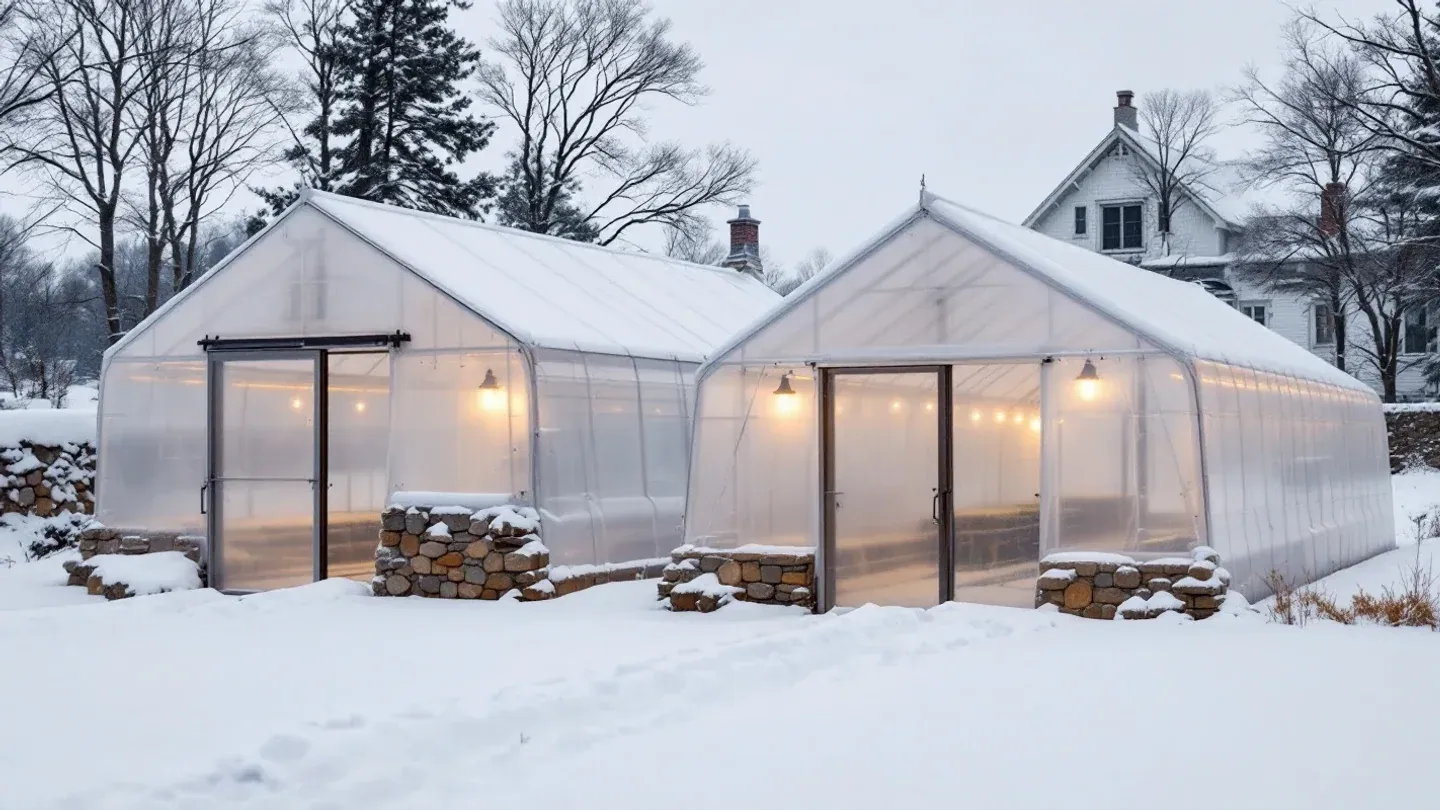
Bartok's numbers make the loads concrete. Three inches of wet snow or twelve inches of dry snow adds about five pounds per square foot, so a 30 by 72 foot tunnel has to carry roughly 10,800 pounds. An 80 mile per hour wind pushes with about 16 pounds per square foot and lifts the roof at roughly 220 pounds per linear foot. His prescriptions: ground posts 24 to 30 inches deep, auger or screw anchors about every 10 feet on windy sites, at least three purlins on tunnels under 26 feet wide and five on wider ones, cross ties or trusses above 26 feet, and diagonal bracing at the four corners. If the tunnel stays covered through a snowy winter, he wants 2 by 4 posts under the ridge every third or fourth hoop.
Shape is the other half. A gothic peak sheds snow better than a round Quonset roof, and gutter-connected multi-bay tunnels carry no purlins or bracing at all, so their plastic comes off every winter. Cornell calls wind the biggest threat and prefers a protected site to an exposed hilltop. The Arkansas guide closes with a line worth taking seriously: consider insuring the structure, a topic we covered in what insurance a farmer needs.
What the extra weeks are worth
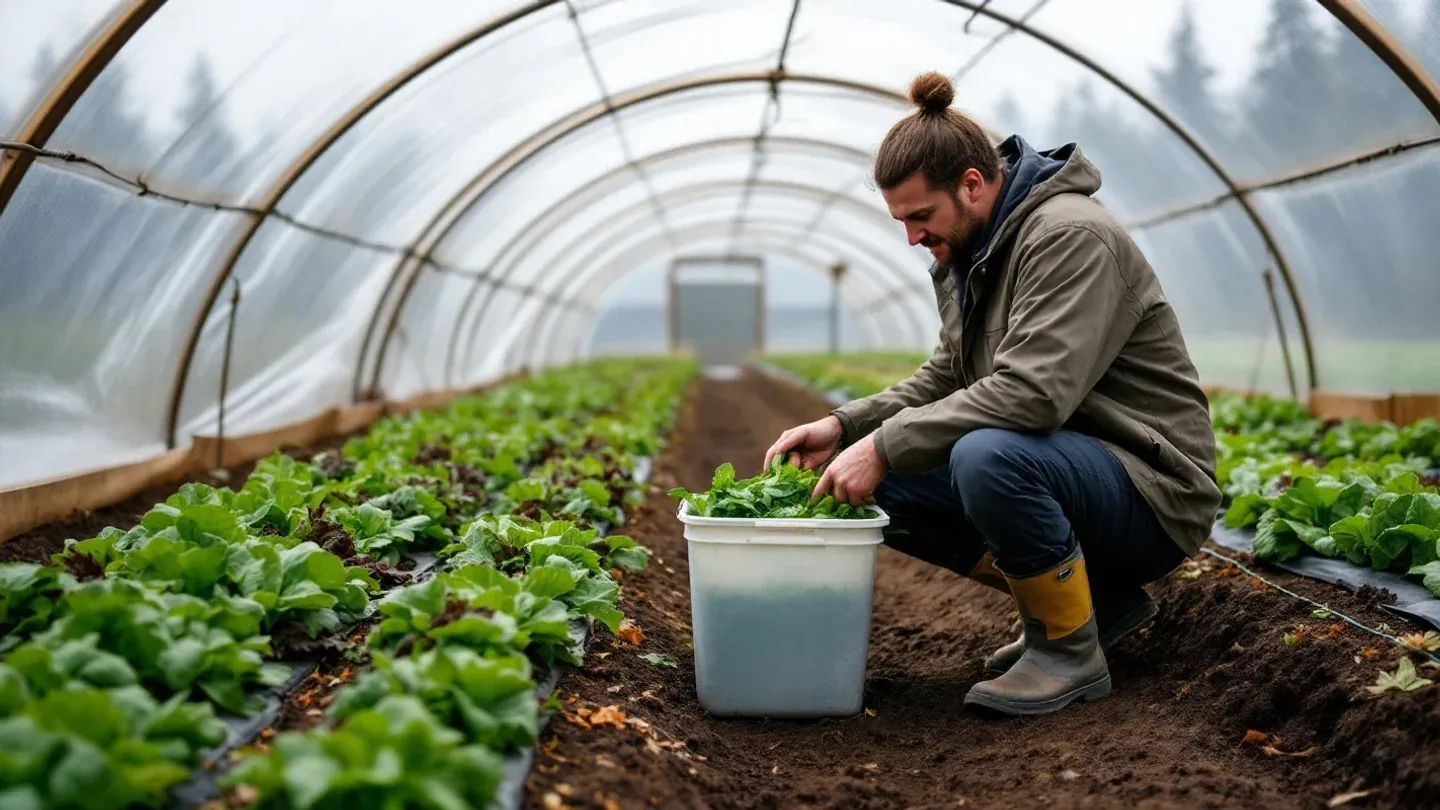
Season extension is a number, not a slogan. Gathering Together Farm in Oregon's Willamette Valley tracked its three tunnels for an Oregon State University case study: peppers came in three weeks earlier, eggplant four, lettuce four weeks earlier and four later, tomatoes four weeks later, carrots six weeks earlier. The farm put the extra gross income from the tunnels at about $29,000 in 2004, with tomatoes alone worth $18,000, and held five more restaurant contracts in the winter of 2004 to 2005 than in earlier years.
Smaller tunnels earn smaller money, and the budgets are honest about it. Utah State's early tomato budget for a 14 by 96 foot tunnel assumes 1,700 pounds sold at $2.00, $3,400 gross, and a net return of about $1,720 after all labor and depreciation. Kentucky's sensitivity table for 200 tomato plants in an unheated tunnel runs from minus $318 at $1.50 a pound and 1,600 pounds to $2,303 at $2.50 and 2,400 pounds. The fact sheet's conclusion is the one to carry around: high tunnel profitability is very sensitive to price, and the produce must sell at steady, premium prices to pay for the tunnel.
That is why the tunnel pays best for farms that already have a direct market waiting for early tomatoes and late greens, whether a CSA, a farmers market stall or a restaurant list. The Indiana survey found that tunnel users across the board reported longer seasons, better crop quality and more stable farm economics, and that growers who put some of their own money into the tunnel reported the biggest gains in economic stability. A tunnel is a ten-year decision, the kind of long-term thinking we keep coming back to. It is also one of the cleanest ways to diversify farm income without adding acres.
The timeline from here
- Call your USDA service center this month and ask for the NRCS planner. Each state sets its own application periods and ranking dates, and an application filed before the first fiscal year 2024 cutoff is in the earliest round.
- Walk the site with the planner. The plan records the tunnel's width and length, the planned growing season, the runoff measures, and the timing for rolling up or removing the cover before winter.
- Ask the planner exactly what you may buy before the contract is signed. The usual answer is nothing, so hold off on ordering.
- Choose a kit that meets your state's specification, not just the national standard, and have the vendor confirm each line of the checklist in writing. Our service providers and manufacturers directory lists suppliers we know.
- Build in spring or fall, when the soil is workable and the day is warm enough to stretch plastic: Jett advises against pulling the cover on below 60 degrees.
- Put drip irrigation in from day one, and consider soil moisture sensors so you water a covered bed by need rather than by habit.
- Line up the winter work now: a cold storage plan for a longer harvest. Add a crop plan that puts the tunnel's square feet to work in every month it is warm enough.
A high tunnel will not make a farm. It will make a good farm better by a few weeks on each shoulder of the season, every year, for a decade. Spend August on the application, fall on the build, and next spring on the first tomatoes in town. For the groups that help with the paperwork, see our organizations directory.