
Every irrigated farm already schedules irrigation. Most of us just do it by looking. In the USDA's 2018 Irrigation and Water Management Survey, 231,474 farms reported a method for deciding when to irrigate. Of those, 180,560 went by the condition of the crop, 93,052 by the feel of the soil, 46,477 by a personal calendar and 12,765 by when the neighbors started. Only 27,629, about 12 percent, used a soil moisture sensing device. In Texas it was 927 farms out of 11,997, under 8 percent.
That gap is worth closing this summer, and it costs less to close than most people assume. A few sensors, placed where the roots are, turn watering from a guess into a reading. This piece covers the three sensor types a small farm will actually meet, where to put them, what the numbers mean, and how the readings change decisions on a vegetable field and on an irrigated pasture. It builds on our older notes on how farms can conserve water and on what precision agriculture means at a scale smaller than a center pivot.
A July that makes the case
The timely part first. On June 20, Del Rio and Rio Grande, Texas, reached 113°F and San Angelo reached 114°F, all-time records for those stations, and on June 24 Rio Grande Village in Big Bend hit 119°F, one degree short of the Texas all-time record, according to NOAA's climate summary for June. The U.S. Drought Monitor map valid July 4 put about 27 percent of the contiguous United States in drought, up about eight points since the end of May. In Texas, the same map had 72 percent of the state at least abnormally dry and 27 percent in drought. Any week's map is a click away in the Drought Monitor archive.
Heat like that does two things to an irrigator. It pushes crop water use up, so the interval you are used to is suddenly too long. And it tempts you to water by anxiety, which burns pumping hours, pushes nutrients below the roots and still leaves the crop short by mid afternoon. A sensor settles the argument with a number.
What a sensor actually measures
Soil holds water the way a sponge does. One to three days after a rain or an irrigation, once the excess has drained, the soil is at field capacity, the most water it can hold against gravity. As plants draw it down, there comes a point where they can no longer pull water out: the permanent wilting point. Everything between those two limits is available water, and the whole art of scheduling is to stay in the upper part of that range. Colorado State's water balance fact sheet lays this out, with typical available water capacities of about 0.12 inch per inch of soil for sandy loams and 0.20 for loams. How much your ground holds depends on texture and organic matter, which is one more reason the work of healing the soil and irrigation planning belong together.
Sensors report that state in one of two languages. Tension sensors, which means tensiometers and granular matrix blocks, report soil water tension in centibars or kilopascals (the same unit): how hard roots must pull to get water. Zero is saturated, field capacity typically falls between 10 and 30 centibars depending on texture, and 1,500 centibars is the permanent wilting point, as the Oregon State specialists explain in their SARE guide for small vegetable farms. Volumetric sensors, the capacitance probes, report the share of the soil volume that is water.
The difference matters more than it sounds. A tension reading of 40 centibars means the same thing to a plant in sand or in clay. A volumetric reading does not. University of California irrigation advisors give the example of a crop that needs water at 25 percent volumetric content on a sandy loam but at 35 percent on a clay loam. Tension tells you when. Volume, once you know your soil, can also tell you how much.
Three sensor types, honestly compared
Tensiometers
A tensiometer is a water-filled tube with a porous ceramic tip and a vacuum gauge on top. It acts like an artificial root, and it is the only direct measurement of tension, which is why the SARE guide calls it the most direct and accurate method. The limits are real. It needs service: the UC advisors refill the reservoir with degassed water at least once a month and check the seals. And it loses its vacuum once the soil dries past roughly 70 to 80 centibars. For leafy greens, celery and cole crops, which are rarely allowed to get that dry, that is no problem. For a crop managed drier, it is.
Granular matrix blocks
The granular matrix block that Utah State's vegetable guide points to is the Irrometer Watermark. It is an electrical resistance block calibrated to read the same tension values as a tensiometer, it needs no maintenance, it is meant to stay in the ground for five years or more, as the SARE guide notes, and it is read with a hand meter or a logger. Utah State's vegetable guide names it for monitoring drip-irrigated tomatoes, peppers and eggplant. The trade-off, from the UC advisors: resistance blocks are less accurate than a tensiometer below about 40 centibars, which is exactly where the wet-soil decisions for salad crops are made, but they read dry soils a tensiometer cannot and they cost less.
Capacitance probes
Capacitance sensors read the soil's dielectric properties and convert them to volumetric water content. They respond quickly, they log continuously, and some are built as multi-depth probes in a single access tube. But the reading shifts with soil texture, and many are only accurate to plus or minus 2 or 3 percent without site calibration, which is a problem when a cool-season vegetable needs water after a depletion of only 3 to 5 percent. On a small farm they earn their price where you want remote, continuous data and are willing to calibrate them against a tensiometer or the feel of the soil in the same bed.
Where to put them
Placement decides whether the numbers mean anything. The guidance from land-grant specialists is consistent.
- At least three stations per field, to spread the risk of measuring a wet or dry corner. Virginia Tech's sensor guide notes that center pivots commonly vary about 25 percent above or below the average application, so avoid spots that get much more or much less. The UC advisors suggest the top, middle and bottom of the field.
- In the plant row, between plants, where roots are concentrated and taking up the most water. Under drip, that means beside the line, inside the wetted zone.
- Away from high points, depressions and slopes, in the soil type that represents the field. Where a field has both heavy and light ground, the SARE guide says to monitor and manage each separately. The USDA Web Soil Survey shows the map units, and our six easy soil tests will tell you what you are standing on. The soil labs in our service providers and manufacturers directory can put a number on texture and organic matter.
- Two depths per station. The common pattern is a pair at about one third and two thirds of the root zone. Virginia Tech's version is a shallow sensor at about 6 inches and a deep one near the bottom of the root zone at 18 to 24 inches. For lettuce, the UC advisors found 8 and 18 inches worked well; for broccoli and cabbage, 12 and 24.
Install tensiometers and blocks in a pilot hole with a slurry of soil and water so the tip makes full contact. An air gap gives false readings. Give the station a day to equilibrate before you trust it.
What the numbers mean
For tension readings, the SARE guide's scale is a good wall chart: 10 to 30 centibars is adequately wet for most soils (very sandy ground is already getting dry at the top of that range), 30 to 60 centibars is the usual range for an irrigation decision, and 100 to 200 centibars is dangerously dry. Where you set the trigger inside that range depends on soil and crop. Virginia Tech's working table runs from 25 to 30 centibars on loamy sand through 30 to 40 on sandy loam, 35 to 50 on loam, 40 to 60 on silt loam and 60 to 80 on clay loam. Utah State, writing for drip-irrigated tomatoes, peppers and eggplant, starts irrigation at 20 to 25 percent depletion, which it puts at about 17 to 22 centibars on sand, 22 to 27 on sandy loam, 25 to 30 on loam and 35 to 45 on clay loam.
The deep sensor is your audit. Virginia Tech's rule: if it never moves after an irrigation, only the top of the profile got wet and you applied too little. If it rises but stays below field capacity, the depth was right. If it climbs past field capacity, water went below the roots and took nutrients with it.
Read tension as when, not how much. For the amount, use the water balance in the Colorado State sheet: available water capacity for your texture, times the depth you manage, times the share you allow to be used before the crop suffers, the management allowed depletion or MAD. The Colorado authors suggest checking that arithmetic against the sensor readings about once a week and correcting the balance when the two disagree, which catches a bad assumption before it costs you a crop.
Vegetables: small depletions, quick decisions
Vegetables are where sensors pay back fastest, because the margin is thin. Cool-season greens slow their growth at moderate tensions of 30 to 40 centibars. Virginia Tech lists a MAD of 30 percent for lettuce, onions and peppers, 30 to 40 percent for potatoes and 40 percent for tomatoes, against 50 to 55 percent for corn and 50 to 60 percent for alfalfa. Colorado State manages vegetables 6 to 12 inches deep at the seedling stage and 18 inches through flowering.
Put those together for a pepper bed on sandy loam managed 18 inches deep. Eighteen inches times 0.12 is about 2.2 inches of available water, and a 30 percent MAD leaves about 0.65 inch to spend between irrigations. In a week of 100-degree afternoons that can be gone in two days. That is why drip vegetables are watered often and lightly, and why a shallow sensor at 6 to 8 inches, read every morning, earns its keep. Growers in humid regions should not refill to field capacity either: Virginia Tech's worked example leaves a 10 to 20 percent deficit so a thunderstorm has somewhere to go. If you grow under plastic, the same logic applies, and our piece on what the NRCS high tunnel initiative pays for covers irrigation inside the structure.
Pasture: deeper roots, longer intervals
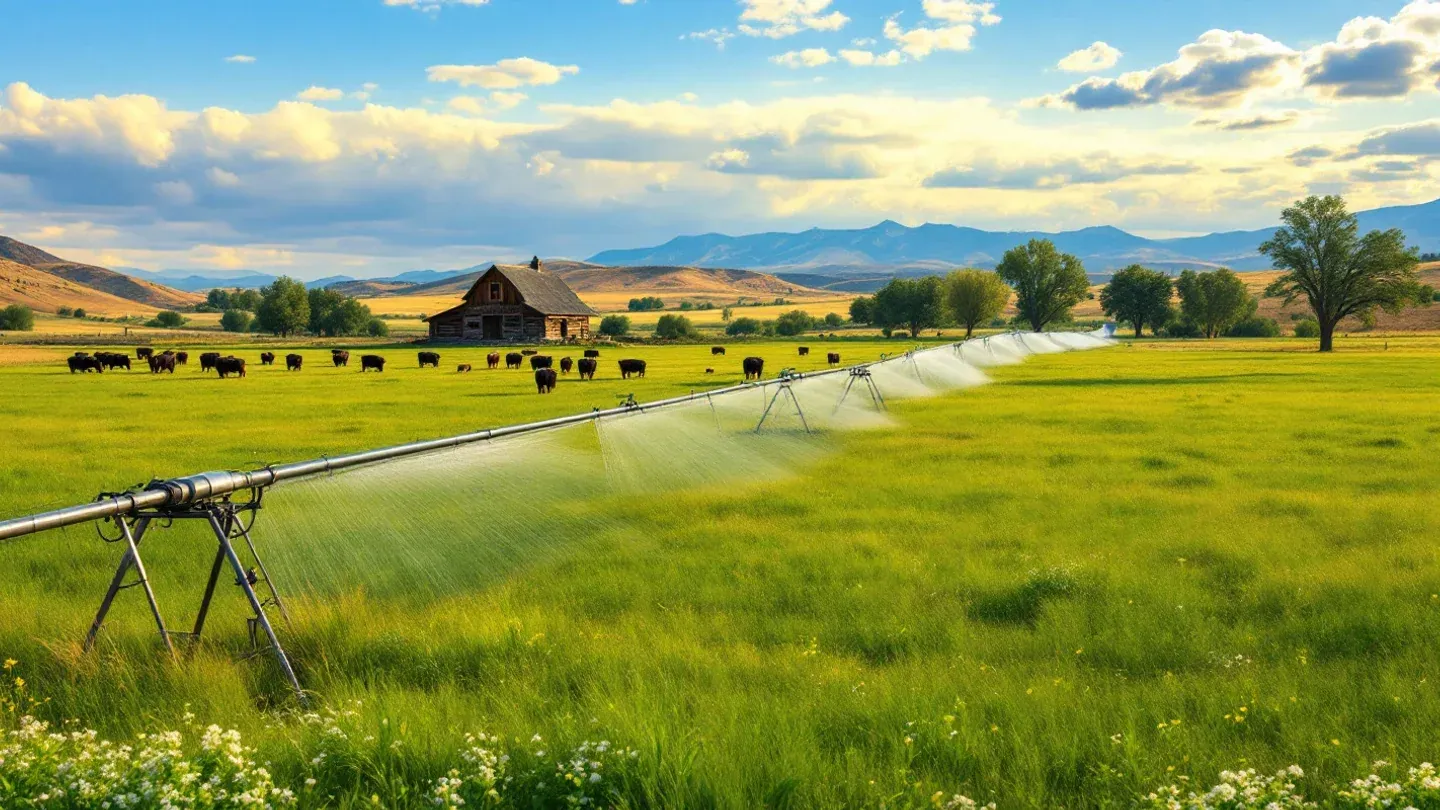
Irrigated pasture is the opposite case. Colorado State manages mature grass and pasture at 24 inches, against 18 inches for vegetables from the vegetative stage on, and the allowable depletion for a perennial forage is far more forgiving: Virginia Tech's table puts alfalfa at 50 to 60 percent, against 30 percent for lettuce and peppers. Take a loam at 0.20 inch per inch: 24 inches gives about 4.8 inches of available water, and at a 50 percent depletion there are 2.4 inches to spend before the stand stalls. If the grass is using a quarter inch a day, which is an illustration rather than a measurement, that is a nine-day interval, and a single deep sensor at 18 to 24 inches will tell you when the interval is up far better than the calendar will.
The payoff for a grazier is grass that keeps growing through July instead of going dormant, which is the difference between a rotation that holds and one that collapses into feeding hay in August. How the herd itself copes with the heat is the subject of our article on heat stress in cattle. The supply side, the ponds, wells and water lines, has its own piece.
How a few sensors change the decision
Here is what actually changes on a farm after its first season with three stations.
The calendar goes away. You stop watering Tuesdays and Fridays and start watering at 35 centibars, which in a cool week might be every fifth day and in a week like this one every second day.
The deep leak shows up. If the deep sensor climbs past field capacity after your habitual run time, water is going past the roots, and the fix is a shorter set. That is water, pumping fuel and nutrients saved in one move, and a cleaner creek downstream.
You learn your own ground. After a month of readings the sandy knoll and the heavy bottom are no longer a theory; the beds that need a separate zone valve are obvious.
The record exists. A notebook of readings and run times is the irrigation plan a lender, a landlord or an NRCS planner will ask to see, and it is the thing that lets you hold the decision steady from one season to the next, which is what we mean by thinking long term.
NRCS practice 449 and the paperwork
The Natural Resources Conservation Service has a conservation practice standard for exactly this. Code 449, Irrigation Water Management, is defined as "the process of determining and controlling the volume, frequency, and application rate of irrigation water." Its criteria ask for a written plan that sets timing and amount, with timing based on crop evapotranspiration, soil moisture monitoring, computerized scheduling or plant monitoring, and the amount based on the soil's available water capacity for the rooting depth, the current soil moisture, the growth stage and the system's distribution uniformity. Where rain is expected in the growing season and a water balance is kept, the plan includes an onsite rain gauge or another reliable local rainfall record. The practice applies to all currently irrigated land, and each state publishes its own version through the Field Office Technical Guide.
Whether your state's ranking lists 449 for cost share this year is a question for the district conservationist; our primer on EQIP and CSP payments for small farms explains how those applications work. The point is that the sensor stations and the notebook you keep for your own reasons are the same plan the standard describes.
A practical close
Here is the week's list.
- Look up your soil map unit on the Web Soil Survey and write down its available water capacity.
- Buy three stations' worth of sensors suited to the crop: tensiometers for salad greens, Watermark blocks for most other vegetables and for pasture, a capacitance probe only if you will calibrate it.
- Install in the row at two depths, in a slurry, and give them a day to settle.
- Pick a trigger from the tables above and write it where the crew will see it.
- Read every morning for two weeks and compare with the feel of the soil and the calendar you used to follow.
- Watch the deep sensor after each irrigation and adjust the run time until it rises and stops short of field capacity.
- Keep the log. It is the plan.
None of this needs an app, a subscription or a data plan, which is the simplest version and usually the right one. A gauge in the bed, read with a cup of coffee in hand, is still the best irrigation technology a small farm can buy. If you want a deeper dive, the extension bulletins above are free, and our podcasts, blogs and videos directory is where to watch farmers who keep that kind of daily routine on camera through the rest of this hot summer.