
Last week a dome of high pressure parked over the Midwest and Northeast and held hot air against the ground for days. NASA's Earth Observatory logged the results: on June 17, Chicago, Milwaukee, Indianapolis, Cleveland, Pittsburgh, Syracuse and Louisville all tied or broke calendar-day records, and on June 19 Boston reached 98 degrees and Hartford 97. Heat-related emergency department visits across the two regions rose more than fourfold. Cattle do not go to the emergency department. They stand in a pasture and wait for someone to notice.
NOAA's June outlook, published on June 3, favored well-above-average temperatures across much of the central and western states, the Gulf Coast, the Great Lakes and the Northeast. Whatever July brings, the pattern is clear enough to plan around. This article is about doing that: reading heat the way a cow experiences it, getting water and shade right, understanding why tall fescue turns a hot week into a dangerous one, and laying out paddocks so the herd spends the worst days in the best places.
Why the thermometer is the wrong instrument
Cattle shed heat by sweating and panting, and both stop working when the air is already wet. The temperature-humidity index, THI, puts the two numbers together. Texas A&M's animal science department gives the formula: THI = T minus 0.55 times (1 minus RH) times (T minus 58), with temperature in degrees Fahrenheit in the shade and relative humidity as a decimal. Below 72 no stress is expected, 72 to 79 is mild, 80 to 89 is moderate and above 89 is severe. A 92-degree afternoon at 60 percent humidity works out to a THI of about 85. An 84-degree day at 75 percent humidity comes out just above 80, the same band as a 100-degree afternoon at 20 percent humidity in West Texas, which is why a sticky Ohio Valley June can be as hard on a herd as a Panhandle August.
Two things the index does not show matter just as much. The first is the night. Nebraska Extension's heat stress guide treats a THI of 80 as the upper critical limit and links feedlot losses to runs of days above that line with nights that stay above 70 degrees; with little or no wind, it expects deaths after more than three such days with nights above 75. Core temperature peaks about two hours after the air does and takes four to six hours to come back down, which is why Nebraska's BeefWatch warns that an evening work session is not a cool one. A warm night means the cow starts the next day already behind. The second is wind: the same guide credits a steady 5 to 10 mile-per-hour breeze with lowering the effective index by roughly one unit for every mile per hour. The dead-calm day is the one to fear.
The federal government already does this arithmetic for you. The USDA Agricultural Research Service's cattle heat stress forecast takes the National Weather Service seven-day forecast for temperature, humidity, wind and cloud cover, runs it through a breathing-rate model built at the Meat Animal Research Center in Clay Center, Nebraska, and maps the country in four categories, normal, alert, danger and emergency, keyed to predicted breaths per minute of under 90, 90 to 110, 110 to 130 and above 130. ARS is careful to call it a general trend rather than a prediction for any one animal. Check it on Sunday evening and you know which days of the week to leave the herd alone.
Learn the signs before you need them
The simplest field measure is a breathing count, which ARS notes needs no equipment and no handling: count one animal for a full minute and read the number against the same four bands the forecast uses, under 90 normal, 90 to 110 alert, 110 to 130 danger, above 130 emergency. ARS also publishes a six-stage scale with photographs. Stage 1 is faster breathing, restlessness and more time standing; by stage 4 the mouth is open; at stage 5 the tongue is out and the flanks are pumping; at stage 6 breathing turns labored and may actually slow, and the animal holds its head down and drifts away from the herd. Nebraska adds the earlier tells: cattle walking the paddock looking for a cooler spot, drooling, a breathing rate of 75 a minute or more, raising the head to breathe, or turning to face the sun to shrink the hide it strikes. Kentucky's shade bulletin adds crowding under shade or at the water.
Not every animal carries the same risk. Black-hided cattle run hotter than red or white ones. Kentucky lists heavy animals, lactating cows and sick or stressed cattle as the more susceptible ones; Nebraska adds cattle close to finished weight and newly arrived cattle; and anything still carrying a winter coat belongs on the watch list too. ARS notes that vulnerable animals show symptoms early, and that the time to act is when more of the herd starts to follow them.
Water: more than you think, cooler than you think
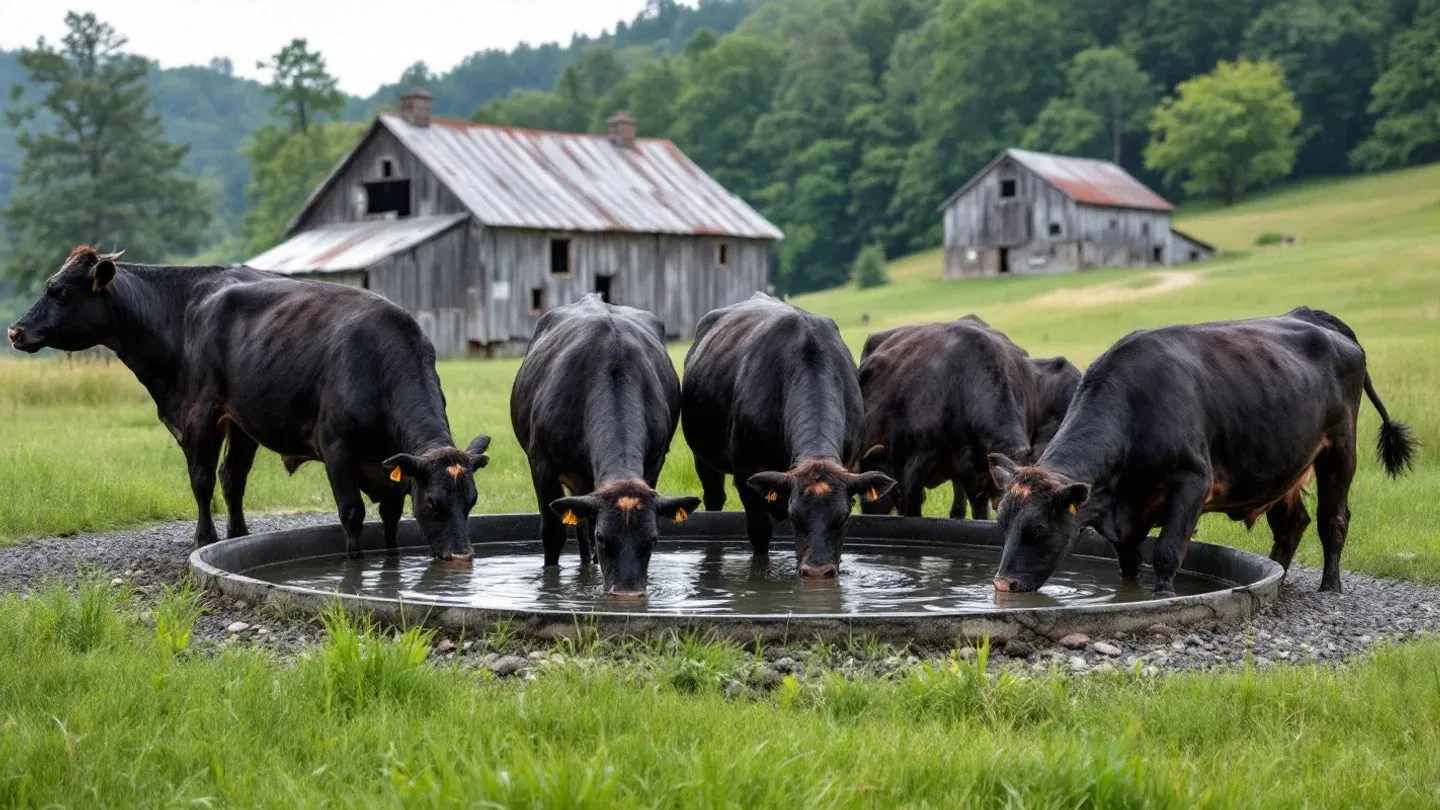
The National Research Council's 2016 beef cattle requirements, as tabulated by Auburn extension, put a 1,300-pound lactating cow at 15 gallons a day at 50 degrees, 20 at 70 and 22 at 90; a 600-pound growing steer goes from 6 gallons to 13 over the same range. Nebraska's planning figure is blunter: above 80 degrees, budget at least 20 gallons per 1,000 pounds of body weight per day, and expect half of it to be wanted inside a two-hour window in the afternoon. That last part is what breaks small systems. A tank that refills slowly from a long poly line may hold the daily total on paper and still run dry at three o'clock with the whole herd standing around it.
Three rules follow. Give enough edge: Nebraska suggests 2 to 4 linear inches of tank space per 1,000 pounds, and ARS cites the Midwest Plan Service figure of 1.5 inches of tank perimeter per head. Keep it cool: ARS reports that intake falls once water temperature passes 80 degrees, and recommends burying lines at least two feet. A black pipe lying on top of the ground in July delivers water nobody wants to drink. Keep it close: Kentucky's shade bulletin notes that once cattle have to walk more than 800 feet to water, grazing gets uneven, with the ground near the tank overgrazed and the far end of the paddock left standing. Lush pasture is up to 80 percent water, as Auburn points out, which is a real contribution in June and a vanishing one once the grass goes dormant in August. Tanks, wells and gravity lines get their own treatment in a later article on livestock water systems. The wider question of how a farm conserves water is one we have been writing about since 2019.
Shade: how much, what kind and where
Kentucky's Shade Options for Grazing Cattle opens with a line worth taking literally: shade is a must for pasture-based grazing systems. The research behind it is specific. University of Kentucky trials with portable shade through the heat of spring and early summer recorded gains of 1.25 pounds a day more for cows, 0.41 for calves and 0.89 for steers. Missouri work found that the biggest effect of shade fell on cattle grazing endophyte-infected fescue, which gained 0.72 pounds a day more with it, and that cows with shade had an 87.5 percent pregnancy rate against 50 percent without.
How much: the optimum is 40 to 70 square feet per mature cow, which the bulletin admits is hard to reach, so it recommends 75 percent of that: 30 to 40 square feet for beef cows, 20 to 25 for 800-pound feeders, 15 to 20 for 400-pound calves. Nebraska's feedlot figure is 20 to 40 square feet per feeder, with the warning that few production benefits are realized when animals are overcrowded under it, and Kentucky adds that cattle packed under shade tend to eat less. Nebraska puts structure height at 7 to 14 feet and sees little gain beyond about 60 percent shade cover.
What kind: cattle prefer trees, and trees cool the air around them as their leaves transpire. The trouble is that trees are rarely where you need them, and a few trees under a big herd get trampled to the roots and die of heart rot. Kentucky's answer for rotational grazing is a portable frame of 2.5-inch pipe on skids, no bigger than 10 by 20 feet, roofed with cloth that cuts light by 80 percent and lasts about five years if it is pulled tight. A 30-cow herd needs 900 to 1,200 square feet, which is five or six of them. Set the structures at least 50 feet from barns or other large obstructions so air moves underneath, orient them north to south so the ground beneath dries as the shadow travels, and shift them before the ground turns to mud. Planting trees on the west side of a pasture buys afternoon shade for the next decade, a job we covered in the hedgerows and windbreaks article. Silvopasture is the long version of the same idea. Makers of portable shade and stock-water equipment are listed in our directory of service providers and manufacturers.
Fescue toxicosis makes a hot day hotter
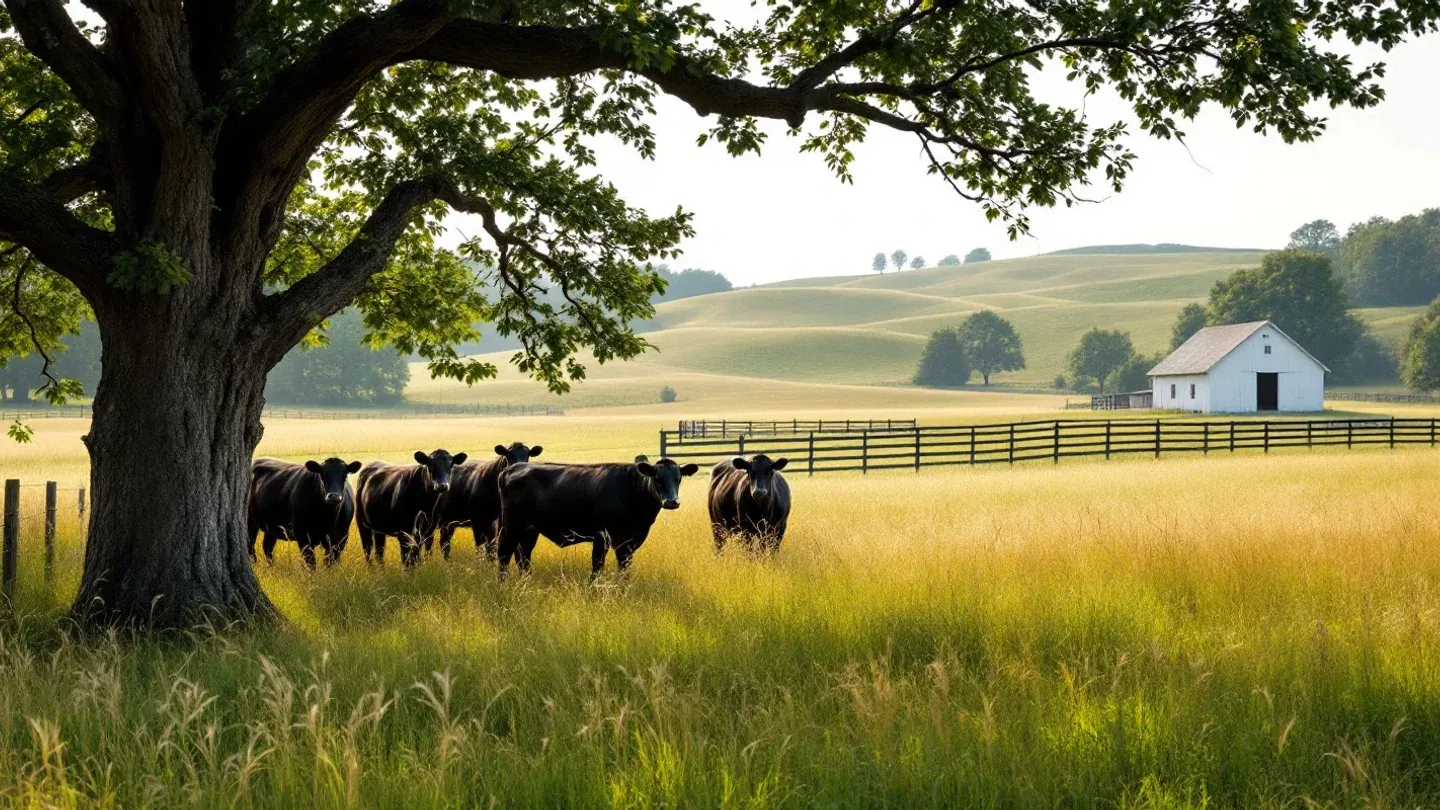
In Kentucky and the humid parts of the eastern United States, where tall fescue is one of the most widely grown pasture grasses, the grass itself is part of the problem. Old stands are frequently infected with an endophyte fungus whose ergot alkaloids, mainly ergovaline, narrow the blood vessels of the animals that eat it. The University of Kentucky's veterinary bulletin on fescue toxicosis describes the summer form plainly: reduced blood flow to the skin that limits the animal's ability to cool itself, plus a dull, rough coat because the winter hair never sheds. Cattle eat less, grow poorly or lose weight, avoid grazing in daylight and spend the day in shade or mud wallows, and conception rates fall. A vasoconstrictive response can show within as little as two days of exposure, and the vessels can stay constricted for six to seven weeks after the cattle are moved off. The shade bulletin estimates that up to 95 percent of the tall fescue pastures there are infected.
The bulletin's management list is the summer grazing plan for anyone on fescue. Ergovaline runs three to ten times higher in seedheads than in leaf blades, so mow them before they mature. Leave the bottom three inches of the plant, because the base of the stem is the other alkaloid store. Interseed legumes such as clover to dilute the dose and lift the quality of the diet. Move cattle onto warm-season grasses in late spring and early summer, when the seedheads are up and fescue sits in its own summer slump. Keep a complete mineral out. And over the long run, renovate the worst paddocks to a novel-endophyte variety, which the bulletin credits with better daily gain, lower body temperatures and sleek coats. Our forage grass guide looks at the alternatives. The fall payoff of fescue, stockpiled for winter grazing, is the subject of our winter feeding article.
Working cattle: early, short, or not at all
Nebraska's rule is simple: handle cattle in the early morning and never after 10 a.m. in summer, after at least six hours of night cooling, and keep them in the pens no longer than 30 minutes. Working raises core temperature by 1 to 4 degrees, and an evening session does not help because the animal is still carrying the afternoon. Ship so that cattle arrive before 7 a.m. Texas A&M adds the rule for the day it goes wrong: if cattle begin open-mouth panting while being worked or moved, stop, release them and call the veterinarian. During an extreme heat event, ARS says it in capitals: do not move animals.
Acclimation is the piece most people forget, and it is what killed the cattle in Kansas two summers ago. In June 2022, the Associated Press reported at least 2,000 feedlot cattle dead in the southwest of the state after temperatures jumped from the 70s and 80s to above 100 within a week, the wind dropped, and many animals had not yet shed their winter coats. The Kansas Livestock Association's spokeswoman put it down to a sudden change that gave the cattle no time to acclimate. Nebraska puts the adaptation rate at roughly one degree a day, about 30 days to adjust from a 50-degree spring to an 80-degree one. The first hot week of the year is the dangerous one, and a cool, wet May followed by a June heat dome is the worst sequence there is. How animals are handled in that week is also a welfare question, which our article on animal welfare on pasture takes up.
A paddock plan for the hottest weeks
Pull up last year's grazing chart and the ARS forecast and plan the summer rotation backward from the heat. Paddocks with trees, a hilltop breeze and a tank within a few hundred feet are reserved for July and August; the open, flat, far-from-water ground gets grazed in June and again in September. Kentucky suggests exactly this: rotate the herd through the naturally shaded paddocks during heat and let those paddocks rest in cooler weather. Slow the rotation if you must, but keep residual height up; the bulletin notes that bare ground reflects more light and heat than thick grass, so a paddock grazed to the dirt radiates it back into the animals standing on it. If you run portable shade, make it part of the move: shade, tank and mineral travel together. This is holistic planning applied to the calendar. It sits well with the grazing principles we set out years ago: decide the moves before the pressure arrives. Portable fencing makes the daily shifts practical, and we give that its own guide in a later article.
Then shift the clock. Heat-stressed cattle graze less in daylight, so a paddock move at 6 a.m. puts fresh grass in front of them in the hours they will actually eat. Nebraska's feedlot advice to deliver most of the ration two to four hours after the afternoon peak is the same logic, and its other lever, trimming the energy content of the ration to cut the metabolic heat load, is a reminder that digestion itself makes heat, so the biggest meal belongs in the coolest hours.
Finally, treat the people the same way. The crew moving fences and checking tanks at noon are under the same sun; our article on protecting farmworkers from heat sets out what a fair farm owes them. Shade and water for the stock, shade and water for the hands. A farm that respects creation does not make either of them wait.
The checklist
- Compute THI from today's forecast and check the ARS map for the week. Mark the alert, danger and emergency days.
- Count breaths on a dozen animals at 3 p.m.: under 90 is normal, 110 to 130 is danger, above 130 is an emergency.
- Budget 20 gallons per 1,000 pounds, half of it in a two-hour afternoon window, and 2 to 4 inches of tank edge per 1,000 pounds.
- Bury or shade water lines; dump and refill any tank that is warm to the hand.
- Provide 30 to 40 square feet of shade per cow, oriented north to south, 50 feet from buildings, moved before it muds.
- On fescue: mow seedheads, leave the bottom three inches, interseed legumes, move to warm-season grass for late spring and early summer.
- Work cattle before 10 a.m., 30 minutes in the pen, and never during an extreme heat event.
- Give new or cool-weather cattle a month to acclimate before the first heat wave.
- Reserve the shaded, well-watered paddocks for the hottest weeks and write that into the grazing chart now.
The herd that comes through August with its weight, its milk and its pregnancies intact is not lucky. Somebody read the forecast on Sunday and moved the shade on Monday. The groups that teach grazing planning and fescue renovation are in our directory of organizations. Thinking long term about trees, water lines and grass varieties is how the next heat dome becomes a routine week instead of a loss.