
Early March is when a lot of first pig projects get decided. The ground is starting to thaw, feeder pigs will be advertised in April and May, and anyone who wants a processor date in October had better call this month. Pigs are also the animal most often oversold to a beginner: they clear brush and turn scraps into bacon, and they also wreck ground, break fences and eat a surprising amount of purchased grain. This is a practical start for a few pigs on pasture or in a woodlot, with the numbers that matter and the rules that catch people out.
The backdrop is a very large industry. USDA counted 75.8 million hogs and pigs on December 1, 2024, with sows saving an average of 11.92 pigs per litter in the fall quarter. The Economic Research Service notes that the number of farms with hogs has fallen by more than 70 percent since 1990, with production concentrated in Iowa, southern Minnesota and eastern North Carolina. A small farm raising pigs outdoors is working against that current. It can be done well, and it starts with the ground.
Start with the ground, not the pig
Susan Kerr's extension guide, published through Oregon State, puts the first rule plainly: "Too many livestock on too little land is the No. 1 mistake made by new and experienced producers alike." She recommends a whole-farm plan before any animal is bought, because carrying capacity differs so much from site to site. Her second rule follows from the pig's digestion: pasture is "a nutritional supplement and playground" for an animal with no rumen, not its main food.
The stocking figures from extension are wide, and the spread is the lesson. Penn State's swine production guide suggests 10 to 12 growing hogs per acre and 4 to 6 gestating sows per acre, depending on soil, plant species and weather. Oregon State's feeder pig guide gives 15 to 34 growing and finishing pigs per acre, depending on pig size and forage. Start at the low end, divide the ground into small paddocks, and move the pigs before the sod is gone rather than on a fixed calendar. Penn State warns that excessive rooting causes erosion and that a balanced ration kept available on pasture reduces it; a perennial pasture is a long-term investment, and the tillage used to establish an annual pasture can also smooth out the field and reduce bacterial and parasite contamination. Our six principles of grazing management apply here too, only with an animal that digs. Done right, pigs leave a paddock with manure spread and compacted spots opened, a fair contribution to healing the soil; done wrong, they leave mud.
Choosing a breed
Kerr's guide notes that heritage breeds such as Tamworth, Large Black, Mangalitsa and Mulefoot are more likely to thrive on pasture than modern commercial composites, and that pastured pigs grow more slowly and reach market weight later, with more variable carcasses.
The Livestock Conservancy's breed pages explain why these animals suit the outdoors. The Large Black was selected in southwestern England for production on pasture and forage, is "best known for their foraging abilities", raises large litters outdoors, and has a black coat that resists sunburn and ears that shield its eyes while it roots. The Tamworth was expected to find its own food, "especially acorns and mast in oak and beech forests", has the legs to walk for it, and has been in this country since 1882; its weakness is summer heat. The Gloucestershire Old Spots was the English orchard pig, raised on whey and windfall fruit, and its sows raise healthy litters on pasture. All three are on the Conservancy's Conservation Priority List, and you will find the Conservancy among the organizations in our directory.
Two cautions from the University of Maine's backyard pig bulletin: crossbred pigs grow faster than purebreds, and heritage breeds need limited feeding so they do not lay down excess back fat. For a first year, buy feeder pigs rather than breeding stock. Maine suggests vaccinated pigs of 25 pounds and up, and a 50-pound piglet reaches 250 pounds in about 100 days on full feed, longer on pasture.
Fencing that holds a pig
Maine advises board or woven-wire fencing for small pigs, which go through gaps you would not believe. Larger pigs can be held by a single strand of electric wire 8 to 10 inches off the ground, but only if they have been trained to it first inside a secure pen; a pig that meets electric fence for the first time in the open will usually push straight through it. Oregon State's guide recommends woven wire or electric netting for pasture, with one or two electric wires near the bottom to discourage rooting under the fence. Kerr adds that the perimeter fence should be predator-proof as well as pig-proof: dogs are the main predator of pastured pigs, coyotes second. Penn State is blunt about the other direction: escaped hogs are one of the causes of the country's growing feral hog problem.
Water and shade
Pigs on pasture drink more than the tables for confinement barns suggest. Maine's watering bulletin puts a finishing pig in a commercial barn at 3 to 5 gallons a day and says pigs on pasture may drink 6 to 8 gallons a head a day, or 8 to 12 on hot days. Short stock tanks work in paddocks, poly tanks are the usual way to haul water out, and nipple waterers need a daily check, because a full reservoir does not prove water is reaching the pig. Penn State says pond water should be avoided and lines should be buried or insulated. In March that still means breaking ice or running a tank heater.
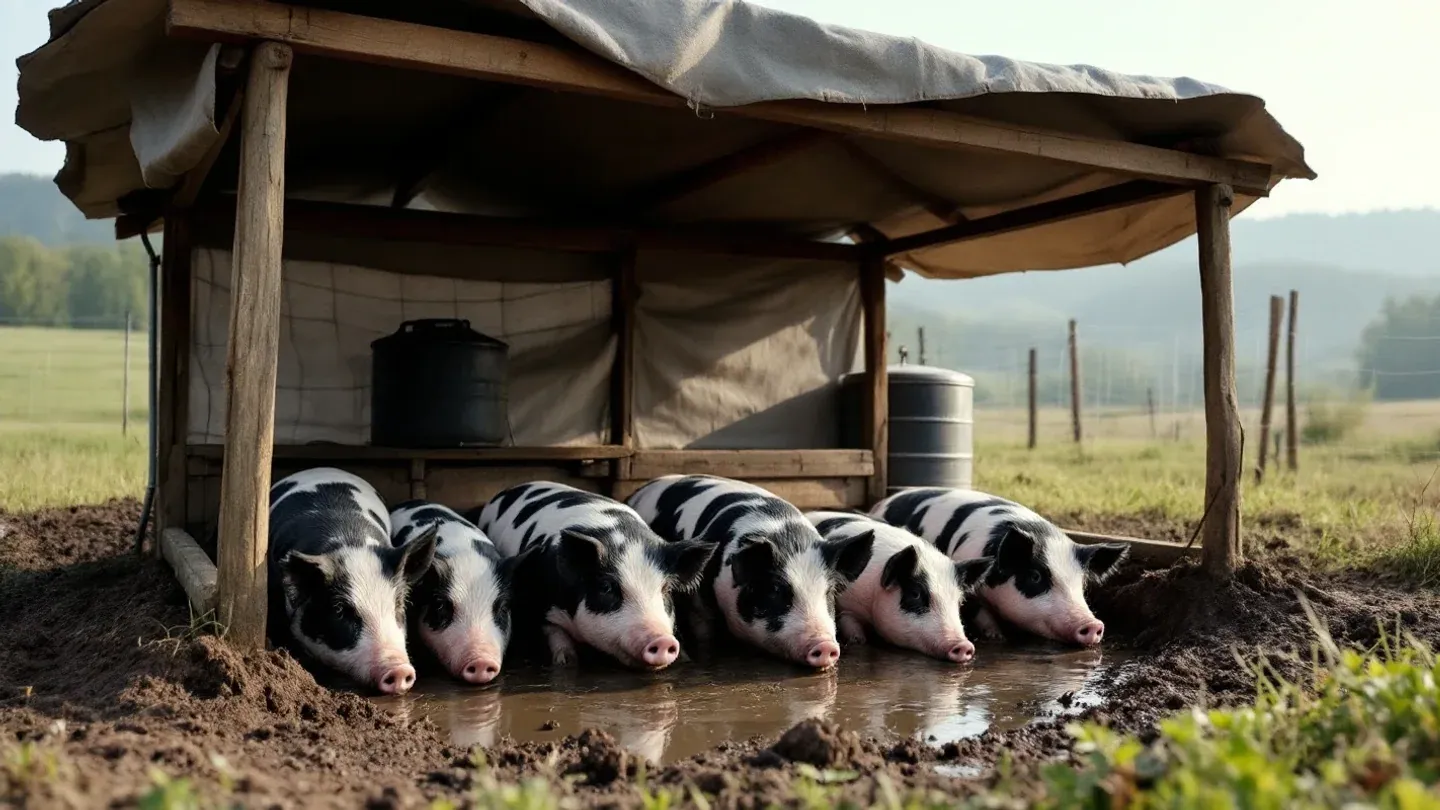
Pigs do not sweat. Kerr's guide calls shade essential, wants wallows shaded so the water and mud stay cooler than the air, and says sunburn risk is reduced by pigmented breeds and access to shade. Cold matters at the other end of the season: Penn State's cold-weather guidance puts a 200-pound finishing pig's comfort range at 50 to 60 degrees Fahrenheit and a suckling piglet's at 85 and above, and notes that cold pigs can need three times the feed or more just to stay warm. Dry bedding, a windbreak at pig height and a roof over the sleeping area are cheap insurance.
Pigs in the woodlot
A woodlot is where pigs look most at home and do the most damage. Cornell's silvopasture resources describe the practice as "the thoughtful integration of trees, forage, and livestock in a managed system", in which forested land is thinned so understory forage can be grazed, by pigs among other animals. Virginia Cooperative Extension stresses that it is not simply letting animals into the woods: a silvopasture is "intentional, intensive, integrated, and interactive", unmanaged access damages trees, mucky conditions under the canopy harbor infectious agents, and rotational grazing is "an essential tool" that stops animals camping in a few spots.
Steve Gabriel's six principles for Cornell are the clearest warning for the species in question. Pigs, he writes, can root and trample desired vegetation and "make a moonscape of your woods or pasture" in a very short time, rotation is non-negotiable, and sensitive ground such as wetlands and healthy, maturing hardwood forests might be best left to their own succession. The practical version: fence small paddocks, keep stays short, move the pigs when the leaf litter is turned and before the roots are bare, keep them off wet ground, fence out the trees you want to keep, and remember that acorn and mast are a season, not a year-round feed. Kerr adds one more woodland hazard: pigs can pick up disease from wildlife carcasses. For the background on trees and animals together, read What Is Silvopasture?. For the wider practice, see What Is Agroforestry?
Feed is the bill that decides it
The romance of pastured pork meets the feed bill in the second month. Kerr's guide states it without softening: pigs "cannot survive on plants alone". Nutritionists used to cap forage at about 10 percent of the diet, and current thinking allows somewhat more; even so, most pasture grasses run 8 to 11 percent crude protein, which cannot even cover maintenance, and you should plan on about half of what is standing in a paddock not being available as feed. Oregon State's figures for a pig on a good diet are 2.5 to 3 pounds of feed per pound of gain, with protein stepping down from 18 percent at 45 to 100 pounds to 13 percent over 150 pounds. Maine's table comes to 700 pounds of grain to take a 40-pound pig to 250. Penn State puts feed at about 65 percent of total expenses in a feeder-to-finish operation and 75 percent in farrow-to-finish, and the ration behind those figures is the one ERS describes for the whole industry: corn and 48 percent soybean meal.
Iowa State's niche pork guidance adds the habits that keep the bill down: feed waste of up to 10 percent is almost undetectable, so set feeders tight and check them twice a day; market at the lower boundary of your target weight, because heavier pigs need more feed for each extra pound; and cull hard, since a sow that raises 12 pigs a year eats almost as much as one that raises 20. Put your own grain price into those numbers before you price a half hog for a customer, and treat the whole enterprise, not the pig, as the unit you manage holistically.
Farrowing: timing the litter to the season
If you do breed, timing is the main tool you have. Penn State's farrowing video gives a gestation of 110 to 117 days for most sows, advises moving sows to a farrowing pen up to ten days before the due date, and lists the essentials at birth: dry the piglets, give them a heat source other than the sow, and make sure every one gets colostrum. Penn State's production guide describes the whole cycle as about ten months, four for breeding and gestation and six to raise the litter to market weight, and advises scheduling farrowings away from peak harvest.
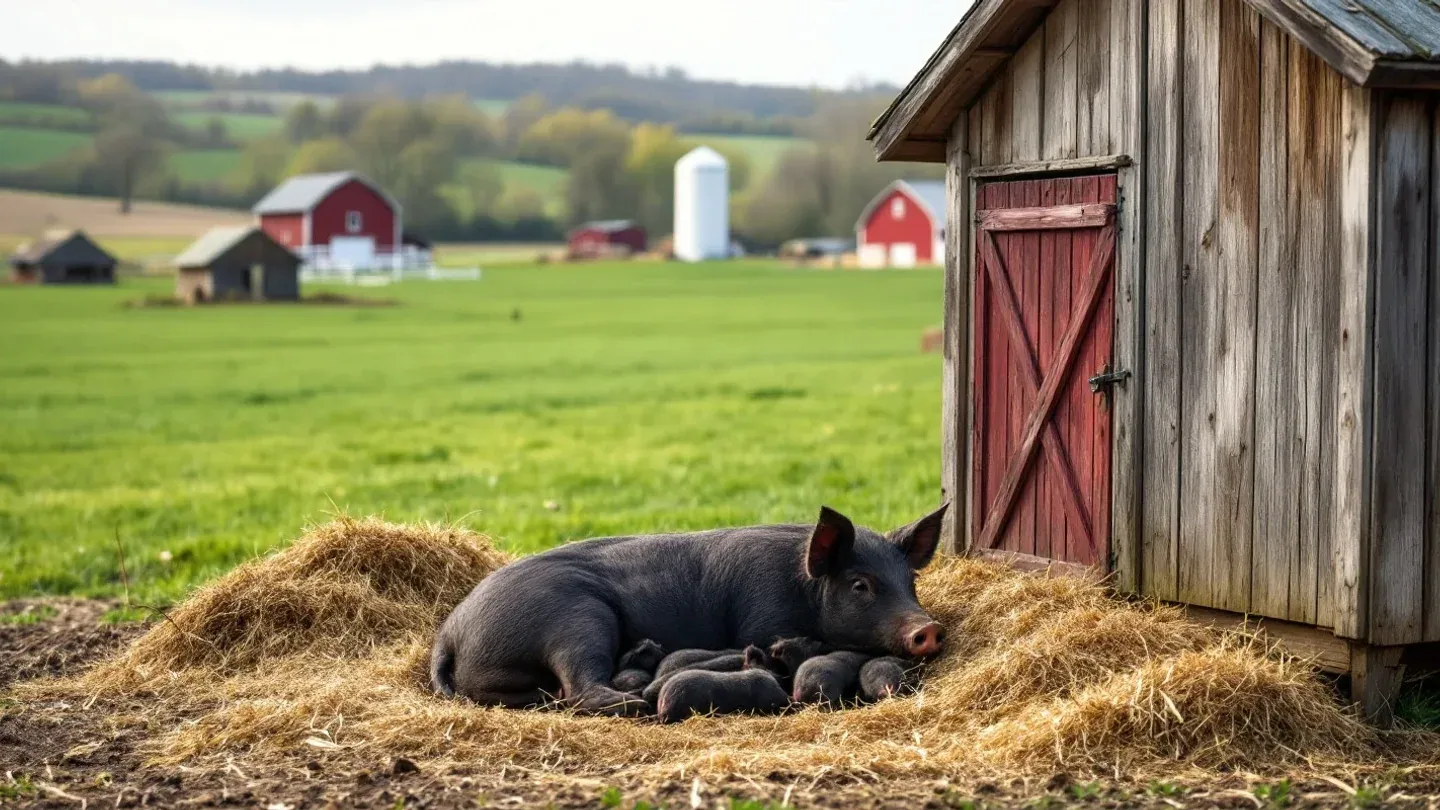
For an outdoor herd the calendar writes itself. Piglets need warmth above 85 degrees, Kerr does not recommend pasture for piglets under 40 pounds, and she notes that sows on pasture probably cannot support the litters of 14 and more seen in confinement. So breed in late winter to farrow in May or June, when nights are warm and grass is growing, or batch the sows so all the litters land in one window, which Iowa State calls critical for a niche producer. Huts, bedding and a quiet eye at farrowing are the welfare standard, and we covered that ground in Animal Welfare on Pasture.
Food waste and the law
Pigs and scraps belong together in the imagination, and there is a federal law in the way. Congress found that raw garbage is one of the primary routes by which contagious swine diseases spread and that African swine fever is "potentially the most dangerous and destructive of all communicable swine diseases"; the Swine Health Protection Act followed. The regulations define garbage as waste derived in whole or in part from meat or other animal material, together with any refuse that has been associated with it, with one exception: ordinary household waste fed to swine on the same premises as the household. Everything else in that category must be heated throughout at boiling, 212 degrees Fahrenheit, for 30 minutes, agitated during cooking, and it may only be fed once it has been treated at a facility holding a valid garbage-treatment license. And the federal rule is the floor: APHIS maintains the list of states that prohibit garbage feeding outright, so your state may ban it entirely.
In practice: the federal rule itself exempts bakery waste, candy waste, eggs and domestic dairy products from the cooking and license requirement, and produce culls or spent grain that have never been mixed with meat or anything that touched it fall outside the definition of garbage altogether. A restaurant's plate scrapings are the textbook case of what must be cooked. The state rule still decides, so call your state animal health official before the first bucket arrives. Maine's bulletin adds the kitchen basics: cook potatoes, dry beans, raw meat and eggs before feeding, and remember that federal rules govern food waste for any meat sold commercially.
Proposition 12 and the farm bill this spring
The timely question for any pork seller in 2025 is California. On May 11, 2023, the Supreme Court in National Pork Producers Council v. Ross upheld Proposition 12, which forbids the in-state sale of whole pork meat from breeding pigs, or their immediate offspring, when the breeding pig was confined in a manner that prevents "lying down, standing up, fully extending [its] limbs, or turning around freely", wherever the pig was raised. The opinions note that California holds about 13 percent of the consumer pork market and produces very little of it, which is why the fight has been about who sets standards for farms in Iowa. A second challenge, from the Iowa Pork Producers Association, was decided by the Ninth Circuit on June 25, 2024, and the law remains in force.
The farm bill is the vehicle for overturning it. The House's 2024 draft, H.R. 8467, carried Section 12007, under which no state may enforce "a condition or standard of production" on products from livestock not physically raised in that state. That bill never became law. Instead the American Relief Act, signed December 21, 2024, extended the 2018 farm bill through September 30, 2025, so the whole argument returns to Congress this year. A farm whose sows live on grass clears California's space standard by a wide margin; the question is whether a pasture farm wants a national rule that strips states of the power to reward it. We laid out the mechanics in The Farm Bill Explained. What the labels on your pork may honestly say is in Honest Labels.
A practical start this season
- Walk the ground in March and decide how many paddocks you can fence and water. Stock at the bottom of the extension range.
- Buy two to four vaccinated feeder pigs in April or May, train them to electric fence in a pen, and move them out when they respect the wire.
- Set up water for 8 gallons a pig a day and shade before the first hot week.
- Price the feed now. Seven hundred pounds of grain per pig at your local price is the number that decides whether the project pays.
- Call the processor this month. Maine's bulletin notes that plants are very busy in the fall, and the half-hog sale works like the half-beef sale. The same inspection line applies, as we described in Local Meat Laws.
- Ask your state animal health official about food waste before you accept any.
- Keep the woodlot for later, after a season of watching what two pigs do to an acre of grass.
Pigs reward a farm that plans in years rather than seasons, which is the habit we call thinking long-term. The farms and ranches in our directory include several that raise pork outdoors; they are the best teachers for what a first season looks like in your part of the country.