
Early April is when a pasture farm is most honest about itself. Calves are on the ground, the grass is just starting, the first warm afternoons are a few weeks out, and every shortcut taken last fall shows. It is also a good moment to talk about welfare, because the law has caught up with the subject in a way it never had before.
Since January 1, 2024, California's Proposition 12 has been fully in force for pork. Massachusetts started enforcing its own confinement law for pork in August 2023. USDA's new organic livestock and poultry standards took effect in January 2024. None of these laws was written with a fifty-cow pasture farm in mind, but all of them define animal welfare in plain terms, and buyers have started using those terms. This article is about what good welfare looks like in a field rather than on a label: how animals are handled, what shade and shelter they need, how they are weaned and hauled, which third-party standards a pasture farm can realistically meet, and what a thoughtful buyer should ask.
Why the law is suddenly interested
Proposition 12 was approved by California voters in 2018. Its text defines "confined in a cruel manner" as confinement that prevents an animal from lying down, standing up, fully extending its limbs or turning around freely, and then puts numbers on it: at least 43 square feet of usable floor space per veal calf, at least 24 square feet per breeding pig after December 31, 2021, and cage-free housing for egg-laying hens from the same date. The law bars the sale in California of whole pork meat, whole veal meat, shell eggs and liquid eggs from animals that do not meet those standards, wherever they were raised.
The pork industry fought it to the Supreme Court, which on May 11, 2023 affirmed the dismissal of the challenge. A California court had held back enforcement for pork while the case was pending. Under the stipulated order of June 16, 2023, that relief expired on July 1, 2023, with one allowance: non-compliant whole pork that was already in the hands of a federally inspected plant, a pork distributor or an end user on that date could still be sold through December 31, 2023. The stipulated injunction terminated at 11:59 p.m. that night. From January 1, 2024, the law applies in full.
Massachusetts passed a near-identical law at the ballot box in 2016, Chapter 333 of the Acts of 2016, with the same definition of cruel confinement and at least 1.5 square feet of usable floor space per hen. The legislature amended it in 2021 to allow 1 square foot per hen in multi-tiered aviaries and to push back the pork provisions, and after a round of litigation those pork provisions took effect on August 24, 2023.
The third change is federal. USDA's Organic Livestock and Poultry Standards, published on November 2, 2023, add rules on handling, transport, slaughter and poultry living conditions to the organic regulations. Certified operations have until January 2, 2025 to comply with most of it; a few poultry housing provisions have until 2029. The rule prohibits tail docking and face branding of cattle, requires that any physical alteration be done at a young age and "in a manner that minimizes stress and pain," and says non-ambulatory or seriously crippled animals must not be transported for sale or slaughter.
For a pasture farm, most of this describes things it already does. The point is different: welfare now has definitions and inspectors attached to it, and a farm that takes respect for creation seriously should be able to describe its practices as clearly as a statute does.
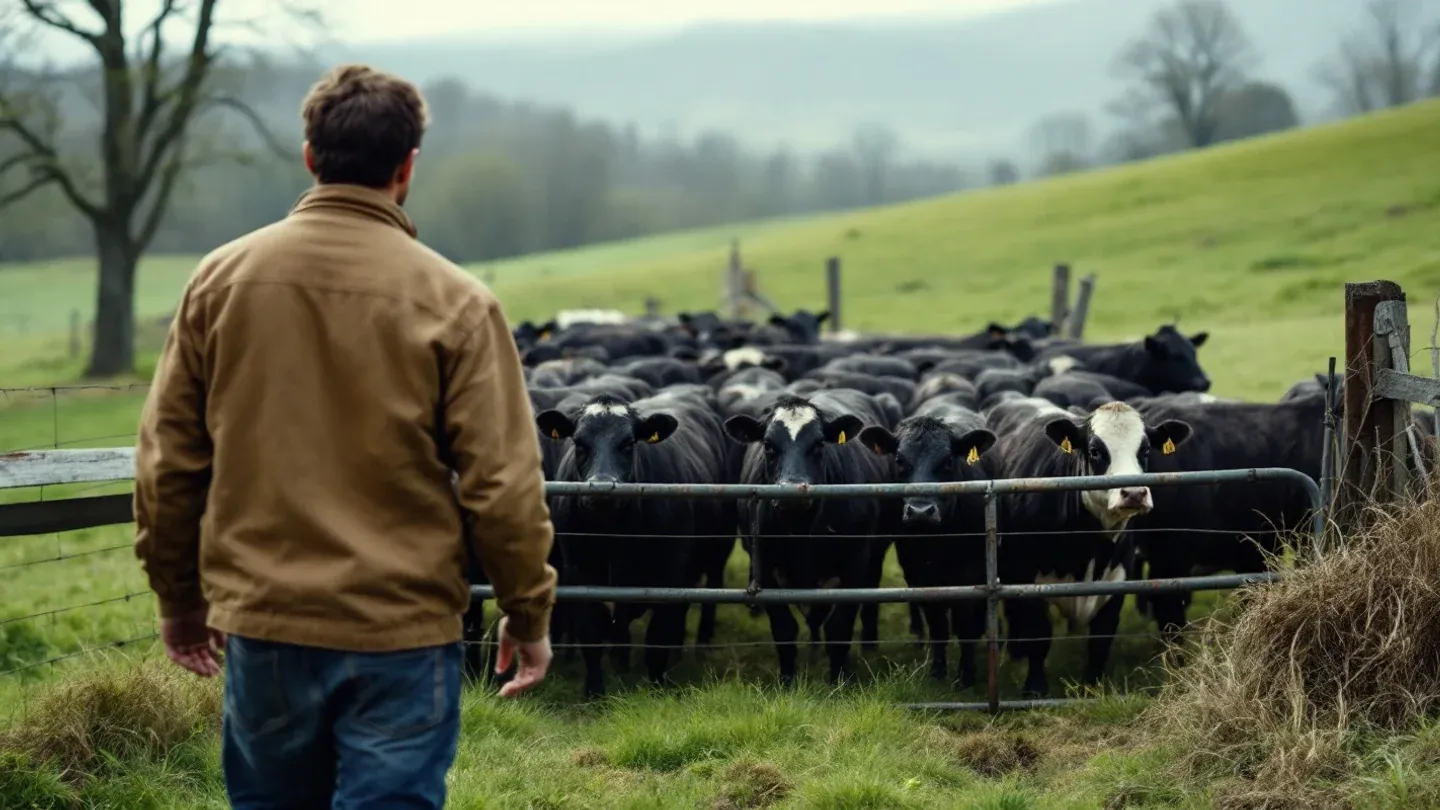
Handling: the flight zone and the point of balance
The most important welfare decision on a pasture farm happens every time somebody opens a gate. Virginia Cooperative Extension's guide to low-stress cattle handling explains the two ideas that make it work. The flight zone is the space around an animal where your presence creates pressure; step in and it moves, step out and it stops. The point of balance sits roughly at the shoulder; walk past it from front to back and the animal moves forward, stand ahead of it and the animal backs up. Pressure, then release, is how cattle learn. The guide's benefit list is long and specific: better safety for people and animals, better immune response to vaccines, better weight gain, better carcass quality and better reproductive performance, each tied to published studies.
Temple Grandin's flight zone page adds the rules of thumb that save the most trouble. Fill a crowd pen only half full. If animals are moving through the alley on their own, leave them alone. Never hit an animal that rears in the chute; back away. Yelling and high-pitched noise are highly stressful, and an excited herd needs 20 to 30 minutes to settle before it will work calmly again. The flight zone shrinks when a handler spends quiet time walking through the herd on days when nothing is being asked of it.
This is why rotational grazing and good welfare go together. A herd moved to fresh grass every day or two sees a person as the signal for something good. The daily moves described in our post on grazing management principles are handling practice. Being consistent with the same quiet routine, the same gate, the same call, does more for welfare than any piece of equipment.
The cattle industry's Beef Quality Assurance program covers cattle handling, facility management and transportation and offers online certification, including courses for people who haul cattle. For a small farm it is a recognized way to show a buyer that the people moving the animals have been trained.
Shade, water and shelter
Shade is where good intentions most often fall short, because an open pasture with one tree in the corner looks fine in April and is a heat problem by July. The University of Kentucky's Shade Options for Grazing Cattle puts numbers on it. The optimum is roughly 40 to 70 square feet of shade per mature cow, which the authors admit is hard to reach, so they recommend a practical 75 percent: 30 to 40 square feet per beef cow, 40 to 50 per dairy cow, 20 to 25 for an 800-pound feeder and 15 to 20 for a 400-pound calf. A 30-cow beef herd needs 900 to 1,200 square feet of shade, or five to six portable 10 by 20 foot shade structures, set at least 50 feet from buildings so air can move underneath. Portable shade on skids moves with the herd and spreads the manure instead of concentrating it.
Water goes with shade. Penn State Extension notes that dairy cattle drink 20 to 35 percent more in hot weather and recommends 3.5 to 4 inches of tank perimeter per cow, with access around the clock on pasture. A trough that works for thirty animals in May will not keep up in August. Trees are the cheapest shade a farm can own, which is one of the quiet arguments for silvopasture.
Winter shelter is simpler than people assume. Cattle and sheep do not need a barn; they need a dry place to lie, a windbreak and feed. The organic living-conditions rule, 7 CFR 205.239, is a fair benchmark for any farm: year-round access to the outdoors, shade and shelter, with shelter that gives animals room to lie down, turn around, stand up and stretch, suitable ventilation, and bedding that keeps them clean and dry. The same rule allows temporary confinement in bad weather and to protect soil and water, which is the right answer to a saturated March pasture. Our post on winter feeding and bale grazing covers the feeding side.
Weaning without the bawling
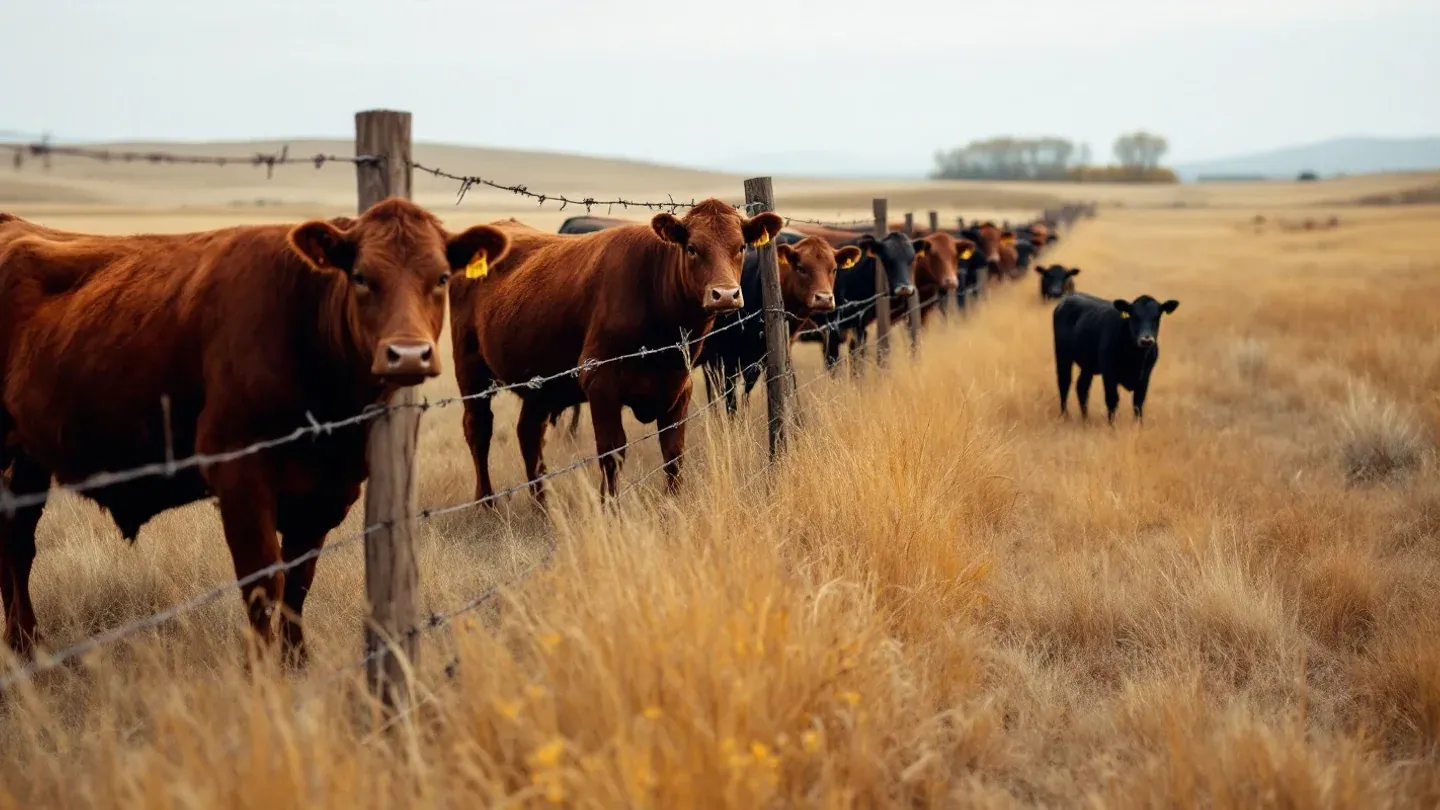
Abrupt weaning, where calves are loaded and hauled away from their mothers in a single morning, is the loudest day of the year on a cow-calf farm and the hardest on the animals. South Dakota State University Extension describes two low-stress alternatives. Fenceline weaning keeps cows and calves in adjacent pastures where they can see, hear and smell each other but cannot nurse; nutritional separation takes about three to seven days. Two-step weaning puts a plastic nose tag that stops the calf nursing in place for four to seven days while it stays with its mother, then removes the tag and separates them.
The research matters here because it answers the economic objection. In a Utah study cited by SDSU, fenceline-weaned calves vocalized less, spent more time eating and gained more weight than abruptly weaned calves, and the gain advantage held for ten weeks. In SDSU's own trial, abruptly weaned calves lost about 2.4 pounds a day for the first week after separation while fenceline calves held their weight. The practical rule is to put the pairs into the pasture the calves will stay in before weaning, so the calves learn the fences and the water before their mothers leave.
Weaning is also the moment when welfare and holistic management meet. A calving season timed to the grass means calves are weaned onto good forage, not onto a feed bill, and a farm that handles its weaning quietly has far fewer sick calves to treat, which is the best argument there is for keeping antibiotics out of routine use.
Transport: the day everything can go wrong
An animal raised well for two years can have its worst day in the last four hours. Federal law sets only an outer limit: the Twenty-Eight Hour Law says animals may not be confined in a vehicle for more than 28 consecutive hours without being unloaded for at least five hours of feed, water and rest, extendable to 36 hours at the owner's written request. No pasture farm should be anywhere near that line. The new organic rule treats eight hours, measured from the time all animals are loaded until the truck arrives, as the point at which a farm must explain how it will maintain welfare on the road.
The practical standard is shorter and stricter. Haul early in the morning in summer. Load calmly, using the same flight-zone principles as in the pen. Never haul an animal that cannot walk on and off the trailer on its own. Know the processor's unloading procedure and holding pens, and if the nearest plant is three hours away, that distance is part of your welfare record whether or not a label mentions it. The small-plant shortage we wrote about in how fragile our meat production system is is a welfare problem as much as a business one.
Honest standards: which label fits a pasture farm
On a USDA-inspected meat label, a claim about how animals were raised is not free speech. Under 9 CFR 412.1, claims "regarding the raising of animals" are special statements, and a label that carries one has to be submitted to FSIS for approval before it is used. A third-party certificate is the simplest paperwork a farm can put behind such a claim, which is why the certifiers matter even to a farm that sells every animal by the half. The main ones a pasture farm can realistically meet:
Certified Animal Welfare Approved by A Greener World requires animals to be raised outdoors on pasture or range for their entire lives on an independent farm, audits every farm at least once a year, and describes itself as the only US label that also audits transport and slaughter. It was written for exactly the kind of farm this article is about.
Certified Humane, run by the nonprofit Humane Farm Animal Care since 2003, keeps farms on the program through annual audits, requires that animals are not overcrowded, requires trained handlers who understand the animals' needs and, for grazing animals, rotational grazing that moves them to fresh areas of pasture.
Global Animal Partnership uses a tiered label in which the higher the number, the more the animal's environment resembles a natural one. Its standards cover beef cattle, pigs, sheep, goats, bison, chickens, laying hens and turkeys, and a farm is certified only after it passes an audit by a third-party certifier.
The American Grassfed Association standard is a diet and welfare standard in one: grass and forage only from weaning to harvest, grazing on pasture with confinement allowed only in emergencies and for handling, no antibiotics or added hormones, animals born and raised in the United States, and independent inspection at least every 15 months.
USDA organic, under 7 CFR 205.240, requires that ruminants get at least 30 percent of their dry matter intake from grazing over the grazing season, and with the new rule it now carries handling and transport standards too.
Which one fits depends on where the meat goes. A farm selling bundles and halves to neighbors may never need a seal, but the standards are the best free checklists in the business, and the certifier directories in our organizations list are the place to start. We compared the diet and marketing claims in detail in Honest Labels: Grass-Fed, Pasture-Raised and Regenerative.
What a buyer should ask
A buyer, whether a household or a restaurant, does not need a certificate to judge welfare. Six questions do most of the work. Where are the animals on a July afternoon, and how much shade is there? How are they moved, and by whom? How are calves or lambs weaned? How far is the processor, and who hauls? What happens to a sick animal, and how is it recorded? Can I come and see?
A farm with good answers will usually offer the visit before you ask. Our farms and ranches directory lists operations that open their gates, and buying from one of them is the most direct form of acting locally there is.
A practical close
For the farm, welfare is a season-by-season list rather than a philosophy. This spring: walk the herd on quiet days until the flight zone is small. Count your shade in square feet against the Kentucky figures and order or build what is missing before June. Check that water capacity will hold at a third more consumption. Plan fenceline weaning now, including which fence needs an offset hot wire. Book the processor and plan the haul for a cool morning. Read one certifier's standard end to end, even if you never apply, and fix the two things it would fail you on. Then write it all down, because the next buyer who asks will want to see it.