
Two pieces of news landed in the same week. On Wednesday, July 31, USDA said it had sent $2 billion to more than 43,000 farmers, ranchers and forest landowners who experienced discrimination in its own farm lending programs. On Friday, August 2, the National Agricultural Statistics Service reported that the average acre of US farm real estate is now worth $4,170, up 5 percent in a year.
Put the two together and you have the oldest question in American agriculture: who gets to farm? The answer has always depended on two things, land and credit, and for most of the last century the federal agency that controlled the credit did not hand it out fairly. This article walks through how that happened, what the July payments do and do not fix, why land is the hard part for every new farmer now, which programs open a door, and what a settled farm can do about it on its own road.
How the ledger got this lopsided
Black land ownership in the United States peaked around 1910. A 2022 paper in the American Economic Association's Papers and Proceedings, using Census of Agriculture data, finds that it then fell by nearly 90 percent between 1910 and 1997, and puts the compounded present value of the land lost between 1920 and 1997 at roughly $326 billion. In acres, the Farmland Access Legal Toolkit at Vermont Law and Graduate School counts the land Black farmers operated as almost 16 million acres in 1910 and under 3 million in 2017.
A good share of that loss ran through the county offices of USDA's lending agencies. The Congressional Research Service's summary of the Pigford litigation records that USDA's Civil Rights Office was closed in 1983 and that a backlog of unanswered discrimination complaints built up for more than a decade. Black farmers who applied for operating loans reported being denied, being made to wait past planting, or being offered worse terms than their white neighbors. Lawsuits filed in August 1997 ended in a consent decree on April 14, 1999. Under the main track of that settlement, 22,551 claims were decided and 15,645 were approved; across both tracks the government paid out about $1.06 billion in cash, tax payments and debt relief. About 73,800 more people filed late and almost none of them were heard, which is why the 2008 farm bill reopened the case and why Congress passed the Claims Resolution Act of 2010 to fund a second settlement of $1.25 billion.
That is the history behind last week's announcement. It is not ancient. A farmer who was turned away in 1990 may still be farming today, or may have a child who is not farming because of it.
What the July payments are, and are not
Congress tried a repair in March 2021. Section 1005 of the American Rescue Plan Act directed USDA to pay up to 120 percent of the outstanding FSA loan balances of socially disadvantaged farmers as of January 1, 2021. Seventeen months later, in August 2022, the Inflation Reduction Act repealed Section 1005 outright in its Section 22008 and wrote two replacements.
Section 22006 set aside $3.1 billion for distressed FSA borrowers of any background whose operations are at financial risk. Section 22007 appropriated $2.2 billion for a program to help farmers, ranchers and forest landowners who experienced discrimination in USDA farm lending before January 1, 2021, capped at $500,000 per person and run through outside administrators. The same section put $250 million into land access grants and loans, including for heirs' property, and $125 million into outreach and technical assistance for underserved producers. Readers who followed our earlier look at the Inflation Reduction Act will remember that the conservation money got most of the attention; these sections were the quieter half.
The result is the Discrimination Financial Assistance Program, listed in the federal inventory as program 10.984. According to the University of Illinois summary of the July 31 announcement, more than 23,000 people who farm or used to farm received between $10,000 and $500,000, averaging close to $82,000, and about 20,000 people who were kept from starting a farm by a loan denial received between $3,500 and $6,000. Mississippi and Alabama alone account for more than 24,000 recipients. Secretary Vilsack described the payments as an acknowledgment rather than compensation, and gave the examples that recur in the claims: higher interest rates, loans approved too late in the season, loan officers who would not help.
Judge that honestly. An average of $82,000 does not buy back a farm that was lost to foreclosure in 1985, and $5,000 does not start one in 2024. What the program does is put USDA's name on the record, pay something to people who are still alive to receive it, and close a chapter that stayed open for forty years. That is worth something. It is also where the backward-looking part ends and the forward-looking part has to begin.
Why land is the hard part now
Start with the 2022 Census of Agriculture, published in February. The country has 1.9 million farms, down from 2.04 million in 2017, on 880 million acres. The 3.4 million people who run them average 58.1 years old. The number of producers aged 65 and over rose 12 percent in five years, while the number aged 35 to 64 fell 9 percent. Just over a million producers have been farming for ten years or less, and their average age is 47.1. Ninety-five percent of all producers are white.
Now look at who owns the ground. USDA's Economic Research Service reports that roughly 39 percent of farmland is rented, a share that has sat between 38 and 43 percent since 1969. More than half of cropland is rented, against about a quarter of pasture. Eighty percent of rented land belongs to landlords who do not farm at all, many of them retired farmers or people who never farmed. Land does change hands, but rarely on the open market: of the 93 million acres that owners expected to transfer between 2015 and 2019, only 21 million were expected to be sold to someone outside the family. The rest moved by will, trust, gift or a sale between relatives.
Then price it. Friday's report put cropland at $5,570 an acre and pasture at $1,830, both up around 5 percent from 2023. A modest 80-acre pasture farm at the national average now carries a land price of roughly $146,000 before a fence post or a cow. In the Northeast and the Southeast, where pasture averages $4,670 and $5,510 an acre, the same farm costs more than two and a half times that. The National Young Farmers Coalition's 2022 survey of more than 10,000 young farmers found that 59 percent called finding affordable land to buy very or extremely challenging, up from 39 percent five years earlier. Seventy-eight percent of those respondents were first generation, which means no family ground, no family equipment and no family lender who already knows their name.
So the barrier is not only historical. Anyone starting from zero in 2024 faces it. The history explains why the starting lines are so far apart; the economics explain why the gap is not closing on its own.
Heirs' property: the quiet land loss
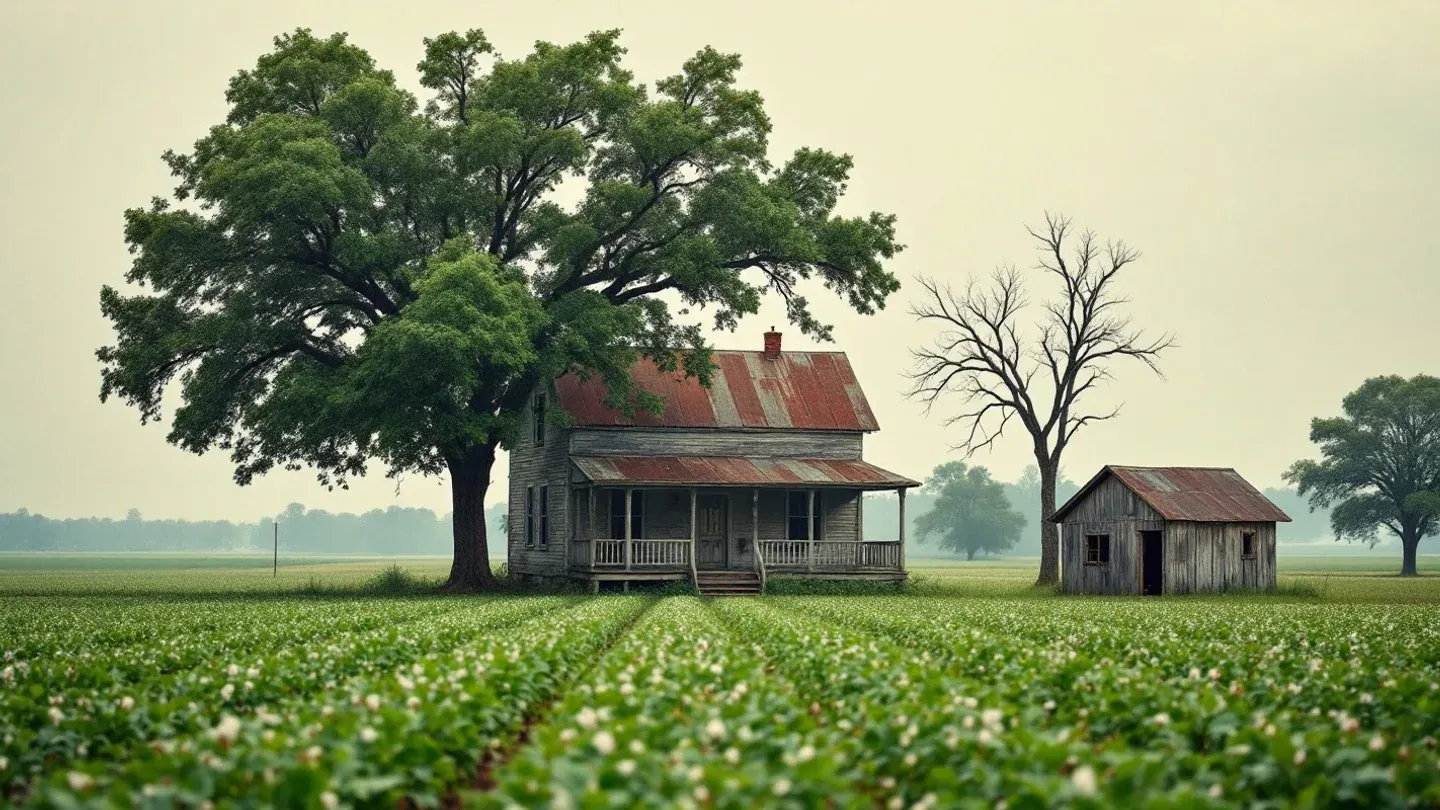
There is one more mechanism that deserves its own section because it is still taking land today. When a landowner dies without a will, or with a will that leaves the farm to several children without a clean transfer, the land becomes heirs' property: every descendant holds an undivided share, the deed stays in the ancestor's name, and the family has what lawyers call cloudy title. The Farmland Access Legal Toolkit explains the consequences plainly. Nobody can use the land as collateral. Everyone has to agree before a lease or a timber sale. And any single heir, or anyone who buys a single heir's share, can file for partition, after which a court may order the whole farm sold at auction for a fraction of its value.
Two fixes exist. The Uniform Partition of Heirs Property Act, a model law finished in 2010, gives co-owners the right to buy out a partition plaintiff at appraised value and pushes courts toward dividing land rather than selling it; a growing list of states has adopted it. And the 2018 farm bill told USDA to let heirs' property operators establish a farm number with alternative documentation, which is the key to loans, disaster aid and conservation programs. The same bill created the Heirs' Property Relending Program, under which FSA lends up to $5 million at 1 percent to cooperatives, credit unions and nonprofit lenders, who relend it to families to clear title, buy out heirs and settle succession. USDA approved the first three lenders in August 2022: a lender serving Indian Country nationwide, the Cherokee Nation's economic development trust in Oklahoma, and a cooperative lender covering six Southern states in partnership with the Federation of Southern Cooperatives.
If your own farm is held in an ancestor's name, this is the single most valuable paperwork you can do this year. If a neighbor's is, this is the single most valuable introduction you can make.
The programs that open a door
None of what follows erases the gap. Each one narrows it for a particular person at a particular moment.
Beginning farmer loan funds. FSA defines a beginning farmer as someone who has operated a farm for 10 years or less and, for ownership loans, owns no more than 30 percent of the average farm size in the county. Every year the agency sets aside a slice of its loan funds for them. The down payment loan is the piece built for a first purchase: 5 percent down from the buyer, 45 percent from FSA up to $300,150, the rest from a bank or the seller. We walked through the arithmetic in our guide to FSA microloans and beginning farmer loans.
USDA inventory land. When FSA takes back a farm, it sells the property, and beginning farmers get first priority to buy at appraised value. The same page is candid that USDA does not give grants to buy land.
The Transition Incentives Program. A landowner whose Conservation Reserve Program contract has two years or less to run can earn up to two extra annual rental payments by selling or leasing the ground for at least five years to a beginning or veteran farmer who is not a family member. The new operator must keep the conservation practices in place and may enroll in EQIP or CSP, which we cover in our conservation payments explainer.
Land access grants. In June 2023 USDA selected 50 projects for roughly $300 million under the Increasing Land, Capital and Market Access Program, funded by the Section 22007 money described above. The projects, spread across 40 states and territories, run through local organizations and are aimed at farm ownership opportunities, heirs' property and fractionated land, access to capital and markets, succession and business planning. That is the way to reach this money, through a local partner rather than a federal form, and our organizations directory is a place to start looking for one.
Training and mentoring. The Beginning Farmer and Rancher Development Program at NIFA funds networks of extension offices, colleges and community organizations to train new farmers. For the farmer, the practical point is that a documented mentorship counts: under FSA's own rule, an established relationship with an approved mentor can replace part of the three years of experience an ownership loan requires.
What a settled farm can do
Policy moves at the pace of Congress. A farm that already has its land moves at the pace of a conversation over a fence. Here is what we have seen work, and what the law supports.
Lease a piece. A five-year written lease on twenty acres you are not using well is the most direct land access program in existence, and you write it. Put the term, the rent, the conservation obligations and the exit in writing from day one; the Farmland Access Legal Toolkit's collaborative farming page is blunt that informal collaboration offers little security, and that calling someone a partner without a formal entity can make you a general partnership by default, liable for the other partner's debts. If you do not know a farmer who needs ground, the Farm Link Finder is a nationwide directory of the programs that match landowners with farmers looking for ground. We will go deeper on lease terms and land trusts in a later article on land access.
Mentor on the record. A season of real responsibility on your farm, documented, is worth more to a loan officer than any course. Pay for the work; a mentorship is not a free labor scheme, and we have written about what a fair farm owes its crew. Then write the letter that describes what the person managed, and sign it. That letter is the document FSA reads.
Share the iron. A new farm cannot justify a no-till drill, a bale wrapper or a walk-in cooler on twenty acres; an established one often has those sitting idle half the year. The toolkit's warning is fair: shared equipment takes the wear of many hands, some of them inexperienced, so put an hourly rate, a maintenance rule and a damage clause on paper. A short written agreement keeps the friendship intact when the hydraulic line blows.
Plan your own succession early. A farm that ends in heirs' property or a distant buyer is a farm that leaves the community. Thinking through who takes the farm next while you are healthy is as much a gift to your county as to your children. We hold that nurturing families includes the family that farms next door and the one that would like to.
Show up. County FSA committees are elected by local farmers and decide a great deal about who gets served well. The history above happened in county offices. Being involved in yours is not a formality.
Where to start this month
- If any land you farm sits in a deceased relative's name, call your FSA office about a farm number and ask about the relending program lenders in your state.
- If you have idle acres, draft a five-year lease and list them with your state's farm link program before fall planting decisions are made.
- If you have a CRP contract expiring in 2025 or 2026, ask FSA about the Transition Incentives Program now; the sale or lease has to be in place before the contract ends.
- If you employed a new farmer this season, write the experience letter before the details fade.
- If you are the new farmer, read the beginning farmer loan page, find a mentor through the people and organizations in our directory, and start the records that a loan application will ask for in three years.
We have argued for years that small farms matter. The local food economy is built one local relationship at a time. A fairer start is not a transfer from Washington; it is a settled farm deciding that the next one in should have an easier road than it did. The payments of July 31 close a long account. The rest of the ledger is written locally, and it is written by people who already have land.