
Hay is the expense that decides whether a grass-fed herd makes money, and this fall it is scarce. Hay stored on US farms on December 1, 2022 came to 71.9 million tons, the lowest December 1 figure since 1954, and by May 1, 2023 stocks had fallen to 14.5 million tons, the second lowest May total since records began in 1950. In Iowa, where the barn was down 47 percent on the year, the August all-hay price averaged $161 a ton, $14 above a year earlier, and that is before winter buying starts.
The summer did not refill the barn everywhere. On the US Drought Monitor map for October 10, the latest as we write, 40 percent of the Lower 48 is in moderate drought or worse. The state figures are harsher where the cows are: 96 percent of Iowa, 74 percent of Wisconsin, 73 percent of Minnesota, 67 percent of Kansas, 60 percent of Missouri and 75 percent of Texas, where more than a quarter of the state sits in extreme or exceptional drought.
So the question for a cow-calf or grass-finishing operation this month is not whether to buy hay. It is how little hay you can get away with, and how much of what you feed ends up in the cow instead of the mud. Two old practices answer that better than anything we know: stockpiling and bale grazing. Here is how they work, with the numbers you need to plan.
Stockpiling: let the fall growth stand
Stockpiling means closing a pasture in late summer and letting the growth accumulate so cattle can graze it standing in November, December and January. Tall fescue is the stockpiling grass of the eastern half of the country because its waxy leaf cuticle resists frost damage. Kentucky's Master Grazer program notes that it holds more crude protein and total digestible nutrients than fescue hay, and that its protein and digestibility decline slowly compared with other forages.
The recipe is simple. In early to mid August, graze or clip the field to 3 to 4 inches, pull the cattle off, and apply 40 to 80 pounds of nitrogen per acre on the strength of a soil test. Mississippi State's guidance allows a start as late as September, with 40 to 60 pounds of nitrogen 60 to 70 days before the end of the growing season; ammonium nitrate outperforms urea in the fall, and nitrogen spread on a hot, wet day loses part of its value. If you are reading this in October, the window for this year has closed in most of the country, but a thick stand rested since August is still worth a great deal in December. Put the date in next year's calendar now.
Expect the stand to lose about 25 to 30 percent of its dry matter over the winter whatever you do, and expect the stockpile to carry the herd 50 to 60 days depending on the start date, the fertilizer rate and the rain. On toxic endophyte fescue, late winter is also the safest season: Mississippi State reports that the toxin levels can fall by up to half by January, and cites a study that found an 85 percent reduction from October to March.
Other forages can be stockpiled too, and the sensible order is the one both Kentucky and Mississippi State give: graze corn, soybean or milo residue and the other stockpiles first, and save the fescue, which holds its quality longest, for the depth of winter. Our overview of the best forage grasses for cattle covers which species suit which region.
Strip grazing the stockpile
How you take the stockpile matters as much as how you grew it. Turn the herd onto the whole field and, by Mississippi State's estimate, uncontrolled grazing wastes about 50 to 60 percent of the forage to trampling and manure. A single strand of temporary electric wire changes that. Allocate a three-day or seven-day supply at a time, start with the strip that includes the water and the mineral feeder, and move the wire when the strip is grazed to open the next one, until the field is done. The same high stock density and short moves that make rotational grazing work in summer make a stockpile last in winter.
Keep hay on hand anyway. Kentucky's reminder is that snow or ice cover can limit access to the stockpile, and the hay you saved by stockpiling is the hay that covers those days.
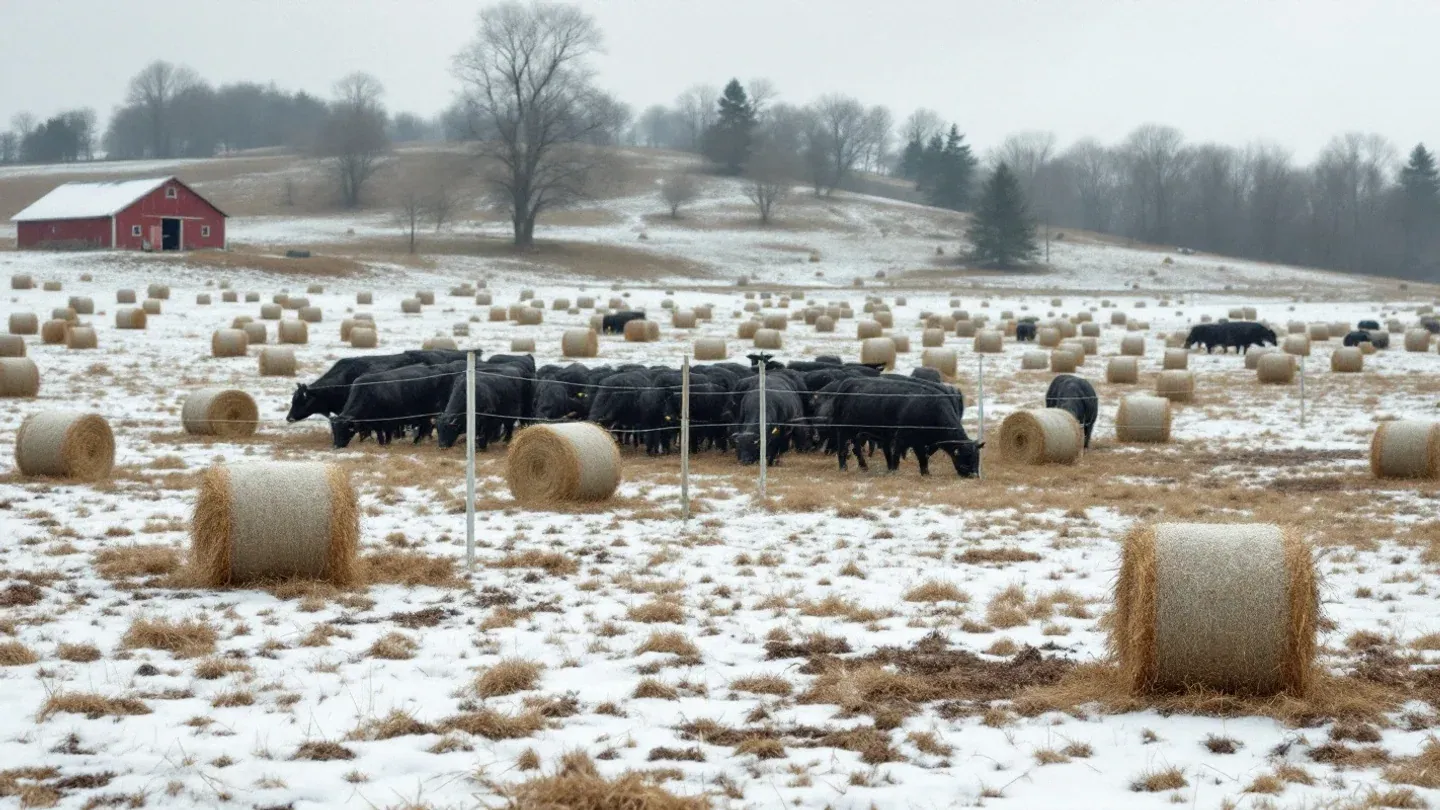
Bale grazing: feeding the soil while you feed the cow
Bale grazing sets the winter's round bales out on pasture in the fall, in a grid, before the ground turns to soup, and then rations them with a poly wire and a moveable bale ring. The cattle move through the grid over the winter; the tractor stays in the shed. The University of Wisconsin's guide, published in January 2023, describes the layout: bales 25 to 50 feet on center, set on edge so they shed rain and snow, net wrap and twine removed, a single poly wire on fiberglass posts pushed into the sides of the bales because ordinary temporary posts will not go into frozen ground, and a frost-free water source on a well-drained high spot as the prerequisite for the whole system. North Dakota State's winter feeding guide puts the usual spacing at 20 to 25 feet and notes that pulling the twine helps cattle eat the bale evenly and cuts waste.
The reason to do this instead of feeding in a lot is what happens to the manure. In a barnyard you scrape it, pile it, haul it and lose nutrients at every step. Under a bale, the cow spreads it herself, and the Wisconsin guide points out that the nitrogen and potassium carried mostly in urine go straight into the sod instead of into a pile. The guide's yield chart, drawn from a Saskatchewan trial (Jungnitsch, 2008), shows more forage the following season on bale-grazed ground than on ground that got mechanically spread manure, and more on both than on the untreated check. Wisconsin's authors credit the hay residue and the hoof action as much as the manure, which is a fair reminder that a winter of bale grazing is one tool to heal the soil, not the whole program.
A few cautions from the Wisconsin guide. Put the grid where the soil test says fertility is needed most, stay 300 feet from streams and 1,000 feet from lakes and ponds, and keep out of concentrated flow channels and the low spots that pond and turn to mud. Secure good hay for it, since the cows will be eating it outdoors in January, and budget 10 percent of every bale for waste. The residual hay left behind when the ring moves becomes bedding; spread the mounds by hand or you will find them in spring. And watch body condition through the winter, because the cow, not the grid, is the measure of whether it is working.
Making it work east of the Plains
Most of what is written about bale grazing comes from the Northern Plains and the Canadian prairies: North Dakota State's guide was written for North Dakota winters, and the Wisconsin yield data come from Saskatchewan. Frozen ground is the normal condition there, and in Wisconsin too: the guide assumes it when it tells you that step-in posts will not go in. East of the Plains the winter is a cycle of freeze, thaw and rain, and a grid that works on frozen ground can pug a wet pasture. Three things keep that in check. The first is the sod: Mississippi State notes that tall fescue resists trampling damage even on wet winter soils, so a thick fescue field is the place to start. The second is the site: a high, well-drained field, never the low spot that ponds, with the bales set out in October while the ground is still firm, as the Wisconsin guide advises. The third is the wire: ration the bales a few at a time and move the fence forward onto ground no hoof has touched since fall, so the herd spends its days on a clean, dry strip instead of wandering a wet field. Setting out the winter's hay before the ground goes soft, then moving a wire and a ring for the rest of the season, is winter feeding at its simplest, and that simplicity is the point; it is why always simplify sits among our beliefs.
The hay budget
Whichever method you use, write the budget before the first hard freeze. Nebraska Extension's rule of thumb is that a dry cow eats about 1.8 percent of her body weight in dry matter on low-quality forage and 2.0 to 2.1 percent on average hay; a lactating cow eats 2.0 to 2.3 percent. Their worked example: a 1,200-pound lactating cow on 55 percent TDN hay needs about 28 pounds of dry matter, which is 32 pounds of hay as fed at 88 percent dry matter, so 200 cows go through 3.2 tons a day before any waste.
Wisconsin's shortcut for bale grazing is handier at the kitchen table. A typical 4 by 5 round bale holds about 765 pounds of dry matter. Add 20 percent for the extra energy cattle burn outdoors in winter and 10 percent for waste, and one bale feeds one cow for about 20 days. Count your cows, count the days from the end of the stockpile to green-up, and you have the bale count. Then test the hay. The Oklahoma trials below fed a protein pellet alongside 5.5 percent protein prairie hay for a reason, and no number of bales fixes a protein gap.
Feeders and waste
Waste is the quiet line item. In Oklahoma State trials published in Translational Animal Science, gestating cows fed prairie hay wasted 19.7 percent of each bale from an open-bottom steel ring, 21.1 percent from a polyethylene ring, 12.4 percent from a sheeted-bottom ring and 5.5 percent from a sheeted ring with a basket; in a second trial a cone insert cut waste from 11.9 to 4.8 percent. A 100-cow herd eating 32 pounds a day for 120 days puts 192 tons of hay into the cows; at 19.7 percent waste that takes about 239 tons of bales, at 5.5 percent about 203, a difference of roughly 36 tons. That is the price of several good feeders in one winter, and the equipment makers in our service providers and manufacturers directory sell them.
Body condition scoring: the dial you watch
Hay budgets are guesses; the cow tells you the truth. Body condition scoring runs on a 1 to 9 scale, read off the ribs, backbone, hooks, pins, tailhead and brisket, and Maryland Extension asks for it at three points at least: 60 to 90 days before calving, at calving and at weaning. The target is a cow at 5.5 to 6 at calving and a first-calf heifer at 6, so that both are at least a 5 when the bull goes in.
The reason is in the breeding records. In a Texas study of 1,041 cows summarized by North Carolina State's Matt Poore, cows scored 4 at the start of breeding had a 58 percent breeding rate, 5s had 85 percent and 6s had 95 percent; a Florida study of 624 cows ran 43, 66 and 94 percent for scores 3, 4 and 5. A spring-calving cow that goes into January at a 4 cannot be fixed cheaply in March. Score the herd now, sort the thin cows and the bred heifers onto the stockpile or the best hay, and let the fat ones clean up. If your calving date fights the grass curve every year, that is a separate conversation we will have in timing your calving season to the grass.
Water when it freezes
A cow on dry hay needs plenty of water, and she drinks less of it when it is near freezing. The Kentucky table puts a 1,000-pound pregnant cow at about 6 gallons a day at 40 degrees and a 900-pound lactating cow at 11, and it warns that very cold water cuts intake and costs the cow energy to warm. Plan the source before the bales go out: a frost-free or geothermal waterer on a high, well-drained spot, a drain-plug tank heater or heat tape where there is power, and a daily check with an axe in the truck for the mornings the ice wins. Wisconsin's guide adds the shelter rule that surprises people: for an acclimated cow, a wet hair coat at 30 degrees is more harmful than snow at zero, so a windbreak, a treeline or the bales themselves between the herd and the prevailing wind is worth more than a barn. We will cover the plumbing in farm ponds, wells and livestock water lines.
Drought help that is open this fall
If your county is on the map, the Farm Service Agency's drought programs are open for 2023 losses, and the deadlines are close. Under the Emergency Assistance for Livestock, Honeybees and Farm-Raised Fish Program, a county qualifies once it has sat at D2 on the Drought Monitor for eight consecutive weeks during the normal grazing period, or hit D3 or D4 at any time; ELAP then pays 60 percent of the above-normal cost of hauling water, hauling feed or hauling cattle to grass (90 percent for underserved producers), excluding the first 25 miles and anything past 1,000. You must file a notice of loss within 30 days of the loss becoming apparent, and keep every receipt. The Livestock Forage Disaster Program pays for grazing losses on drought-designated land; by late April 55 Nebraska counties had already triggered, and more than 200 Texas counties qualify. The application deadline for both 2023 ELAP and 2023 LFP is January 30, 2024. The Emergency Conservation Program cost-shares up to 75 percent of pipelines, wells, pumps and spring developments where livestock water has run short, and emergency haying and grazing of Conservation Reserve acres has been opened in drought counties, which is a hay source worth asking about at the county office. We will walk through these programs more slowly in USDA disaster programs for small farms. The operating credit that bridges a bad hay year is in FSA microloans and beginning farmer loans.
A practical close
Here is the order of work for the next four weeks.
- Score every cow and write the number down. Sort anything under 5, and every bred heifer, onto the best feed you have.
- Walk the stockpile and the hay barn with a tape and a scale. Days of stockpile at a three-day strip, bales on hand at one bale per cow per 20 days, and the gap between them is the hay you still need to buy. Test what you have.
- Buy the gap now, before December, and buy by the test, not by the look of the bale.
- If you will bale graze, set the grid this month on dry, well-drained ground, 25 to 50 feet between bales, put the water in first, and have the wire, reels and posts ready. Our electric fencing guide covers the kit.
- Fix the feeders. A cone or basket insert pays for itself this winter.
- Call the county FSA office this week if your county has been in D2 or worse, and get the notice of loss on file.
The long game is to stop buying most of that hay at all. A farm that stockpiles its fescue, bale grazes what it must feed, and calves when the grass comes is a farm that thinks long term in the plainest way there is: it grows next year's fertility out of this year's feed bill. Our guide to setting up a grass-fed beef farm is where that plan starts. The farms and ranches in our directory are the people to ask how it looks on the ground.