
NOAA's seasonal outlook, issued on May 21, calls for a below-normal Atlantic hurricane season: 8 to 14 named storms, 3 to 6 hurricanes and 1 to 3 major hurricanes, with a strong El Niño expected to develop by late summer and hold the numbers down. The same report carries the standard caution that it only takes one storm making landfall in a populated place to make a season catastrophic. Last year proved the point from the other direction: the 2025 season brought no hurricane ashore in the United States and still produced three Category 5 storms. A quiet forecast is a reason to prepare in August, not a reason to skip it.
Preparation for a small farm has two halves. One is physical: cleared culverts, tied-down equipment, water for the stock. The other is paperwork, and that is what this article is about. USDA's Farm Service Agency (FSA) runs a set of permanent disaster programs that pay for dead livestock, lost feed, uninsurable crops, wrecked fences and replanted orchards, plus an emergency loan for what the grants do not reach. Every one of them has a filing deadline and a documentation standard, and every one runs through your county office. The farms that get paid are the ones that knew the rules before the wind picked up.
The rule under all of them
Each program pays on verifiable records, and the lists overlap. For LIP, FSA names veterinary records, production records, purchase receipts, inventory records and dated photographs as acceptable proof. For ELAP it is feed and water receipts and purchase records. USDA's hurricane page on farmers.gov asks producers to inventory buildings, equipment and livestock before a disaster, with photos, video or written lists, and to keep copies in more than one place, off the farm and in the cloud.
The second half of the rule is the acreage report, form FSA-578. The ELAP rate notice for 2026 states that livestock, honeybee and fish producers must have filed one to be eligible, and NAP coverage needs an accurate acreage report for every covered crop by the reporting date. If your farm has never filed one, the county office will do it with you in an afternoon, and it costs nothing. The habit of keeping those records every week, not once a year, is the plainest expression of being consistent we know.
NAP: the coverage you buy before the storm
The Noninsured Crop Disaster Assistance Program is the only one of these programs that has to be bought in advance, which is why it belongs at the top of an August checklist. It covers crops for which federal crop insurance is not available in your county: FSA lists fruits, vegetables, aquaculture, floriculture, mushrooms, turfgrass, ginseng, honey and maple sap among them. Catastrophic coverage pays on losses below 50 percent of your approved yield at 55 percent of the average market price. Buy-up coverage goes to 65 percent of yield at 100 percent of price.
The cost is modest. The service fee is $325 per crop per county, capped at $825 per producer per county and $1,950 for a producer in several counties; buy-up adds a premium of 5.25 percent of the coverage. Beginning, limited resource, socially disadvantaged and veteran farmers get the service fee waived and the premium halved on certification. The catch is the application closing date, which is set crop by crop and falls months before the season; the county office has the list. Our piece on Whole-Farm Revenue Protection and Micro Farm explains when NAP is the better fit for a diversified farm.
After a loss the clock is short. The regulation requires a written notice of loss within 15 days of the date the damage becomes apparent, or within 15 days of the final planting date for a prevented-planting claim. Hand-harvested and rapidly deteriorating crops, which describes most market garden crops, must be reported within 72 hours, and a phone call to the county office counts if the written form follows.
LIP: livestock that die in the storm
The Livestock Indemnity Program pays for animals that die above normal mortality because of adverse weather, disease or attacks by federally protected predators, and for animals that have to be sold at a reduced price because of a storm injury. The base rate is 75 percent of the determined market value of the animal by kind, type and weight class.
The One Big Beautiful Bill Act of July 2025, which USDA calls the Working Families Tax Cuts Act and whose disaster provisions FSA put into effect on July 8, 2026, changed three things for LIP. Losses to endangered or federally protected predators now pay 100 percent of market value, retroactive to January 1, 2026. A producer with sales records showing a regional premium can ask for an alternative market value up to 145 percent of the national average. And unborn livestock losses are covered for events on or after January 1, 2024, with payments for 2024 and 2025 issued automatically where the adult female losses were already on file.
The deadline for the notice of loss and the application for payment is March 1 after the year of the loss. Do not read that as permission to wait. Carcasses do not keep, and a dated photograph of each animal with an ear tag visible, taken the day you find it, is the single most useful record you can produce. Our guide to heat stress in cattle covers the August losses that LIP also recognizes as adverse weather.
ELAP: feed, water, bees and fish
The Emergency Assistance for Livestock, Honeybees and Farm-Raised Fish Program fills the gaps the other programs leave. It pays for livestock feed and water shortages and the cost of hauling feed and water, honeybee colony, hive and feed losses, and farm-raised fish losses, all from eligible disease, weather or other qualifying conditions.
The 2026 rates are published in Notice ELAP-27: $1.1885 per animal unit per day for feed and grazing losses, $3.75 per mile per truckload to move feed or livestock, $0.11 per gallon of hauled water, $130 per honeybee colony and $270 per hive. Starting with 2026, honeybee losses are measured against a fixed normal mortality rate of 15 percent, and farm-raised fish lost to birds that feed on fish pay $600 per eligible acre, provided the producer holds an active US Fish and Wildlife Service depredation permit. The filing deadline, as for LIP, is March 1 after the year of the loss. A farm that hauls water through a dry September should keep every fuel and water receipt from the first trip; our piece on farm ponds, wells and livestock water lines is the long-term answer to the same problem.
ECP: fences, debris and the land itself
The Emergency Conservation Program is the one farmers ask about first after a hurricane, because it pays for the visible wreckage: removing debris from farmland, grading and re-leveling, restoring permanent fences, restoring water conservation structures and emergency water measures in drought. Cost share is up to 75 percent of the allowable cost, or 90 percent for limited resource, socially disadvantaged and beginning producers, with a cap of $500,000 per person per disaster.
Three rules in the regulation decide whether you are paid. First, ECP opens county by county in announced signup periods after a disaster, so a request has to be filed in the county office. Second, FSA will not share the cost of work started before the request is submitted. It can make a case-by-case exception when the disaster forced immediate action to prevent further losses, but only if the work began no more than 60 days before the county's ECP designation was approved, and anything done before approval is at the producer's own risk. Third, an onsite inspection is required before approval, and conservation problems that existed before the storm are not eligible. In practice: photograph the damage, file the request, then clear the lane you need for the stock and leave the rest until the inspector has seen it. Our older piece on repairing soil erosion is useful once the grading begins.
TAP: orchards, berries and vines
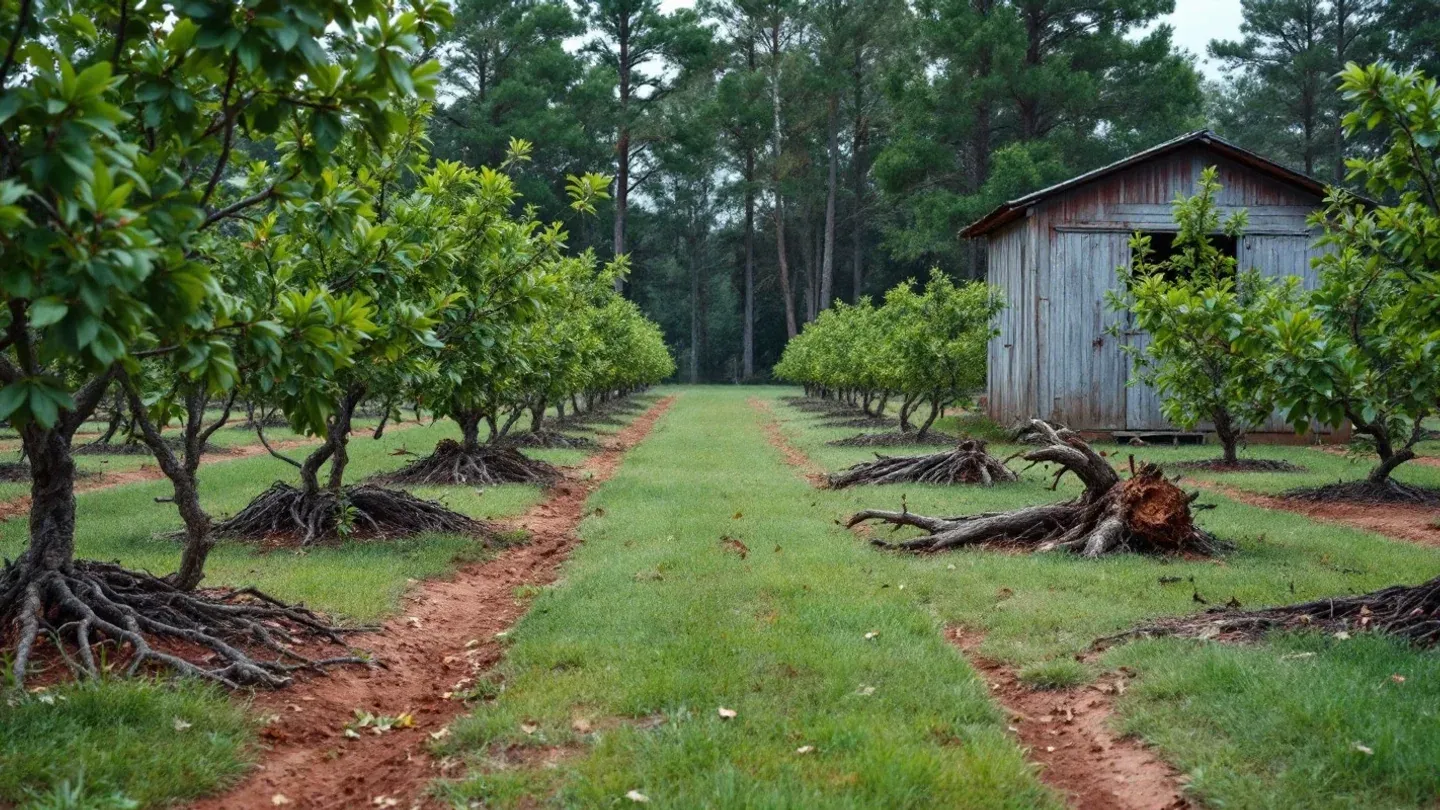
The Tree Assistance Program pays orchardists and nursery growers to replant or rehabilitate trees, bushes and vines that produce an annual crop. Cost share is 65 percent, or up to 75 percent for limited resource, socially disadvantaged and beginning farmers, and the application is due within 90 calendar days of the disaster or of the loss becoming apparent. Two changes from the 2025 law apply to 2026 losses: the old requirement of a 15 percent stand loss is gone, so any loss above normal mortality qualifies, and growers now have 24 months to complete the work, with an extension to 36 months when delays are beyond their control. Growers who lost less than 15 percent of a planting earlier this year and were turned away have until October 7, 2026, or 90 days from the loss if that is later, to apply.
Emergency Farm Loans: credit when the bank says no
The grants above cover a share of specific losses. The FSA Emergency Loan covers the rest: it can be used to replace essential property, pay production costs for the next season, cover family living expenses and refinance non-real-estate debt caused by the disaster, up to 100 percent of the actual loss and a cap of $500,000. Terms run one to seven years for crop, livestock and equipment losses and up to 40 years for real estate. The current interest rate, with the date it took effect, is posted on the FSA rates page.
The conditions are in the regulation. Your county, or a county next to it, must carry a disaster designation; FSA keeps the designations by year and county. The application must reach FSA within eight months of the designation date. A production loss loan needs a crop yield below the normal yield for the crop; the old requirement of a 30 percent loss was dropped by FSA in 2024. A physical loss loan needs disaster damage to equipment, livestock or other personal property essential to the farm, to real estate, household contents, harvested or stored crops, or perennial crops. And you have to show you cannot get credit elsewhere: one written declination from a commercial lender for a loan of $300,000 or less, two above that, with the requirement waivable at $100,000 or less. The same county loan officer handles the microloans and beginning farmer loans we described earlier, so the relationship is worth building before you need it.
What the programs do not cover
Knowing the holes matters as much as knowing the programs. NAP does not cover a crop that could have been insured under federal crop insurance in your county, and none of the permanent programs pays for a crop that had neither NAP nor insurance when the storm hit; only ad hoc aid of the kind described below reaches those losses, usually a year or more later. LIP pays on death losses above normal mortality, so the first few animals in a large herd are yours. ELAP pays set rates per animal unit and per mile, not your actual feed bill. ECP will not pay for a fence that was already down, a gully that was already there or work done before you filed. None of them pays for lost sales, spoiled inventory in a cooler that lost power, a damaged farm stand or the hours you spend cleaning up; that is what property, business interruption and liability cover are for, and our piece on what types of insurance a farmer needs walks through them. Emergency loans are loans: they are repaid with interest, and FSA may deny one if the farm plan does not show it can be.
The supplemental money for 2023 and 2024
Congress also passes ad hoc disaster aid, usually a year or two after the event, and one such program is open right now. The Supplemental Disaster Relief Program pays for crop, tree, bush and vine losses from 2023 and 2024 disasters under the American Relief Act, 2025. Stage 1 covers losses that drew a crop insurance or NAP indemnity; Stage 2 covers shallow, uninsured and quality losses. In April USDA raised the payment factor from 35 to 70 percent and moved the deadline for both stages to August 12, 2026. Livestock, timber and grazing crops are not eligible, and producers in Connecticut, Hawaii, Maine and Massachusetts are paid through state block grants instead. If you lost a crop in a 2023 or 2024 storm and never filed, call the county office this week and ask for the current deadline; FSA has moved it once already and posts changes on the program page. Whether this kind of aid keeps coming depends on the next Farm Bill, which is why we wrote about what happens when the Farm Bill lapses.
Before the storm: the list
- Walk the farm with a phone this week. Photograph every building, fence line, piece of equipment and group of animals, with a count. Save the files off the farm.
- Check that an FSA-578 acreage report is on file for this year, for every crop and every pasture. If you are not sure, call the county office.
- Ask whether the crops you grow are NAP-eligible in your county, what the closing dates are, and whether your fee is waived. Buy the coverage for the next season now.
- Put the deadlines on the wall: 72 hours and 15 days for NAP, 90 days for TAP, March 1 for LIP and ELAP, eight months for an emergency loan, and no ECP work before the request is in.
- After a storm, file the notices first and clean up second, except for what the animals need.
- Run the Disaster Assistance Discovery Tool on farmers.gov once, in a quiet month, so the names are familiar when you are tired and the power is out.
A disaster program is not a business plan. It replaces part of what is lost at the rates Congress sets, after the deadlines it sets, and only for the farms that kept the records. That is the long game of managing holistically: the paperwork done in August is what lets the farm still be there in November. The lenders, insurance agents and consultants who help with these filings are in our service providers directory. The farmer organizations that run disaster workshops in hurricane states are in our organizations directory.