
The Drought Monitor map for the week of August 26 puts 33 percent of the Lower 48 in drought, 20 percent in severe drought or worse, and a little over half the country at least abnormally dry, according to the U.S. Drought Monitor's area statistics behind the August 26 map. NOAA's July climate report had the dry core expanding and deepening across the Northwest and the central Rockies while parts of the Plains got relief. If you graze animals, that is a water map. Grass can be stockpiled and hay can be bought. Water has to be there every day, at the right spot in the pasture, and it has to keep working in February.
This is a practical guide to the three pieces of a livestock water system that should outlast the person who builds them: the pond, the well, and the lines and tanks that carry water from the source to the animal. It leans on NRCS practice standards and extension engineering, because that is where the design numbers live, and it ends with what the government will pay toward the bill.
Start with the number
Everything else is sized from how much the herd drinks on the hottest day. The University of Georgia's water bulletin for cattle puts growing cattle and cow-calf pairs at 2 gallons per 100 pounds of body weight a day when the high reaches 90 degrees, dry cows and bulls at 1 gallon, and says water needs roughly double between 50 and 95 degrees. A cow or bull wants 15 to 20 gallons a day in summer. Lush pasture that is three-quarters water trims that; hay at 10 percent moisture does not.
NRCS engineers design to a blunter rule. The agency's Missouri Livestock Watering Systems Handbook sets peak demand at 30 gallons a day per 1,000 pounds of live weight at 90 degrees, tells you to size a pipeline feeding an open tank to deliver that whole day's demand in 12 hours, and recommends one to three days of backup storage wherever a pump, a power line or a pipe can fail with no pond or creek to fall back on. Our heat stress article covers what happens to intake and gain when that water is warm, dirty or far away.
Write the number down. Head count times gallons, for the heaviest summer stocking you expect in five years. Every tank, pipe and pump decision below comes back to it.
A pond that fills and holds
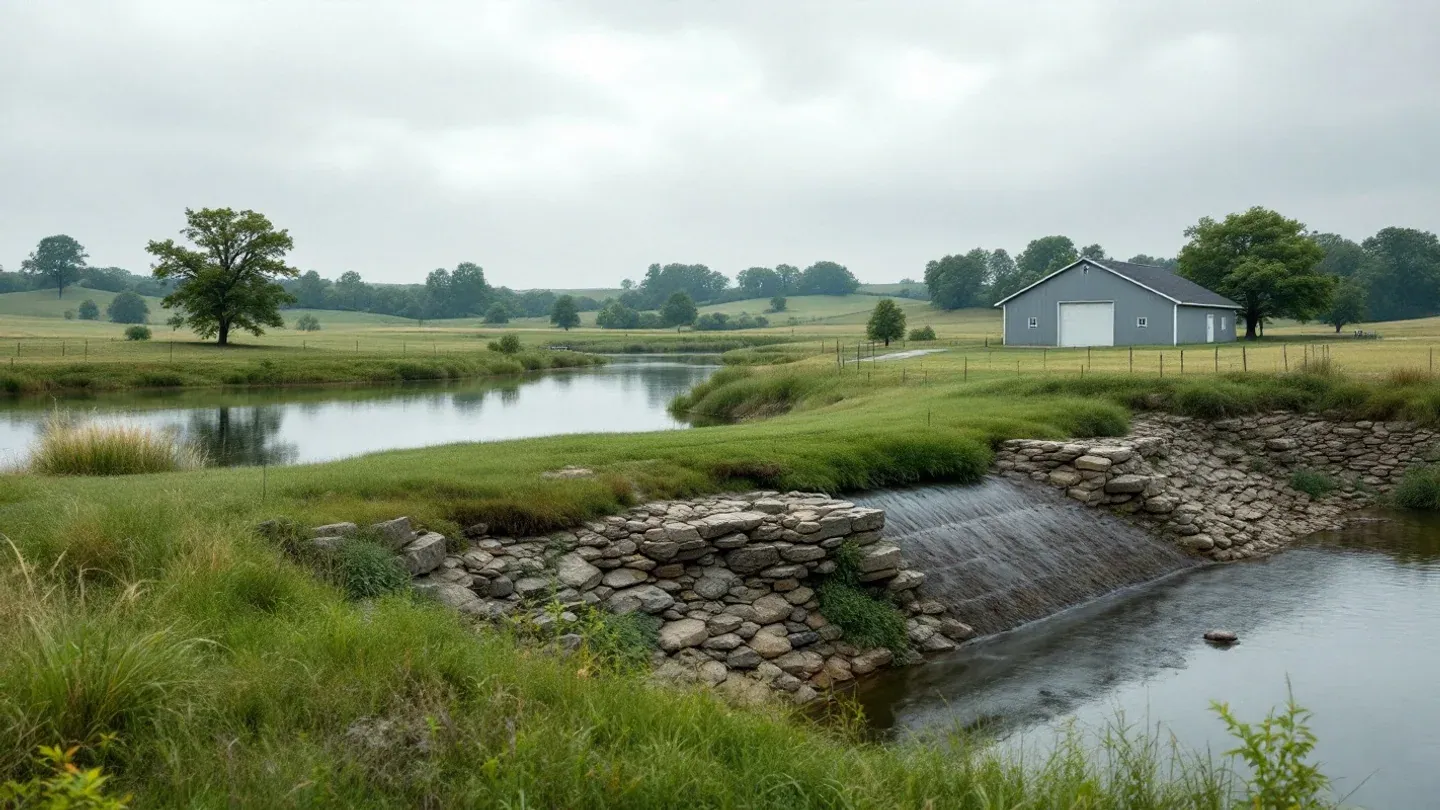
A stock pond is a watershed project before it is a hole in the ground. NC State's Pond Management Guide gives the planning ratio: in pasture, 5 to 20 acres of drainage area for each surface acre of pond, 20 to 40 acres in woodland. Too small a watershed and the pond never fills and grows weeds in the shallows; too large and it needs a diversion to route excess runoff around it. The same guide asks for an average depth of 6 to 8 feet in a pond of an acre or more, side slopes of 2:1 or 3:1 with at least 3 feet of water at the edge to limit weeds and discourage muskrats, and a drainpipe with a bottom draw-off so you can lower the pond for repairs.
The NRCS practice standard for ponds, Code 378, as adopted in Texas, adds the livestock-specific criteria. Dig test pits or borings before you build: where runoff is the water source, everything from the surface down to the planned depth has to be tight enough to hold water, or of a type that can be sealed. The drainage area should at minimum let the runoff from a 2-year, 24-hour storm fill the pond. The minimum depth must be met over a quarter of the pond's area, and the standard allows up to 2 feet of extra depth as sediment storage, because every pond silts in from the day it is finished.
Permits are simpler than most people fear and more involved than some hope. Construction and maintenance of farm or stock ponds is one of the listed exemptions from Clean Water Act Section 404 permits, per EPA, but the exemption falls away when the work amounts to a new use of the water and reduces the reach or impairs the flow of regulated waters. NC State's guide is blunter for its state: if the dam crosses a stream or the work touches a wetland, expect the Corps of Engineers and the state to want paperwork. Ask before you move dirt. A pond is the one piece of water infrastructure that is nearly impossible to undo, and a failed spillway writes its own gully downstream.
Fence the pond, pipe the water
The best thing you can do for a pond is keep the cattle out of it. Kansas State's guide to a remote waterer below a pond dam sums up the research: animals prefer a tank or trough, then a pond, then a pool in a stream, then flowing water, and they drink more when the water is better. Fencing the pond and leaving a 30-foot grass buffer inside the fence filters runoff and keeps hooves off the dam and spillway. Georgia's bulletin reports a 9 percent higher weight gain in nursing calves when their mothers drank from a trough rather than directly from the pond, and recommends setting the intake pipe at least 3 feet below the surface so blue-green algae toxins stay out of the line.
The Kansas design is a gravity line trenched around one end of the dam or through it, with an anti-seep collar of bentonite or a rubber membrane where the pipe passes the dam so water does not follow the pipe through it. In Kansas the trench runs about 4 feet below the pond's water level to keep the line from freezing, the pipe is sized to deliver the day's demand in 4 to 8 hours, and the tank lip sits about 15 inches above a geotextile-and-rock pad that costs a third of a concrete one. The payoff is cleaner water, a longer-lived pond and a saved water budget, which is why we keep pointing back to how farms conserve water.
The well: test it before you trust it
A well is the most convenient source and the easiest one to oversell. The NRCS water well standard, Code 642, as adopted in Oklahoma, lays out the order of work a licensed driller should follow for an agricultural well. The well is developed first, pumped at about 120 percent of the planned production rate until the discharge runs clear. Then, after at least 24 hours of recovery, a pumping test establishes specific capacity and the dynamic water level, and the well is designed so the water never draws down to the pump intake or the top of the screen. If local groundwater is unknown or questionable, the water is tested, and the standard flags nitrates in fertilizer country and minerals such as sulfate and sodium as the things that come back to bite livestock.
Ask the driller for those three numbers in writing: yield in gallons per minute, static water level and pumping level. A low-yield well is not a dead well; it is a well that needs a storage tank between it and the herd, so the pump can run slowly all day while the cattle drink in bursts.
Then test the water, and keep testing it. More than 43 million Americans drink from private wells that the Safe Drinking Water Act does not regulate, and EPA cites a USGS survey of 2,100 private wells in which about one in five had a contaminant above a health benchmark. EPA's well-care page asks for an annual test for coliform bacteria, nitrates, total dissolved solids and pH, a certified driller for any work on the well, and a sanitary cap. Penn State's testing guide reports that about half of private supplies have never been tested and that about half of private water systems fail at least one drinking water standard, and insists on a certified laboratory rather than a treatment salesman's kit.
For cattle, Georgia's bulletin gives the thresholds that matter: dissolved solids below 3,000 parts per million do not affect gains or feed intake, water above 5,000 should not be used, and 4,000 to 5,000 has been shown to cut stocker gains and milk production, and with it weaning weights. Nitrate under 100 parts per million is safe, 100 to 300 is questionable and over 300 is unsafe, with younger animals the most vulnerable. High iron and sulfate bind copper and zinc and show up later as a mineral deficiency nobody can explain.
Buried lines and surface lines
The NRCS livestock pipeline standard, Code 516, as adopted in Texas, starts where this article did: a water resource inventory of every well, pipeline, tank, pond and stream on the operating unit, with required storage set from the grazing plan, how often the stock are checked and how long a pump repair takes. Buried pipe goes deep enough to be safe from traffic, farm operations, freezing and soil cracking. Full-pipe velocity is capped at 5 feet per second, the working pressure of buried plastic pipe at 72 percent of its rating and of surface-laid pipe at half, and any new trough sits at least 100 feet from wells, streams, ponds and riparian areas. Surface installation is allowed only where conditions such as rock make trenching impractical.
The Missouri handbook turns that into two kinds of line. A summer line is buried 12 to 30 inches, often pulled in behind a ripper with flexible polyethylene pipe off a reel, laid to a grade that drains at every low point, and drained for the winter. An all-year line goes below the frost line, which depends on your coldest temperatures, soil, cover, sun exposure, soil moisture, whether water keeps moving and how warm it leaves the source. The handbook's advice is to bury below frost wherever the ground allows, even for a line you only plan to use in summer, because a deep line never needs draining and forgives a sloppy grade. High-density polyethylene can run on the surface where trenching is impossible.
Tanks: where, how big, and how to keep them open in January
Where the tank sits decides how the pasture gets grazed. The Georgia version of the NRCS watering facility standard, Code 614, lists improving animal distribution as a purpose of the practice and tells the planner to place facilities to promote even grazing and take pressure off sensitive ground. The Missouri handbook puts a distance on it: when water is more than 800 feet away, cattle go as a herd and drink in big groups, so the tank is sized for a third of the day's demand; when water is close they come in ones and twos and a tank holding a fiftieth of the day's demand works. Allow about 15 inches of rim per animal in the group that shows up together. This is the engineering behind our six principles of grazing management and behind managing holistically: water placement is a grazing tool, not just plumbing.
Tire tanks are the small farm's workhorse, and NRCS has drawings for them. Montana's 614 standard bars used materials for tanks with one exception, large-diameter heavy-equipment rubber tires. Arizona's standard drawing 614E calls for a tire at least 10 feet across with part of one sidewall cut away, set on a concrete slab at least 6 inches thick over a firm base of compacted gravel or native soil, inlet and overflow pipes cast into the concrete, the trough no taller than 22 inches, the tire partly buried if that is what it takes, and an escape ramp of expanded metal so birds and small animals can climb out. Louisiana's tire tank drawing uses a concrete floor at least 2 inches thick troweled to drain, a float valve, a removable PVC riser that sets the water depth and drains the tank when pulled, and an outflow pipe no smaller than the inflow. The Georgia standard requires one wildlife escape device per 30 feet of rim west of the 100th meridian, sloped no steeper than 45 degrees.
Freeze protection is a design choice, not a heater. The Georgia standard asks for float valves and controls protected from freezing and ice, and Montana's version suggests a continuous trickle through winter tanks and an overflow outlet 40 feet from the tank with positive drainage so ice does not build a skating rink around it. Kansas State's covered concrete waterer is the no-heater approach: a tank buried under about 3 feet of soil with only a small trough exposed, sited on a well-drained south-facing slope out of the winter wind; a larger tank serves more animals on a smaller flow and freezes less. Those are the tanks that make winter stockpiling and bale grazing possible on a far paddock.
Solar pumps
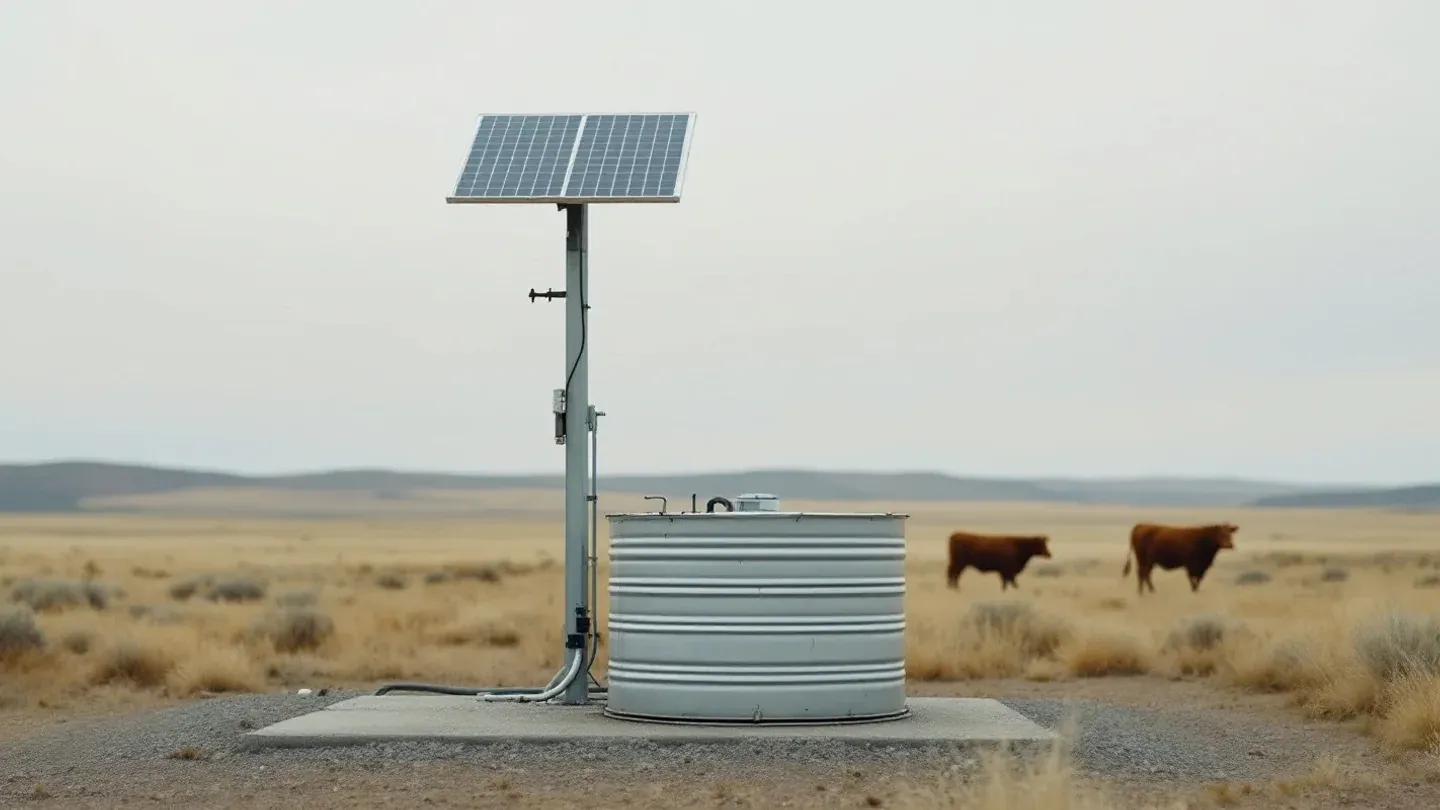
The Missouri handbook, written in 1997, was already laying out solar pumping, and the logic has not changed. A solar pump runs whenever there is light, slower when there is less of it, and its main drawback is the up-front cost, which the handbook says is more than made up for by not having to run a power line to the site. The simplest systems are low-voltage direct-current pumps with no batteries or converters, a submersible in a well or a rotary vane pump at a spring box, with a tracking panel to stretch the pumping day; a pump jack version handles deep wells and makes a good windmill replacement. The design rule is storage: enough tank volume to carry the herd through periods of low sunlight and heavy drinking, worked out in close coordination with the pump and panel suppliers. Our solar on the farm article covers the grant side of panels in general.
What NRCS and FSA will share
All four of the practices above, Pond 378, Livestock Pipeline 516, Watering Facility 614 and Water Well 642, are NRCS conservation practice standards, adopted state by state in the Field Office Technical Guide, which the EQIP regulations define as the official local NRCS source for planning and implementing conservation practices and where the approved practices are listed. The same regulations have NRCS develop the list of practices eligible for payment and the payment schedules that price them, and USDA's drought page below names livestock watering systems among the common EQIP practices. The money terms are set in the EQIP statute: payments may cover up to 75 percent of the cost of a practice; beginning, limited-resource, socially disadvantaged and veteran farmers can receive up to 90 percent and at least 25 percent above the regular rate, and on request at least half of their payment in advance to buy materials or hire a contractor, to be spent within 90 days. Contracts run up to 10 years. The federal fiscal year turns over on October 1; before you sign, ask your local office for the practice scenarios and the per-foot and per-unit rates that will apply to your contract. How EQIP and CSP payments work walks through the application and ranking, and USDA grants worth a small farm's time sorts the rest.
Drought changes the menu. USDA's drought page lists livestock watering systems among the EQIP practices used for drought recovery, notes that ELAP can reimburse the cost of hauling water to livestock, and explains that any part of a county sitting at D2, severe drought, for eight consecutive weeks of the growing season earns a nearly automatic Secretarial disaster designation, the designation that makes FSA emergency loans available in that county and the ones next to it. FSA's Emergency Conservation Program cost-shares up to 75 percent, or 90 percent for limited-resource producers, on practices that include emergency water conservation measures during severe drought and the restoration of water conservation structures, during signup periods announced after a disaster. The organizations directory lists the grazing groups and conservation districts that usually know a signup is coming before the press release does.
The order of operations
Do it in this order and the system lasts.
- Put the number on paper: head count, weight, gallons per day at 90 degrees, plus one to three days of storage.
- Inventory every source you already have, then test the well and the pond water before you spend a dollar connecting them.
- Fence the pond and pipe from it; set the intake deep.
- Bury every line you can below frost; lay summer lines to drain.
- Place tanks for grazing distribution, size them to the walk, and give wildlife a way out.
- Choose the freeze strategy on paper: buried concrete, continuous flow or a drained summer line.
- Visit the NRCS office before construction with the plan, the numbers and the water tests, and ask which practice scenarios fit.
The drillers, tank makers and pipeline contractors who do this work in your region are the people to ask about frost depth and local soils; our service providers and manufacturers directory is a starting point. None of this is glamorous, and that is the point. A pond sited to its watershed, a well that was tested before it was trusted, and a line buried below frost are the quiet, long-term decisions that let everything else on a grass farm work, in a dry August and in a cold February alike.