
If you run a small farm, March is grant season whether you want it or not. The Value-Added Producer Grant window closes in a month, state departments of agriculture are running their own rounds, and the inbox fills with webinars. It is also the strangest spring for USDA money in years, with contracts frozen, reimbursements late and farmers in court. So before you give up two weeks of evenings to an application, it helps to know which federal grants actually fit a farm your size, what each one costs you in match and paperwork, and which ones to leave to the nonprofits and universities they were written for.
What is going on with USDA money right now
Start with the news, because it shapes the advice. On January 20 the President signed an executive order whose section 7 told every agency to pause the disbursement of funds appropriated through the Inflation Reduction Act and the Infrastructure Investment and Jobs Act and to review its grant and contract programs within 90 days. At USDA that meant the IRA-funded share of EQIP, CSP and the Rural Energy for America Program, the money we described in The Impact of the Inflation Reduction Act of 2022 on Farming.
By mid February, farmers who had already done the work were waiting on reimbursements. Harvest Public Media reported an Iowa grower who had planted cover crops under a USDA-supported contract and was out $16,000 to $17,000. In late February USDA announced a first $20 million for farmers who already held awards, against the roughly $2.3 billion across 30,715 conservation contracts that the National Sustainable Agriculture Coalition counted, and on March 2 the department said its review was complete and the EQIP, CSP and ACEP funds would be released, without saying how much or when (Grist, March 5).
On March 13 five farms and three nonprofits sued the administration and USDA over Rural Energy for America Program grants they had been awarded for solar panels and energy efficiency and could not draw on, among them a Maryland farm whose owner said the farm could not invest in itself until its loans were paid back. The same week, states learned that USDA was canceling about $1 billion in local food purchasing: an estimated $660 million that schools were to spend this year under Local Food for Schools, and $420 million under the Local Food Purchase Assistance program, which is to be wound down at the end of its performance period.
Two lessons for anyone writing an application. First, the programs below do not draw on the IRA pots; they run on annual appropriations, farm bill money and, in one case, the American Rescue Plan, which is why the Value-Added Producer Grant round opened on schedule in January. Second, these grants pay mostly by reimbursement, and this winter is the reminder that the check does not always come when the plan says. The wider picture is in A New Administration and USDA: What Farmers Should Watch. The conservation money is in The Conservation Title and the Fight Over IRA Money.
The one open now: Value-Added Producer Grants, due April 17
USDA Rural Development posted the fiscal 2025 VAPG notice on January 17 with about $30 million available and 190 awards expected. Applications go in through the agency's Grant Application Portal by 11:59 p.m. Eastern on April 17, 2025, and the notice says in capital letters not to wait until deadline day.
There are two kinds of grant. A planning grant of up to $75,000 pays a qualified consultant to write a feasibility study, business plan or marketing plan for a value-added product. A working capital grant of up to $250,000 pays post-harvest operating costs for processing or marketing that product: an accounting system, a marketing campaign, food safety certification, hired help (not the owner or immediate family) and up to $6,500 of equipment that improves food safety. Neither pays for a building, fixed equipment or a vehicle.
The catch is the match. Every grant dollar needs a dollar of your own, in cash or eligible in-kind contributions, and applications with a cash match score higher. You must also produce and own more than half of the raw commodity going into the product, and if you have been selling that product for less than two years you have to show the project moves you into an emerging market. Ten percent of the funds are reserved for beginning, veteran and socially disadvantaged farmers, another ten percent for mid-tier value chain projects and ten percent for food safety projects. If you qualify you compete for the reserved money first and the general pool second, and a small or medium family farm picks up five priority points either way.
Paperwork after the award is real but bounded. The rules at 7 CFR 4284.960 require a financial report on form SF-425 and a performance report every six months, plus a final report within 120 days of the end; a working capital final report has to show customers gained, revenue returned to the producer and jobs created or saved, so write benchmarks you can measure. If you sell a product that would benefit from a real feasibility study, this is the federal grant most worth a small farm's time. We walked through the product side in Turning a Crop Into a Value-Added Product That Sells. A planning grant application is, in practice, a farm business plan with a budget attached.
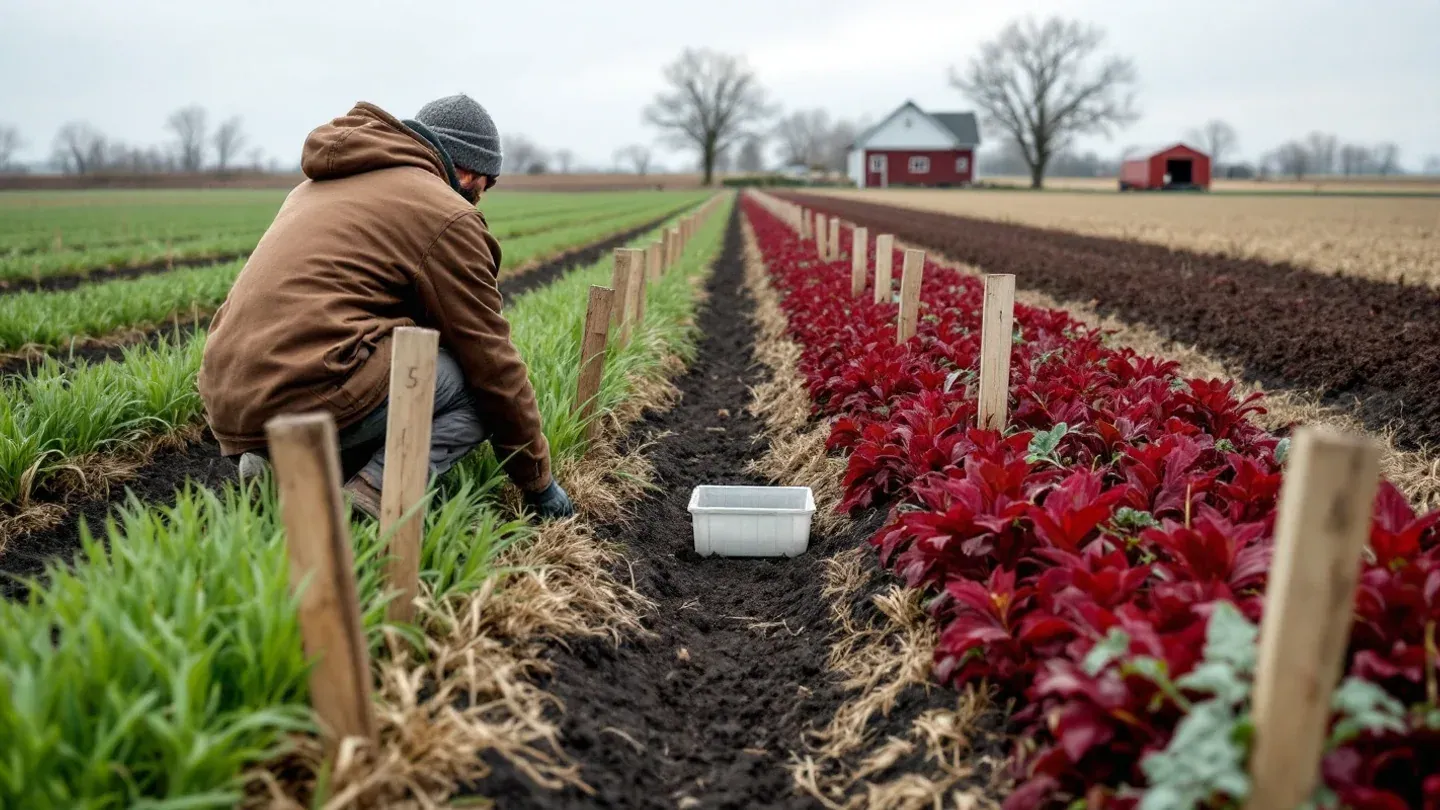
SARE farmer and rancher grants: small money, right shape
The Sustainable Agriculture Research and Education program is funded by USDA's National Institute of Food and Agriculture and run through four regional offices, each with a grant written for farmers rather than institutions. The money is modest and the fit is excellent: you propose a question about your own farm, test it and tell other farmers what happened.
In the North Central region a Farmer Rancher Grant pays up to $15,000 for an individual and $30,000 for a team, and the program funds about 40 projects a year. Its call for proposals says plainly that applicants may be just beginning the transition to a more regenerative operation, that grant funds cannot pay for buildings, motorized vehicles or everyday farming expenses, and that the money arrives in installments tied to a progress report and a final report. The other three regions set their own ceilings in the same tens-of-thousands range. The Northeast program lets you pay yourself for project time and bars capital costs and durable equipment. The Southern program is for established farmers with at least $1,000 of documented farm income, requires a cooperator, pays by reimbursement with no advances and holds the final payment until the final report is approved. The Western program pairs each producer with a technical advisor and expects both research and outreach.
Nothing in SARE is open in March. Deadlines run from late October to early December, so a farm that wants one writes it over the summer, ideally with the regional state coordinator, who the North Central call says may be able to help with the writing. If you are testing a cover crop mix, a grazing rotation or a new market, this is the grant to build around: the closest thing USDA has to paying you to heal the soil and report back. Our organizations directory lists the regional SARE offices and the groups that help farmers apply.
FMPP and LFPP: only if you bring neighbors along
The Farmers Market Promotion Program and the Local Food Promotion Program are sister programs at the Agricultural Marketing Service. FMPP exists to develop and expand direct producer-to-consumer markets: capacity building grants of $50,000 to $250,000 and training and technical assistance grants of $100,000 to $500,000. LFPP funds the businesses that process, distribute, aggregate or store local food, with planning grants of $25,000 to $100,000 and implementation grants of $100,000 to $500,000. Both require a cost share equal to 25 percent of the federal money.
Agricultural businesses and producer networks are eligible, and AMS's questions and answers confirm that a sole proprietorship can apply, but the project must benefit more than one producer or food business and the applicant cannot be the sole beneficiary. That rules out a grant for your own stall and your own website. A market association, a group of farms building a shared delivery route or a food hub fits. Last year's solicitation came out on February 27 with a May 14 deadline and about $10.5 million for FMPP. As of mid March AMS has not posted the 2025 request, so watch the program page rather than the calendar.
RFSI and the state door
The Resilient Food Systems Infrastructure program put about $400 million into every state department of agriculture to build the middle of the supply chain: processing, aggregation, cold storage. The states run the competitions, so rounds and deadlines differ by state. Under USDA's program scope, infrastructure grants run from $100,000 to $3 million with a 50 percent match, reduced to 25 percent for historically underserved farmers, and states may also offer simplified equipment-only grants of $10,000 to $100,000 with no match and a short application. For a small farm that needs a walk-in cooler, a mill or a packing line, that equipment-only track is the best thing on this whole list. Call your state department of agriculture and ask whether its RFSI round is open.
The same door leads to the Specialty Crop Block Grant Program. Only state departments of agriculture apply to USDA; growers apply to the state, there is no federal match, and the purpose written into the program is to enhance the competitiveness of specialty crops, which is a different question from improving one farm.
The ones to skip
The Beginning Farmer and Rancher Development Program sounds made for you. It is not. Applications may only come from a network or partnership of public and private entities, and individuals are excluded from review. Use it by attending the courses it funds through your extension service or a farmer group.
Skip the $500,000 training and implementation tracks of FMPP and LFPP unless you are an organization with staff. Skip any grant whose match plus reporting hours is worth more than the award. And do not confuse a grant with the programs that fit a working farm better. EQIP and CSP are cost-share contracts, explained in How EQIP and CSP Conservation Payments Work for a Small Farm. FSA's microloans are debt, but fast. The organic certification cost share refunds 75 percent of certification costs up to $750 per certification scope, with no narrative to write. A grant is one line in a diversified income, not the plan, which is the point of our older piece on how to diversify farming income.
The plumbing nobody mentions
Every federal application needs an active SAM.gov registration and a Unique Entity ID, and the VAPG rules require them at application and throughout the award. Grants.gov says to allow up to 10 business days for a SAM registration to become active, warns that it can take weeks or months if your information cannot be verified, and reminds you that it is free and has to be renewed every year. If you have not registered, do it this week. The VAPG notice sends you to the program page on the Rural Development website for the portal's user guides and access instructions, so set up that access before you write a word.
Writing a plan that fits
Start from the farm plan, not the grant. If the project is something you would do anyway, the grant lowers the cost. If it is something you invented to spend the money, you will be running it for two years with reports due. That is what we mean by always simplify. It is also what it means to think long term.
Read the scoring before the narrative. The VAPG notice spells out how points are awarded for the match, the priority categories and the viability of the business; the North Central SARE call tells you to search the SARE database, read recently funded projects and involve cooperators. Write benchmarks you can measure with records you already keep, because the final report will ask for them. Budget your own hours, keep every receipt from the first day of the project period and none from before it, and plan the cash to carry the project until the reimbursement lands.
Then put three things on the wall: April 17 for VAPG, a summer writing block for a fall SARE call, and a phone call to your state department of agriculture about RFSI. Everything else on the USDA grants list can wait for a farm with an office.