
Next Tuesday, February 13, USDA releases the 2022 Census of Agriculture, the once-every-five-years count of every farm in the country. Somewhere in those tables are the farms that sell not at a stall or through a CSA box but to a buyer who takes a pallet and expects an invoice. That is wholesale. For a farm with twelve acres and one truck, the door into it usually has a name: the food hub.
We have argued for years that a region should be able to feed itself, in Localism in Agriculture. We made the case again in October's piece on selling to your local school district. The idea sits inside our belief that a farm should act local. A hub is where that idea meets a loading dock. This article explains what a hub does, how it charges, what it will expect from your farm, and how to tell one with a future from one that will not see another season.
What a food hub actually does
USDA's Regional Food Hub Resource Guide, written in 2012 with the Wallace Center, still carries the working definition: a business or organization that actively manages the aggregation, distribution and marketing of source-identified food from local and regional producers, so that those producers can meet wholesale, retail and institutional demand. Two words carry the weight. Source-identified means your farm's name stays on the box. Actively manages means somebody is paid to make the phone calls you do not have time for.
The guide lists what sets a hub apart from an ordinary distributor. It moves product from many producers to many markets. It treats growers as partners rather than interchangeable suppliers and buys from small and mid-sized farms when it can. It works with growers to meet buyer requirements, or finds someone who will. And it uses the farm's story and its growing practices to earn a better price than commodity product would fetch.
In daily terms a hub consolidates orders, grades and repacks, holds product cold, delivers, invoices the buyer and chases the payment. Many add producer services: production planning so that forty farms do not all plant zucchini, post-harvest and food safety training, business coaching, and in some cases liability insurance.
When USDA compiled the guide it counted 168 hubs nationwide: 40 percent privately held companies, 32 percent nonprofits, 21 percent cooperatives and 5 percent publicly held, the guide's example being a group of city-run farmers markets in Santa Monica that had taken on hub work. The survey behind it found a young industry. Sixty percent of hubs had been operating five years or less, average sales were just under one million dollars, and the median hub bought from 40 suppliers.
The money moving through these channels is not small. USDA's Economic Research Service reports that local food sales reached $11.8 billion in 2017, about 3 percent of all farm sales, up from $8.7 billion in 2015. In 2015, 39 percent of local food sales went through intermediaries and institutions, 34 percent direct to consumers and 27 percent to retailers, and most of the growth has come through intermediaries, institutions and retailers, not the farmers market. That is the channel a hub opens.
How the money moves
Every hub pays its growers in one of three ways, and USDA's case studies in Moving Food Along the Value Chain show the range.
Commission on consignment
The hub sells on your behalf and keeps a percentage. Appalachian Harvest in Abingdon, Virginia, charged its growers a 27 percent commission for packing, sales and transportation, plus an 8 percent grading fee for anyone who delivered ungraded produce. The Oklahoma Food Cooperative let producers set their own prices, charged them a 10 percent commission, charged the buying members another 10 percent for handling, and set no volume threshold, so a producer could start with a very small amount and grow from there.
Purchase and resale
The hub buys at an agreed price and takes the risk of selling. The resource guide gives the split at three established hubs: Tuscarora Organic Growers in Pennsylvania directed 75 percent of revenue to its growers and 25 percent to operations, the Local Food Hub in Virginia returned 80 percent of the buyer's price to the farm, and Intervale growers in Vermont netted about 85 percent of wholesale income through their hub.
Membership plus margin
A formal cooperative is owned by its members, and SARE's guide to scaling up for wholesale says to expect an annual membership fee that supports the staff and the infrastructure, plus a role in governance. We will go deeper on that structure in Producer Cooperatives: Pooling to Reach Bigger Buyers.
Whatever the model, hold on to the number SARE puts bluntly: wholesale prices will not be near direct market prices, and you make it up on volume. The hub's cut is the price of the truck, the cold room, the salesperson and the weeks the buyer takes to pay. If your cost of production does not leave room for that cut, the hub is not your market yet.
What a farm has to deliver
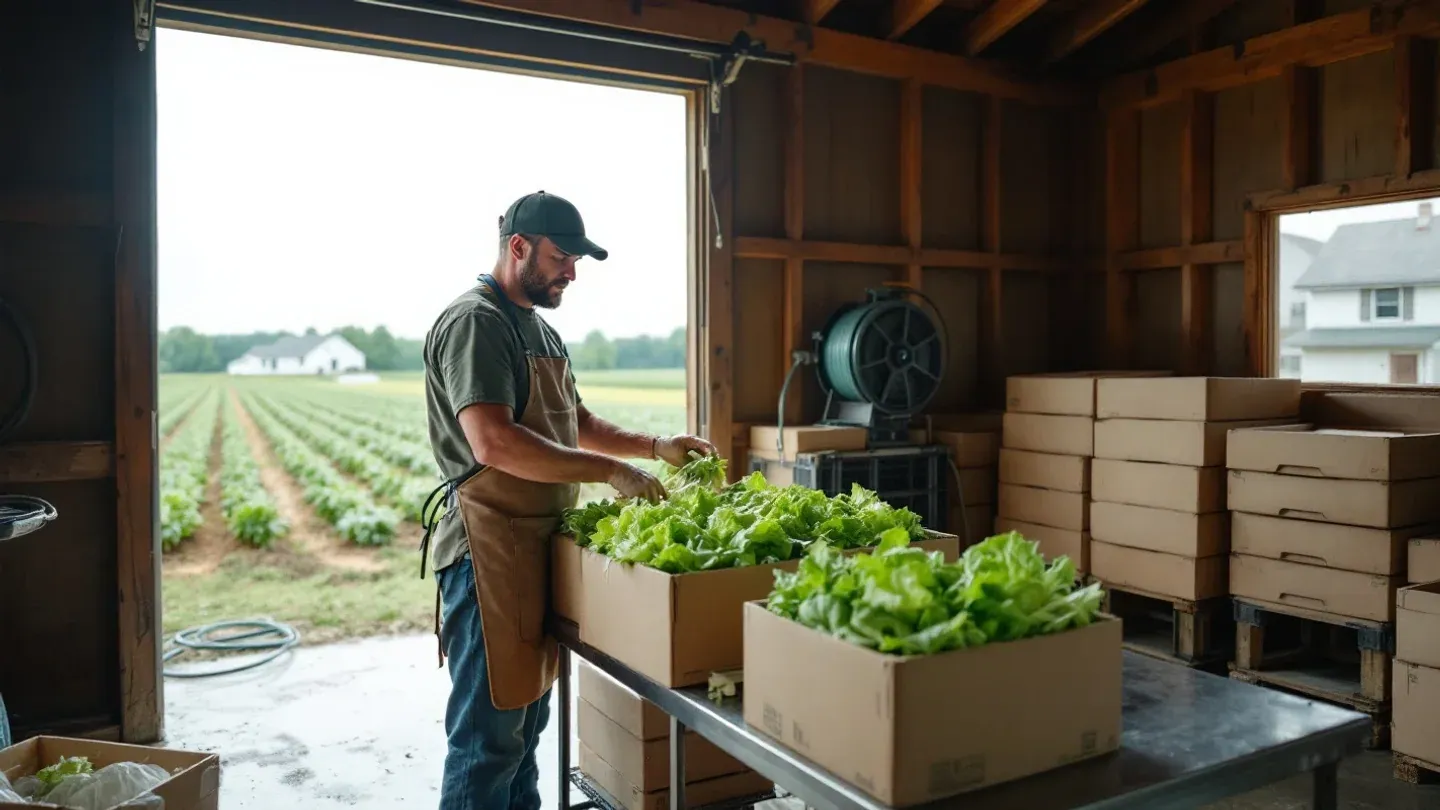
A hub lowers the bar to wholesale. It does not remove it. SARE lists what still lands on the farm: a food safety plan, field heat out of the crop at harvest, and the documentation a buyer expects.
Consistency
Wholesale buyers want higher volumes and steadier quality and delivery than a market customer ever asked for. A hub can forgive a short week once. It cannot forgive a grower who shows up with lettuce only when the market was slow.
Food safety
Many hubs require GAP certification or at least a written plan, because their buyers do. USDA's case study of Big River Farms in Minnesota shows what that cost one aggregator: to sell green peppers to a restaurant chain its growers had to be GAP certified, so it wrote food safety procedures that followed GAP protocols, trained every grower on them, kept separate coolers, tarps and harvest crates for the certified produce, paid for audits and seasonal portable toilets, and spent staff time on records and on checking that growers followed the rules. After three seasons it concluded that the cost of keeping the certification was starting to outweigh what the account was worth. We will walk through the audit in Getting Wholesale Ready: GAP Certification for Small Farms. The building is covered in Designing a Wash and Pack Shed That Meets FSMA Rules.
Cold
Product arrives at the hub's temperature or it does not go on the truck. If you do not yet own a cooler, December's article on on-farm cold storage is the place to start.
Grading and pack
Appalachian Harvest wrote crop-by-crop standards for its growers and charged the 8 percent fee to anyone who left the grading to the hub. Expect a pack list: box type, count, weight, and often a PLU sticker on loose produce, which SARE notes also keeps your brand visible down the chain.
Insurance
Buyers ask the hub for proof of product liability coverage, and the hub asks you. A supply agreement reproduced in USDA's Food Value Chains report, between a farm-owned dairy, a farmer-run brand and a Kansas City grocery chain, requires each supplier to carry $2 million in product liability coverage and hand the chain proof of it. Our older piece on what insurance a farmer needs covers the policy types.
Paperwork
SARE describes the rhythm: an availability and price list, notice one to two weeks before a crop comes in, an order confirmation, a pending invoice, a packing slip with the delivery and a final invoice. Agree on that protocol before the first box moves and keep every record.
How to tell a hub that will last
The resource guide's authors interviewed hub operators about money, and the pattern is worth memorizing. Ten of the operators called their business economically viable, five expected to break even within one to three years, and two said they were close. Legal structure and region did not predict which group a hub fell into. Age and size did. The viable hubs had a median of 9.5 years in operation against 5 for the rest, every viable hub grossed at least one million dollars a year with a median of six million, and the not-yet-viable hubs had a median of half a million. Even the survivors spoke carefully. The manager of a hub that had been operating for more than thirty years called her business "viable, but certainly vulnerable."
Two more findings explain why. The challenge operators named most often was balancing supply and demand, and for most of them demand outran what their region could grow in certain categories. That is good news for a grower, as long as you ask which categories. And the cash gap is real: one operator said the hub aimed to pay farmers in two weeks while customers took six to eight weeks to pay, so the hub was financing those receivables out of its own pocket or a credit line it could not always get.
So before you deliver a single case, ask the questions SARE suggests before joining a cooperative, starting with its long-term track record, and a few of our own:
- How many seasons has the hub operated, and what were last year's gross sales?
- How does it pay growers, on what terms, and how does it cover the gap between paying you and being paid?
- Which products is it short of, and which is it already turning away?
- What share of sales goes to its largest buyer, and what share of its budget is grant money that ends on a date?
- Who sets grading and pricing standards, and do growers have a voice in it?
A hub that answers readily, with a ledger to back it up, is a hub that thinks the way we ask our readers to think long term. One that changes the subject is telling you something too.
The programs feeding hubs right now
Three federal programs are putting money into exactly this kind of infrastructure, and a grower should know what they mean for the hub down the road.
The Local Food Purchase Assistance program pays states, tribes and territories to buy food produced in the state or within 400 miles of where it is delivered, for food banks and other feeding programs. A second round, LFPA Plus, announced in November 2022, added up to $464 million and brought the program to nearly $900 million. Ask whether your hub holds an LFPA contract and when it ends. It is real volume, and it is also temporary money that should not be the only reason a hub exists.
The Local Food Promotion Program funds the enterprises that aggregate, distribute, process or store local food: planning grants of $25,000 to $100,000 and implementation grants of $100,000 to $500,000, with a 25 percent match. Cooperatives, producer networks and agricultural businesses are eligible, which means a group of farms can apply for the hub they wish existed.
And the twelve USDA Regional Food Business Centers, whose lead organizations USDA named on May 3, 2023 are the new regional front door. Each center is funded to provide technical assistance and Business Builder awards of up to $100,000 to small and mid-sized producers, processors, distributors and other food supply chain businesses. The Northeast center alone holds a $30 million award, and the list of lead organizations runs from Rural Action in Appalachia to Colorado State University in the Northwest and Rocky Mountain region, with the Intertribal Agriculture Council running a national center. A call this winter is worth your time.
We covered the larger policy frame in The Farm Bill Explained for a Small Regenerative Farm. The gap these programs are trying to close is the one we described in 2020 in Additional Aid Needed for Farmers Selling Locally.
Before you sign up
Find the hubs near you. USDA's Local Food Directories list food hubs alongside farmers markets and CSAs. The groups in our organizations directory know which hubs in their state are buying. Then visit on a delivery day, not on a tour. Watch how the boxes come in, whether the cooler is full, and whether the manager knows every grower's name.
Start with one crop for one season, priced from your own numbers, and keep your direct channels running while you learn the hub's rhythm. That is what we mean by being consistent: a buyer who can count on you is worth more than a buyer who pays more once. Read the grower agreement twice, especially the pages on payment terms, insurance and who owns the product between your gate and the buyer's dock.
And when you have a season behind you, show up at the hub's grower meeting. The hubs that last are the ones whose farmers get involved in setting the standards they will be held to. A food hub is not a middleman you tolerate. Done right, it is forty farms deciding to reach the wholesale market together, and keeping their names on the box while they do it.