
On January 31, 2024, USDA's National Agricultural Statistics Service released its annual Sheep and Goats report. All sheep and lambs on US farms stood at 5.03 million head on January 1, down 2 percent from a year earlier, and all goats and kids at 2.47 million head, also down 2 percent. The 2023 lamb crop was 3.03 million head. Those are small numbers next to cattle, and they have been shrinking for a long time. Meanwhile, USDA's Economic Research Service reports that imports now supply more than half of the lamb and mutton eaten in this country, almost all of it from Australia and New Zealand.
Read one way, that is a shrinking industry. Read another way, it is an open door. A farm that already runs cattle on pasture has most of what a small flock needs: grass, water, a grazing plan and the habit of moving animals. What it usually lacks is the knowledge that keeps sheep and goats alive, which is a different body of knowledge from cattle. This article covers the basics: why the species fit together, the parasite that decides everything, fencing, guardian animals, minerals, when to lamb and kid, and where the meat goes.
Why sheep and goats fit a cattle farm
Cattle, sheep and goats do not eat the same pasture in the same way. Oregon State University Extension puts it simply: browsing is eating at eye level or above, grazing is eating with the head down, and while both small ruminants can do both, goats prefer to browse and sheep prefer to graze. Penn State Extension describes meat goats as nonselective browsers that work a plant from the top down and eat more brush and less desirable plants than other livestock, and it notes that on marginal grazing land goats complement both sheep and cattle when they are stocked according to local recommendations.
In practice that means a cattle pasture with multiflora rose, blackberry, cedar regrowth or weedy corners is carrying feed that cows will not touch. Goats will. Sheep take the forbs and the shorter grass between the cattle's bites. The land gets grazed more completely and more evenly, which is the whole point of the six principles of grazing management we wrote about years ago. More even grazing is also one of the quiet ways a farm heals its soil. If you have been thinking about silvopasture, goats are the species that make a brushy woodlot pay while the trees grow.
The second fit is less obvious and more important. Cattle and horses do not share the internal parasites of sheep and goats. Penn State's parasite guidance says that grazing them together, or running cattle behind small ruminants in a leader-follower rotation, helps break the parasite cycle, because larvae picked up by the wrong host go nowhere. A cow is, among other things, a vacuum cleaner for sheep worms.
That fits how we think about a farm: as one system, managed holistically, where each animal does a job the others cannot. It is the same reasoning behind our older case for combining livestock and plant growing.
The parasite that decides whether you succeed
New sheep and goat owners lose animals to one thing more than any other: the barber pole worm, Haemonchus contortus, a stomach worm that the University of Rhode Island calls the most economically important parasite of small ruminants on pasture. It causes anemia and, in severe cases, death. Dewormers that once worked reliably have been used so heavily that Oregon State now lists drug-resistant internal parasites among the major contagious diseases of concern in small ruminants. That is why the American Consortium for Small Ruminant Parasite Control, a group of university and veterinary scientists formed in 2003, spends so much effort teaching producers to deworm less, not more.
The tool for that is FAMACHA. It is a laminated card that matches the color of the lower eyelid to a level of anemia, using five color categories from 1, red and not anemic, to 5, pale white and severely anemic. The idea is targeted selective treatment: you check every animal, and you treat only the ones that need it. The animals that cope on their own are left alone, so the worms they carry are never exposed to the drug and resistance builds more slowly.
You cannot simply buy the card. Producers must be trained to receive one, and Louisiana State University is the sole distributor in North America. The University of Rhode Island runs an online certification: training videos, an assessment with a pass mark of 80 percent, and a short demonstration video of you scoring both eyes of two animals. The card itself costs under $20. For a flock of thirty, it is the best money you will spend this year.
The card treats the symptom. Grazing management treats the cause. Penn State's guidance on preventing parasites through grazing is specific: most larvae live in the first two inches of forage, so move animals before a paddock is grazed below four inches. An egg can reach the infective stage in as little as six days, so plan for animals to leave a paddock within about five days of entering it. In summer, rest paddocks for 65 days or more before the sheep or goats return. Cattle can graze those resting paddocks in the meantime, which is where the multi-species fit earns its keep.
Finally, keep a treatment log and cull the animals that need deworming more often than the rest. Parasite resistance, usually measured by fecal egg counts, is a moderately heritable trait, and the National Sheep Improvement Program lists it among the traits its estimated breeding values can predict. Over a few years, your own selection does more than any drug.
Fencing that holds goats and stops predators
Cattle fence is not sheep fence, and sheep fence is not always goat fence. Penn State's meat goat guidance is blunt: goats require tight fencing. Its recommendation is a five or six strand high-tensile fence with the first, third and top wires electrified, or woven wire with a single electric strand run on the inside to stop goats climbing and rubbing.
Oregon State's getting-started guide adds the safety rules. Do not use barbed wire for sheep or goats; it causes severe injuries. Ordinary field fencing with large openings can trap the heads of horned animals. Electric netting is useful for short rotations but can entangle animals, so use it where you can check them. And one detail that surprises cattle people: wool insulates sheep from an electric fence, so either shear before training them to it or raise the charge.
For a cattle farm the practical path is usually a sound perimeter fence, upgraded where it is weak, with portable electric netting or multi-strand polywire for the daily moves inside it. Train new animals to electric fence in a small, well-fenced pen before trusting them in a paddock with a single strand. A flock that respects the fence on day one saves you a year of chasing.
Guardian animals
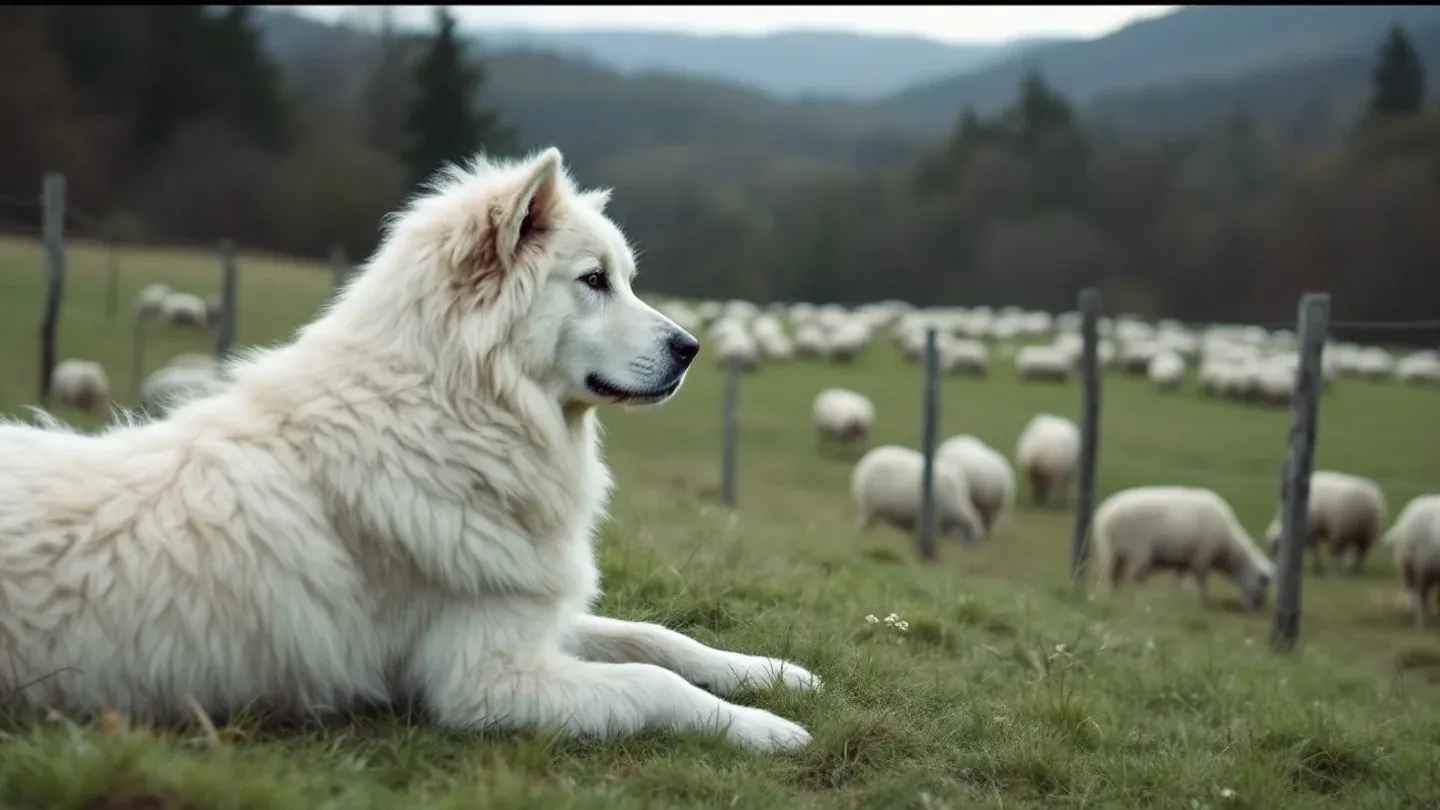
Coyotes are the number one predator of sheep and goats in the United States, and no fence stops them everywhere. The answer many working flocks rely on is a livestock guardian dog. Texas A&M AgriLife's overview of guardian dogs tells the story of its own Martin Ranch, which weaned a 20 percent lamb crop in 2009 before guardian dogs were introduced; since 2012 the lamb crop has exceeded 100 percent. Nationally, NASS put death loss in 2023 at 200,000 sheep and 365,000 lambs.
The same publication gives the numbers a beginner needs. The general recommendation is one dog per 100 ewes or does, though two dogs are usually better, because the flock stays protected if one is lost. Flocks of a thousand seldom run more than six. Great Pyrenees are the most common breed because they are good guardians and the least aggressive toward people; Anatolian Shepherds, Maremmas and Akbash are the other common choices. Puppies bond to livestock best when the process starts at four to eight weeks of age, and the research indicates a dog may never bond properly if bonding begins after 16 weeks. Expect 12 to 24 months before a puppy is an effective guardian. Budget at least $1,000 for the first year and about $500 a year after that.
The biggest risk to the dog is the dog itself: only 52 percent live to six years, and 57 percent of fatalities happen when a dog leaves the property. Teaching respect for the boundary fence is the single most important lesson, and a dog that keeps finding holes should be culled rather than tolerated. Tell your neighbors before the dog arrives, and put a tag on it that says what it is.
Dogs are not the only option. Oregon State lists llamas, burros, donkeys, mules and horses as guardians that can work against predators, each with its own care needs, and advises watching any new guardian closely for the first week to be sure it accepts the flock.
Minerals: one feeder does not fit all
Sheep are sensitive to copper. Oregon State's nutrition guide says the mineral supplement for sheep must be formulated specifically for them, and that rule gets harder to follow when three species share a paddock and a feeder. A mineral mixed for cattle or goats is not the right one for sheep. If the animals run together, one practical answer is to offer a sheep-safe mineral to the whole group and supplement the cattle and goats separately, somewhere the sheep cannot reach. The same guide lists urinary stones in wethers as a serious concern that proper mineral and vitamin intake helps prevent. Ask your extension office which mineral the soils in your county call for.
When to lamb and kid
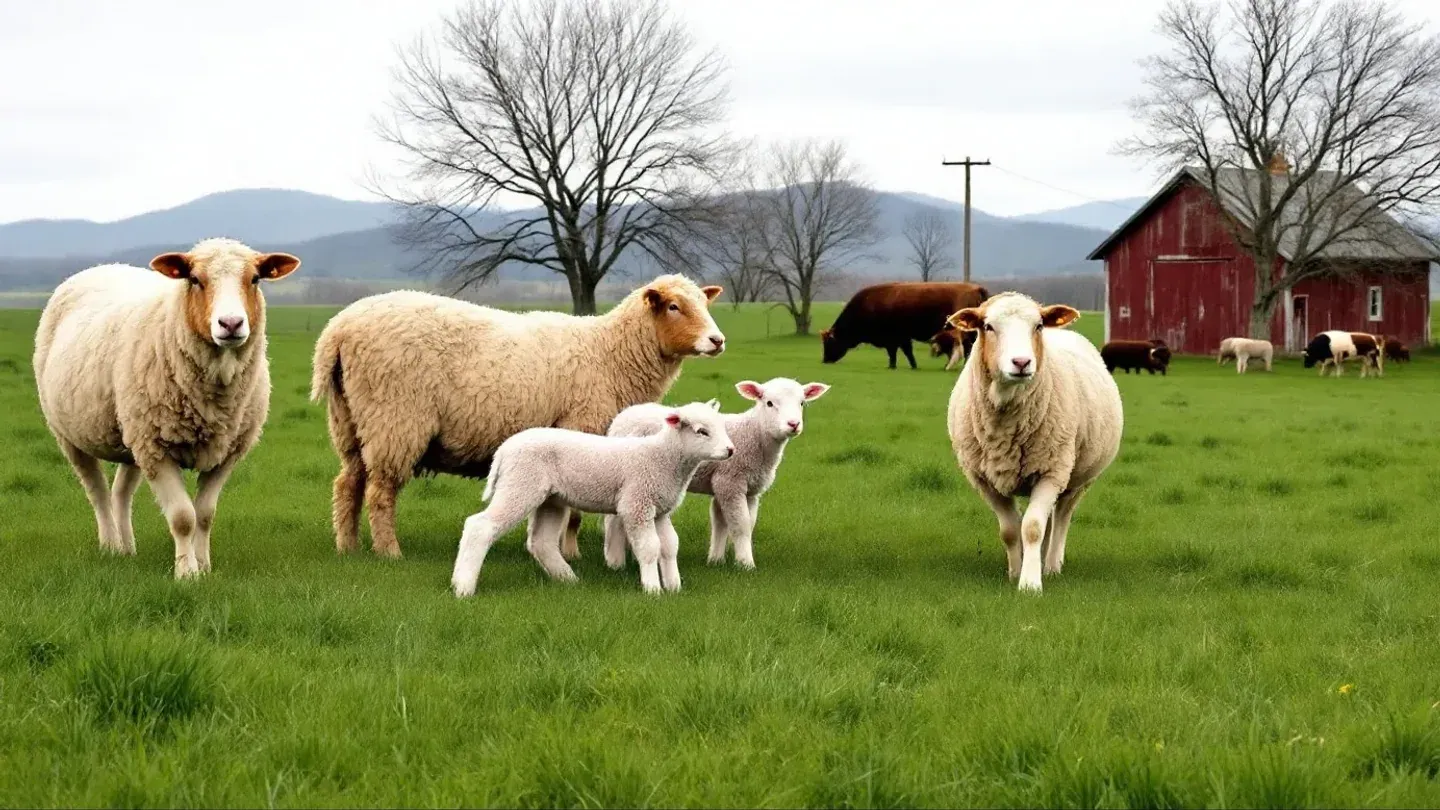
Sheep are seasonal breeders. Penn State's production guidance says ewes are most fertile in September, October and November, with day length the key environmental factor and a gestation of about five months. Most ewes therefore lamb in spring, which is also when the grass comes. For a farm that already follows the grass with its cattle, a spring lambing on pasture is the simplest start, and the logic is the one we laid out for winter feeding on stockpiled pasture: work with the growth curve, not against it.
Goats are similar but not identical. Penn State's meat goat guide gives a gestation of 148 to 152 days, peak sexual activity in the fall months, and a target of 1.9 to 2.3 kids per doe in a well-managed herd. Boer goats can breed year round, which matters if you want kids for a winter holiday.
Two preparations pay for themselves. Flushing, which means raising nutrition for two to three weeks before the ram goes in, encourages twins, and a move to lush pasture does it as well as grain. Body condition should be scored on the five-point scale before breeding, aiming for a 3. Lambing out of season is possible with breeds such as Dorper, Katahdin, Polypay or Dorset, and it earns higher prices, but Penn State warns that lambing rates run about 25 percent lower and breeding is harder. Learn the spring version first.
Where the lamb and goat go
Lamb is a niche in this country. ERS puts per-capita consumption at about one pound a year, down from nearly five pounds in the 1960s, with Texas the largest sheep state and California second. But the niche is concentrated and loyal. ERS describes the typical lamb buyer as an established consumer in an ethnic community in a metro area such as New York, Boston, Philadelphia, San Francisco or Los Angeles, and Penn State's marketing guidance puts minority populations at about 58 percent of US lamb consumption.
Much of that demand is tied to religious holidays, and the buyers want live animals of a particular size. Penn State's guide lists them: milk-fed lambs of 30 to 45 pounds and kids of 20 to 40 pounds for Western Easter; milk-fed lambs of 40 to 55 pounds for Orthodox Easter; weaned lambs of 60 to 80 pounds and goats of around 60 pounds for Ramadan and Eid al-Fitr; blemish-free animals over 60 pounds, yearlings preferred, for Eid al-Adha; milk-fed lambs of 40 to 60 pounds for Christmas. The Islamic calendar runs about eleven days shorter than ours, so those targets move earlier every year. In 2024, Orthodox Easter falls on May 5 and Eid al-Adha in the middle of June. Work backward from the dates your buyers care about, with a five-month gestation, and you have your breeding calendar.
Penn State's advice is to sell these animals live, at auction or directly to the buyer, because a producer cannot sell meat unless the animal was processed in an inspected plant. If you also want to sell lamb or chevon by the cut, the same lessons apply as for beef: find a processor before you breed and ask whether it takes sheep and goats at all, and be careful with claims like grass-fed, which we unpacked in Honest Labels. The processing bottleneck that hit beef in 2020 did not spare small ruminants. Several of the operations in our farms and ranches directory run sheep or goats alongside cattle and are good places to see how established farms price and sell. The groups in our organizations directory include the ones that run grazing schools and courses.
A first-year plan
Start smaller than you want to. Twenty to thirty ewes or does is enough to learn on and few enough to lose sleep over without losing the farm. Penn State's meat goat guide estimates $7,000 to $9,000 to start with 25 does, before fencing and dogs.
Before the animals arrive: get FAMACHA certified; fix the perimeter fence and buy enough netting for one paddock at a time; put a sheep-safe mineral in place; find a bonded guardian dog or commit to raising two pups; locate your buyers and the dates they need animals; choose a lambing window that matches your grass.
In the first grazing season: move animals every four or five days, never below four inches, and keep the cattle one paddock behind them. Score eyelids regularly through the warm months and after rain, and treat only the animals that score poorly. Write everything down: who was treated, with what, when, and which dams raised the best lambs on grass. By the second year the records will tell you which animals belong on your farm, and you will have the beginnings of a flock that fits your land rather than one you have to prop up.
That is what we mean by thinking long term. The sheep and goat numbers in the January report are down again this year. The land, the grass and the buyers are still there, and so is the room for farms that do this well.