
A reel of polywire, a bag of step-in posts and a small energizer cost less than most single pieces of farm equipment, and they change a pasture more than almost anything else you can buy. Portable electric fence is what turns a field grazed all season into a rotation: a fresh strip every day or two, a long rest behind it, and a stocking density you choose rather than the one the herd chooses for you. This guide covers the parts that trip people up: how big an energizer to buy, which conductor fits which animal, why grounding fails in a dry July, how one person moves a herd before breakfast, and what the NRCS fence practice pays in the 2026 fiscal year.
A dry July makes the case
The US Drought Monitor map of July 14, 2026, released on July 16, showed a split country. Heavy rain brought widespread relief from northeast Texas through the Mid-Atlantic, with improvements in Tennessee, Kentucky, Virginia and North Carolina. The western Great Lakes went the other way: warm, dry weather brought widespread degradation across northern Minnesota, northern Wisconsin, the far western Upper Peninsula of Michigan and eastern North Dakota. Extreme and exceptional drought expanded in central Colorado, parts of Washington degraded on abysmal streamflow, and the northern High Plains ran 3 to 9 degrees above normal as a heat wave took hold. Several cities in southern and eastern Montana set all-time record highs on July 12, including 115 degrees in Miles City.
Two things follow for a grazier. A drought is when rotation earns its keep: a paddock that is rested regrows on whatever rain comes, while a field grazed continuously gets eaten to the crown, which is the whole argument of our older piece on the six principles of grazing management. And dry soil is the enemy of an electric fence, because the circuit runs through the ground, as the grounding section below explains. The Drought Monitor is also the map that determines federal drought assistance for producers, so it pays to know where your county stands on it for reasons beyond the fence.
Size the energizer by output joules
Virginia Cooperative Extension's guide to selecting an energizer makes the first point plainly: there is no standard rating that lets you compare energizers across brands. Claims of "miles of fence" depend on soil, vegetation and how the fence was built. Stored joules measure what sits in the capacitor; output joules measure what reaches the fence, and the output figure is always lower. Compare output joules and ignore the rest. The guide's working rule is about one output joule per mile of fence, and it notes that extra wires on the same fence do not need extra joules as long as all hot wires are connected at the start and end of each run.
The same publication calls an underpowered energizer one of the biggest mistakes in electric fencing and recommends buying a larger unit than you currently need, because fence gets added and vegetation gets heavier. The University of Vermont's grazing checklist adds that manufacturers often overpromise how many miles their units will power.
Plug-in energizers are the most cost-effective per output joule and are commonly available up to about 30 output joules. Solar units mostly deliver less than 1 output joule, with larger ones up to about 2, and they are the natural fit for a strip fence far from power. If a unit runs on a battery, keep it above half charge, or about 11.6 volts, or its life drops sharply. Never run two energizers on one fence, and never close a fence into a continuous loop. For a portable system the practical layout is usually a big energizer at the barn feeding a permanent perimeter or a single lead-out wire, with the polywire clipped to that wherever the day's strip begins.
Polywire, polytape or netting
Polywire is a plastic twine with fine metal filaments woven in. Virginia Tech's companion sheet on how an electric fence works explains why that matters: the filaments have less surface area than a 12.5 gauge high-tensile wire, so resistance is higher and voltage drops the farther you get from the energizer. That is why polywire belongs on temporary fence, not on long permanent runs. The NRCS Missouri booklet Electric Fencing for Serious Graziers puts numbers on it: six-strand polywire runs about 9,700 ohms per mile and three-strand about 16,000, against 56.4 ohms for a mile of 12.5 gauge wire. Buy six strands at least.
The University of Maine's materials evaluation found six conductive filaments plenty for most jobs; nine-strand is stronger and more conductive but bulkier, and a full reel holds about 300 feet less. Polytape is more visible, which matters for horses, but it is bulkier, harder to rewind and wears out faster. White shows best against green or dry yellow grass; buy black and white where snow is part of the season.
For cattle one wire is normally enough. The Missouri booklet puts the wire at about two-thirds of the animal's height, and the spacing table in Virginia Tech's how it works sheet, adapted from the Virginia NRCS technical guide for practice 382, gives 26 to 32 inches for a single-wire cattle fence. Sheep and goats are a different problem: the same table calls for three hot wires at 8, 18 and 30 inches, or four at 6, 16, 26 and 36, and the Missouri booklet says at least three wires for sheep or goats. Running three or four reels for every move is why most small-ruminant graziers use electric netting for daily paddocks instead: it carries the low wires for you, at the price of more weight, more tangling in tall grass and a higher cost per foot. Our piece on sheep and goats on pasture covers netting and guardian dogs in more detail.
Grounding: where most fences fail
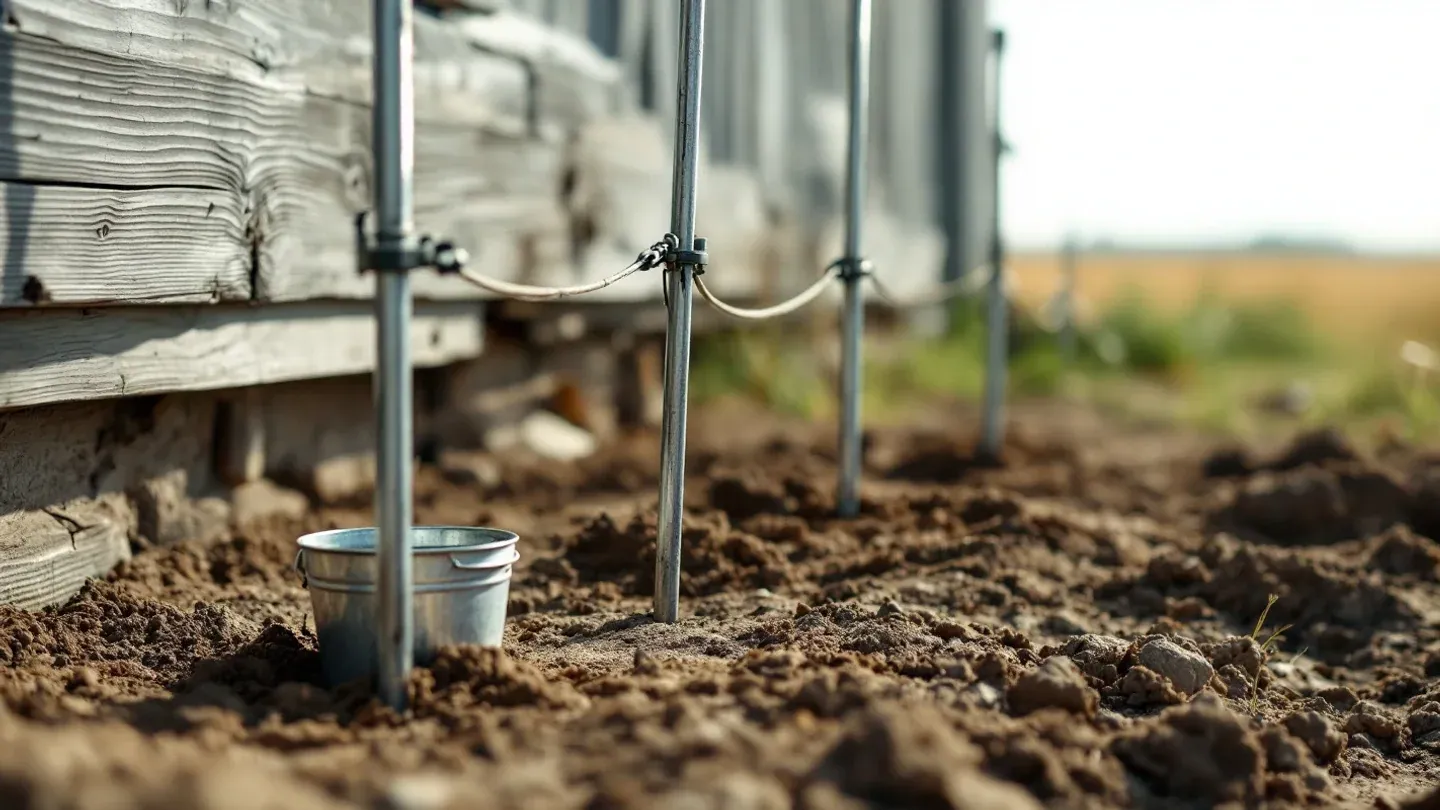
The Missouri booklet states it without hedging: most electric-fence problems are caused by poor grounding. Its rule of thumb is at least three feet of rod in the ground per joule of output, rods ten feet apart so that at least some of them find moist soil, and a location chosen with a long, dry summer in mind, such as the north side of a building under the drip line. Virginia Tech's grounding guide gives the industry minimums: three rods for energizers up to 15 joules, five up to 25 and seven up to 35, each driven six feet into moist soil and at least ten feet apart, kept at least 33 feet from utility and household grounds, galvanized rods joined with galvanized wire and never mixed with copper. In very dry or sandy ground, water the rods regularly; a slurry of bentonite and coarse salt around each rod improves conductivity for a few years.
A small solar unit on a strip fence gets its own ground, usually a single three-foot rod with a T-handle, which Virginia Tech says serves most small solar energizers. In a July like this one, pour a bucket of water on it when you move the fence.
Test the ground rather than trusting it. The Missouri method: 300 feet from the energizer, lean three to six steel posts on the fence until the fence reads 2,000 volts or less, then put the voltmeter on the last ground rod. It should read zero; most energizers tolerate up to 300 volts there. Anything higher means more rods.
Posts, reels and the one-person move
For fence that moves often, the Missouri booklet recommends tread-in posts with small spikes and wide tread plates, one post every 40 to 60 feet, which is enough because polywire is light. Use a steel T post at corners and gates: polywire is not strong enough to pull one over. The Maine evaluation adds a caution for dry weather: polyethylene tread-ins go into wet ground easily but can be impossible to push into baked soil, while plain fiberglass rods work in all conditions, if more slowly. In a dry summer, carry a few fiberglass rods and a small hammer. On reels, both sources agree. Maine's evaluation calls a reel essential and found the steel-crank reel worth its extra ten dollars; the Missouri booklet says reels save time and extend the life of the polywire.
The routine that lets one person move a herd without help is to build tomorrow's fence today. Run two reels. While the herd grazes today's strip behind wire one, walk wire two across the far edge of tomorrow's strip and clip it to the lead wire. The move itself takes a minute: unhook the handle on wire one, step back, and the herd walks into fresh grass because fresh grass is the reward. Reel up wire one as you go, and it becomes the fence for the day after. In the growing season a back fence protects regrowth from being grazed twice; on winter stockpile the Missouri booklet says not to bother with one, and to start at the end closest to water. Our guide to stockpiling and bale grazing picks that up. Cut-out switches, which Virginia Tech notes are often installed at the entrance to each field, let you kill one section while you work on it without walking back to the energizer.
Water first, then the wire
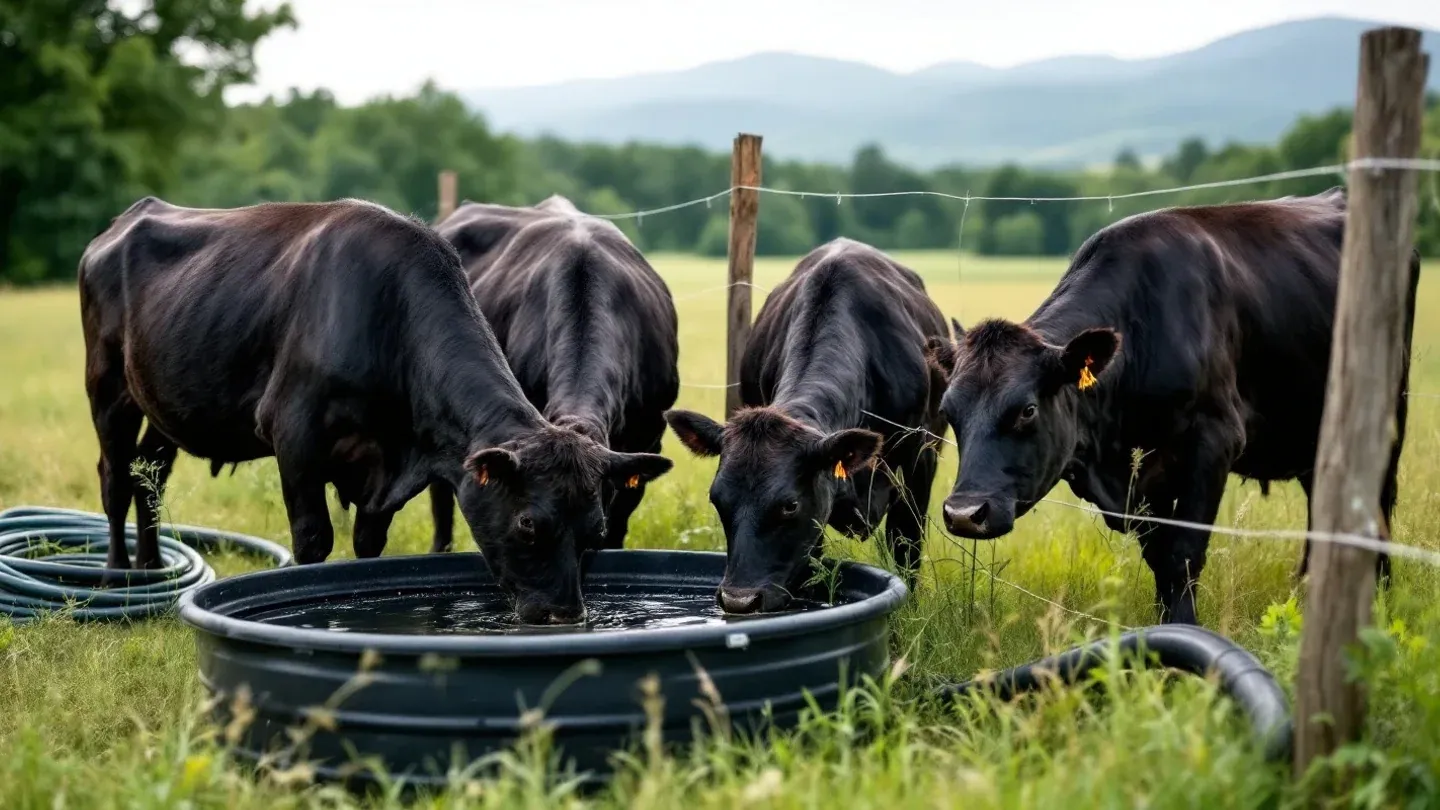
Set the water before you set the fence. The Vermont checklist gives the numbers that shape a layout: a dairy cow may drink 20 to 30 gallons a day; once water is more than 900 feet away animals go to it as a group, and the tank then needs to hold at least a quarter of the daily requirement and let 5 to 10 percent of the herd drink at once. Portable tubs of 100 to 150 gallons that move with the fence cut walking, spread nutrients more evenly across the pasture and leave fewer heavy-use areas than a fixed tank. Black pipe laid along the fence line stays cooler once grass grows over it. For the supply end, see farm ponds, wells and livestock water lines. For shade and summer grazing plans, see heat stress in cattle.
Training animals to a fence they can barely see
A strand of polywire holds a cow because of what she remembers, not what it can physically stop. The University of Maine's training guide describes the standard method: a small enclosure with a physical perimeter of woven wire or boards and the electric fence inside it. Let the animals find the wire on their own; never herd them into it, because they need an escape route. Most groups are trained in no more than a day. Sheep and goats are the hardest, and wool insulates, so train sheep right after shearing. Retrain every spring, and cull the animal that keeps testing the wire.
Virginia Tech's how it works sheet adds the voltage side: make sure the fence reads at least 5,000 volts during training, and keep it there afterward. Producers who routinely hold 3,000 to 5,000 volts for cattle and 7,000 for sheep report that their stock respect the fence even during a power loss. The Missouri booklet's energizer spec is similar: a low-impedance unit with at least 5,000 volts output, 35 to 65 pulses a minute, and a pulse no longer than three ten-thousandths of a second.
Read the voltmeter on every move
Carry a digital fence tester, and a fault finder if the budget allows; the Missouri booklet says the second one greatly speeds up locating subtle shorts. The University of Maine's troubleshooting table is the one to tape inside the energizer box. Low readings at several points along the fence point to an energizer that is too small or set low, weak batteries, an inadequate ground system or dried-out soil. A low reading in one spot means a broken wire, a dead short, a broken or disconnected jumper, or a ground rod that has come loose or deteriorated. Many of this summer's fence problems will be in the first group, and the fix is water on the rods, another rod, or a bigger unit.
What NRCS practice 382 pays in fiscal year 2026
Fence is NRCS conservation practice 382, funded through EQIP, usually as part of a grazing plan. How the money works in general is in our explainer on EQIP and CSP payments for a small farm. What changed this year: a Minnesota NRCS briefing on its 2026 EQIP updates explains that all practice scenarios were nationalized for 2026, that EQIP and CSP now use the same scenarios, that rates are set at national headquarters, and that 3,600 scenarios were posted on December 23. States still choose which scenarios they offer, and the same briefing warns that not every scenario in the national report is offered in Minnesota.
Pennsylvania's published cost list for FY 2026, issued March 11, 2026, shows what the fence scenarios look like in practice. Temporary or portable fence pays $0.68 per foot, high-tensile electric fence with four wires or fewer $2.16, five or more wires $2.84, and 96-inch woven wire $6.78. Each scenario has a second rate, marked HU in the list, for historically underserved producers: beginning, socially disadvantaged, limited resource and veteran farmers and ranchers, whom the EQIP payment rule allows to be paid up to 90 percent of the estimated cost of a practice against 75 percent for everyone else. For fence that means $0.82, $2.59, $3.41 and $8.14 a foot respectively. Pennsylvania caps practice 382 at $75,000, a total cap rather than an annual one, under the policy that states may use payment caps to manage limited funding. At 68 cents a foot, a mile of temporary fence comes to about $3,590. Check your own state's list, since not every scenario is offered everywhere, and remember that EQIP pays afterward: before NRCS issues a payment you certify that the fence is complete to the contract, and NRCS or an approved technical service provider certifies that it meets the technical standard.
For scale, the Missouri booklet's 2005 figures put a four-strand barbed-wire fence at about $5,000 per mile and a single-wire electric fence at about $1,600. Prices have moved since, but the ratio is why electric fence made rotational grazing affordable in the first place, and why the grass-fed operations in our guide to setting up a grass-fed beef farm are built on it.
A practical close
Before you spend money, settle five things in this order. Where the water is, because the fence follows the water, not the other way around. How many miles of wire the energizer must push, counted on the perimeter plus the longest strip you will ever run, then buy the next size up in output joules. Where the ground rods go, chosen for the driest August you can imagine. Which conductor matches the animal: one strand of six-strand polywire for trained cattle, netting or three low strands for sheep and goats. And how you will train the new animals before they ever see open pasture.
Then build the routine: two reels, tomorrow's fence set today, the tester in your pocket, a bucket of water for the ground rod on dry days. A move that takes one person ten minutes will happen every day; a move that needs two people and an hour will happen when it is convenient, which in July is never. That is the quiet logic behind our belief in keeping things simple. It is also what managing the whole means here: the fence is only worth what the rest it creates is worth. Fence suppliers and energizer makers worth knowing are listed under service providers and manufacturers. The grazing groups that run fence-building field days are in our organizations directory. If you want a second opinion on your layout, start with the principles in how to graze responsibly and draw the water lines first.