
Every farmers market in the country has heard the same question this spring: "Why are your eggs still seven dollars when the store is back under five?" The honest answer is that a pastured flock never priced off the store in the first place. It cannot. The grocery egg rode a disease curve up and down in six months. Your hens eat the same feed in March as in September, and the feed bill, not the headline, is what a dozen has to cover.
This article walks through the decisions in the order a small farm meets them: how big a flock, what to house it in, what the feed really costs, what the hens will lay by season, what the egg handling rules require, and how to set a price you can defend when the supermarket number swings.
The 2025 egg shock, seen from the farm gate
The numbers were real. The Bureau of Labor Statistics average price for a dozen grade A large eggs went from $4.15 in December 2024 to $4.95 in January, $5.90 in February and $6.23 in March 2025, then fell to $5.12 in April and $4.55 in May, the latest reading published as this is written. For scale, the same dozen averaged $2.52 in January 2024.
The cause was supply, not demand. The Congressional Research Service counted 1,667 flocks and 168 million birds lost to highly pathogenic avian influenza between February 2022 and March 25, 2025, with table-egg layers making up 75 percent of the losses, partly because laying hens live longer than other poultry. Americans ate an estimated 274 eggs per person in 2024, and USDA expected 2025 table egg production to come in 1.3 percent below 2024.
On February 26, 2025 the Secretary of Agriculture announced a plan of up to $1 billion, reproduced by the Louisiana Department of Agriculture: up to $500 million for biosecurity, with USDA covering up to 75 percent of the cost of fixing the worst gaps found in audits, up to $400 million for indemnity and faster repopulation, up to $100 million for vaccine and therapeutic research, plus regulatory relief and temporary imports. The same CRS fact sheet records that in March USDA raised the layer indemnity from about $7 to nearly $17 per lost bird and announced egg import commitments from Turkey and South Korea. We covered the wider policy picture in what farmers should watch from the new administration and USDA.
None of that money reaches a 200-hen pasture flock, and none of it changes your costs. What it does is set the customer's reference price, which is the problem this article ends with.
Pick a flock size you can carry, not one you can imagine
The federal rules draw one line, and it is a useful one for planning. FDA's egg safety rule applies to producers with 3,000 or more laying hens. Under 21 CFR 118.1, a farm with fewer than 3,000 hens, or one that sells all of its eggs directly to consumers, is outside the Salmonella testing, pullet sourcing and record-keeping program. The Egg Products Inspection Act in 21 U.S. Code 1044 likewise exempts a producer selling eggs from his own flock directly to household consumers and any producer whose annual production comes from 3,000 or fewer hens. Below that line you answer mainly to your state's egg law. Above it you are a regulated egg handler.
Within that space the real limit is labor and market, not law. The University of Vermont study of 1,000 and 3,000 hen pastured flocks put weekly labor for 1,000 hens at four to fourteen hours of washing, three to ten hours of daily chores and one and a half to three hours of sales and deliveries. It also found that labor, feed and pullets together were almost 64 percent of the cost of a dozen. A flock that outruns the hours you have will eat its margin in spoiled eggs and missed markets.
Our advice is the same we gave for pastured broilers: start with a flock that fits one person's morning, learn the lay rate and the feed bill on your own ground, then grow in steps. That is managing holistically applied to chickens: the flock has to fit the people, the land and the customers at the same time.
Space rules of thumb from the same Vermont report: at least 2.5 acres of pasture for every 1,000 hens, divided into eight or more paddocks of at least 13 square feet per bird, with the flock moved at least weekly. ATTRA's egg production guide adds one nest box for every four hens and six to eight inches of roost per bird, with roosts about three feet off the floor.
Housing that moves with the grass
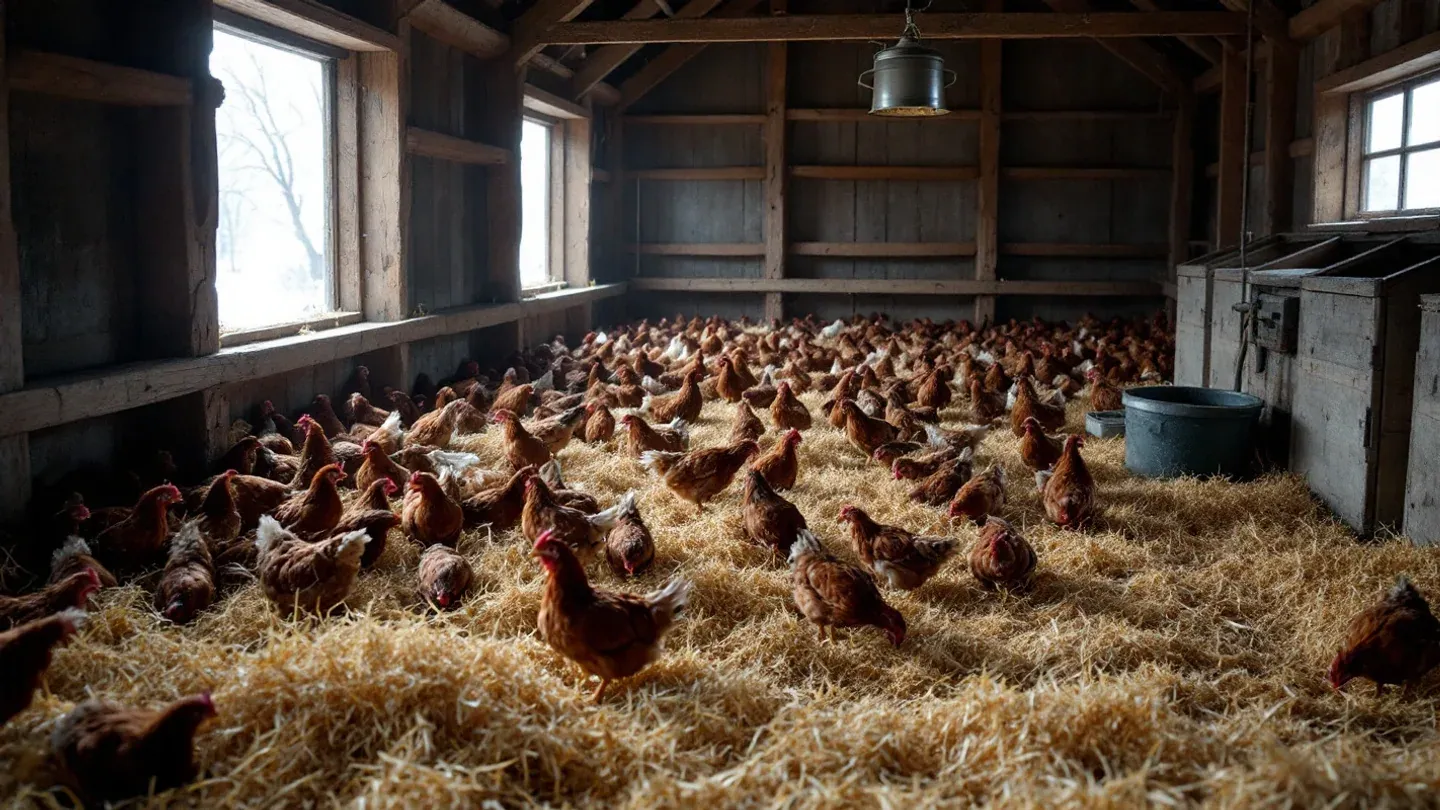
ATTRA sorts layer housing into fixed and mobile. The fixed version is a house in the middle of the pasture with doors opening to divided paddocks. Mobile comes in two builds: a house on wheels, built on a trailer and pulled by a tractor, and a house on skids, anywhere from a hand-pulled hoop house to a larger building moved by an ATV, pickup or tractor. The mobile versions are what make a layer flock a soil tool. Manure lands where the grass needs it, the hens scratch out fly larvae and weed seeds behind the cattle, and the bare patch under the house heals before the flock returns. That is the chicken's part in healing the soil, and why we have long argued for combining livestock with plant growing rather than running either alone.
Two design points matter more than any floor plan. First, predators. ATTRA's rule is to shut the house securely at night, when most attacks happen, and open it only after sunrise; electric poultry netting stops skunks, opossums and raccoons but not bobcats, coyotes or dogs, and some producers say a guardian dog is not fully trustworthy until it is three years old and well trained. Predator stress alone can knock lay for up to a week even when no bird is lost. Second, light. The Vermont report notes that adding a timer and bulb is easy in a fixed house and awkward in a mobile one, and that even lit flocks drop in winter. If you plan to carry the flock through a northern winter, plan the power and the bedding pack now, not in November.
Our service provider and manufacturer directory lists builders of mobile houses and suppliers of netting and energizers. The fencing itself is covered in portable electric fencing for rotational grazing.
Feed is the bill that decides everything
Kansas State's small flock nutrition guide puts feeding at 60 to 70 percent of the cost of production, and nothing about pasture changes that. ATTRA estimates that pasture supplies roughly 5 to 20 percent of a laying hen's daily nutritional requirement, depending on breed and forage quality. The rest comes from the bag.
The Vermont budgets assumed 0.30 pounds of feed per hen per day and showed what a tenth of a pound means: a 1,000-hen flock eating 0.30 pounds instead of 0.25 pounds a day spends an extra $4,107 a year on feed, without laying one more egg. On conventional feed in 2015, feed came to $1.08 per dozen, labor $0.90 and pullets $0.41. Organic feed can run up to twice the conventional price, which pushed the 1,000-bird organic model to $4.82 per dozen in that study.
A quick way to see your own number: a hen at a quarter pound a day in a flock laying at 70 percent produces about 4.3 pounds of feed per dozen eggs; at a 50 percent winter lay rate it is 6 pounds per dozen. Multiply by your delivered feed price per pound and you have the single biggest line in your cost per dozen before you have counted a minute of labor. Buying in bulk, keeping feeders out of the rain and feeding a complete layer ration rather than scratch are the plain, boring moves that protect that line. That is what we mean by always simplify: the enterprise that tracks feed per dozen every month will out-earn the one with a prettier coop.
Lay rate follows the daylight, not your bookkeeping
Oregon State's PNW 565 lays out the curve. Pullets start laying at 18 to 20 weeks, peak at about 35 weeks at above 90 percent, hold that for roughly 10 weeks and then decline slowly. A commercial White Leghorn lays about 265 eggs a year; backyard and heritage breeds lay fewer, which is the trade-off we take up in heritage breeds on pasture. ATTRA lists Leghorns, Bovans Browns, Rhode Island Reds and the Gold, Black and Red Stars as capable of more than 250 eggs a year.
Day length drives the rest. To hold production, Oregon State says the day must stay above 12 hours or be increasing; 14 to 16 hours is typical, a bulb bright enough to read by is enough, and even a one-day lapse in the schedule can hurt, so use a timer. ATTRA's method is to add 15 minutes of light a week from 20 weeks until the day reaches 16 hours and hold it there. Hens molt in the fall as days shorten and stop laying for what can be several months; ATTRA notes that the weekly egg count declines after the first molt. Hens produce well for two to three years and then fall off.
The Vermont farms reported summer lay rates of 70 to 85 percent and winter rates of 50 to 70 percent even with supplemental light, and the report's answer is to keep flocks of different ages: most producers bring in new pullets in spring and fall and overlap them with the old layers before culling, so production never rests on one group. Build that stagger into the budget. A customer who buys three dozen a week in July expects three dozen in January, and being consistent with supply is worth more to a farm's reputation than a few extra dozen in June.

Handling, washing and the rules you are still under
Being exempt from the FDA program does not mean eggs are unregulated. ATTRA's small-scale egg handling guide is the best single reference: collect about three times a day, more in extreme weather; dry-clean lightly soiled eggs with a brush or sanding sponge and discard the filthy ones rather than washing them; if you wash, use flowing water at least 20 degrees Fahrenheit warmer than the warmest egg and at least 90 degrees, never a soak, because a wet shell draws bacteria through the pores and the cuticle that protects the egg is damaged by washing; dry before packing; store at 45 degrees Fahrenheit and 70 to 85 percent humidity; and, for a specialty producer, sell within seven days of lay. Some states require small producers to candle, and ungraded eggs usually have to be marked as such on the carton.
Federal temperature rules sit alongside that. For covered farms, 21 CFR 118.4(e) requires eggs to be held and transported at or below 45 degrees Fahrenheit ambient beginning 36 hours after lay. USDA's 9 CFR 590.50 requires shell eggs packed for consumers to be stored and transported at no more than 45 degrees and to carry the safe handling statement; a producer-packer with 3,000 or fewer layers is exempt from that section's temperature rule but, in the regulation's own words, is still required to comply with the safe handling labeling. Many state egg laws set their own temperature, carton and licensing rules on top, so read your state's before the first market. Our piece on cottage food laws walks through how to find those pages. On-farm cold storage covers the cooler itself.
Grading is a separate matter. USDA grading is a voluntary program under 7 CFR Part 56, and the AMS 56 standard defines the quality grades AA, A and B and the weight classes that cartons refer to: Jumbo is at least 30 ounces net per dozen, Extra Large 27, Large 24, Medium 21, Small 18, Peewee 15. AMS publishes the grade tolerances as well. A small farm need not grade, but sorting by those weights and selling an honest "Large" is cheap credibility, and it matters for the same reason we argued in honest labels: the pastured premium rests on trust.
Pricing a dozen honestly when the store price swings
Here is the trap of 2025. In March a customer compared your $7 dozen with a $6.23 grocery average and thought you were fair. In May the same customer compared it with $4.55 and thought you were greedy. Nothing on your farm changed. If you price off the store, you will cut when it falls and feel pressure to raise when it spikes, and you will teach your customers that your eggs are a commodity with a markup.
Price from your own cost instead. The Vermont study is the clearest published worked example: a 1,000-hen pastured flock on conventional feed cost $3.32 per dozen before loan payments and $3.71 with them, and the 3,000-hen model cost $2.91 and $3.24. Those are 2015 Vermont numbers, and yours will differ, but the method holds: feed, labor at a real wage, pullets, housing, cartons, market fees, mortality and the molt months, divided by the dozens you actually sold. Our companion piece, know your cost of production before you set a price, goes through the spreadsheet line by line, and the broader farm business plan frames it.
Then look at the ceiling. The same Vermont research found wholesale demand for local pastured and organic eggs dropped once the price passed $4.25 a dozen, while Whole Foods stores along the East Coast were retailing pastured eggs at about $6.99 and organic at $8.99, roughly $4 and $5 wholesale; consumers were surprised that pastured ran nearly $2 above cage-free. Direct sales at a market stall or through a farm-to-door CSA keep that whole spread on the farm, which is why eggs are so often the enterprise that pays for the other ones; they are among the quickest ways to diversify farm income.
Three rules we would hold to:
- Set the price from cost plus a margin that pays you, and change it on a schedule, once a year, with notice. Not when the news does.
- When the grocery price spikes above yours, do not raise to meet it. Say so out loud. The customers who notice will stay for years.
- When the grocery price collapses below yours, explain the feed bill in one sentence and leave the price alone. Thin weeks pass; a price you cannot sustain does not.
That is acting local in its simplest form: a price set by the real cost of a real flock, told plainly to people who can drive past the pasture.
The short list before the first pullets arrive
- Decide the flock size by the hours you have, and check your state's egg law before you order birds.
- Choose skids or wheels based on what you already own to pull them, and plan the night-time predator lockup before the first move.
- Price feed delivered, by the pound, and write feed per dozen into the budget at the summer and winter lay rates above, not at the peak.
- Plan two age groups so production does not drop off a cliff in the first molt.
- Set up collection, dry cleaning, 45-degree storage and labeled cartons before the first dozen leaves the farm.
- Set one price from cost, write down why, and keep it.
ATTRA and the extension services linked above are in our organizations directory. The farms and ranches directory includes pastured egg producers who have run this enterprise for decades. The egg shock of 2025 showed how fragile a concentrated supply can be, a point we made about meat production five years ago. A few hundred hens on grass will not fix that. They will feed a town steadily, at a price that tells the truth.