
January is the month for this. The ground is frozen across most of the country, the state nursery order forms are out, and whatever goes into the ground this spring will be shaping the wind, the soil and the insect life on your farm for the next forty years. This is a guide to field edges that earn their keep: what a windbreak or hedgerow actually does, what the research says it is worth, how to choose and space the plants, how to keep them alive through the first three summers, and who will help pay.
What a row of trees does to the wind
A windbreak works by forcing most of the wind up and over it. According to How Windbreaks Work from the University of Nebraska, wind speed drops on the windward side for two to five times the height of the trees (2H to 5H) and on the leeward side for up to 30H. For a row of 30-foot trees that means measurably calmer air 60 to 150 feet upwind and as far as 900 feet downwind, with the zone that designs count on running out to 10H.
Density matters more than people expect. A barrier that is 40 to 60 percent solid gives the largest protected area and excellent erosion control. A solid wall builds turbulence on the lee side and shrinks the sheltered zone, and anything under 20 percent dense does little. Gaps act as funnels that push wind above open-field speed, so lanes belong at the ends of the planting, and a row should run at least ten times as long as it is tall.
Inside the sheltered zone the microclimate shifts: daytime air within 10H is several degrees warmer, relative humidity runs two to four percent higher, and evaporation and plant water loss fall. That is where the yield comes from, and it is also where the soil stays. The Arbor Day Foundation's field windbreak sheet notes that fine soil particles start to move once wind passes about 13 miles per hour, and the South Dakota forestry division points out that wind erosion does its worst on large open fields in the weeks when the surface is loose, dry and bare for planting. Slowing the wind over that window is the cheapest erosion repair there is, far cheaper than the repairs after the fact. It is also the plainest expression of our first belief, heal the soil: keep it where it is.
The yield math
The South Dakota Department of Agriculture and Natural Resources summarizes the shelter research in its Field Windbreaks bulletin: crop yields in the protected zone improve by 5 to 45 percent depending on the year, with worldwide averages of 10 to 15 percent for corn, 12 to 17 percent for soybeans and 20 to 25 percent for winter wheat, mostly from better water use. The same bulletin is honest about the catch: under limited moisture the trees compete with the first rows of crop, and that strip yields less. In most cases the gain across the rest of the protected field more than covers it, and the bulletin's worked example has a 160-acre corn and soybean farm with four single-row windbreaks recovering its establishment cost and lost acreage within ten years.
The Arbor Day sheet puts whole-field gains at up to 20 percent where hot, dry winds are the problem, counting the land the trees occupy. Nebraska's Lewis and Clark Natural Resources District adds two design rules: keep the planting footprint under about 5 percent of the field, which is why most crop-protection windbreaks are a single row of tall trees, and expect the biggest response 3 to 10H downwind with some benefit out to 15H. The benefit is largest in dry years.
Vegetable growers see the sharpest numbers. In Nebraska trials reported in Windbreaks for Fruit and Vegetable Crops, cabbage yields rose 14 to 18 percent in shelter, sheltered snap beans returned a gross value 47 to 63 percent higher than unprotected beans, and marketable melon yields were 70 percent greater, largely because the plants were not sandblasted, dried out or whipped. Sheltered peppers doubled their marketable yield, with more flowers and less bacterial leaf spot. For transplants on sandy ground, a windbreak is also one of the better ways to conserve water, and the same publication asks for 40 to 60 percent density early in the season, when seedlings need it most.
Hedgerows and the insects you want
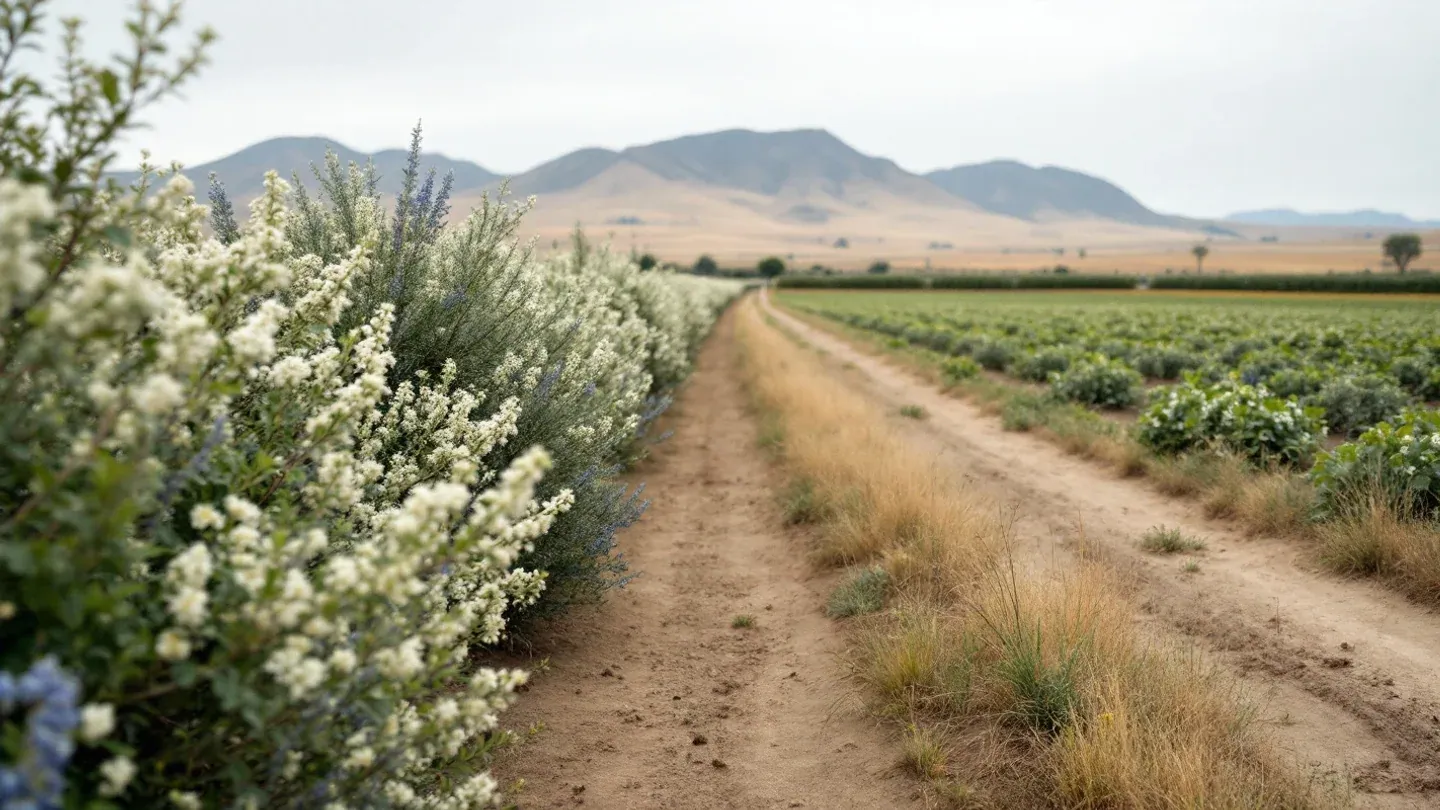
A hedgerow is the shrubby, flowering cousin of the windbreak: a dense linear planting of mostly native shrubs and bunch grasses whose main job is habitat rather than wind. The best US numbers come from work in California's Sacramento Valley. In a paired comparison of tomato fields with and without hedgerows in Yolo County, published by Morandin, Long and Kremen in the Journal of Economic Entomology in 2016, only one of eight fields next to a hedgerow reached the aphid treatment threshold, against four of eight fields with conventionally managed weedy edges. Aphid suppression held for the full 200 meters they measured into the field, and parasitism of pests was higher for the first 100 meters.
Pollination moved too. Canola plants set beside hedgerows received 4.2 native bee visits per observation against 1.0 beside unplanted edges, and the extra native bee visits were worth an estimated 21 percent more seed yield where honey bees were not already saturating the crop.
Then they did the accounting. A typical 1,000-foot (305-meter) hedgerow in that region cost about $4,000 to design, prepare, plant, irrigate, weed and keep vertebrate pests off through its first three years. On insecticide savings alone it pays for itself in 16 years. Add the pollination benefit on a crop that needs it and the payback falls to 7 years, and with the usual 50 percent EQIP cost share the pest-control-only case breaks even in 9 years. Upkeep after year three was minimal, and the plants took three years to mature into a reliable flower supply. Those are California figures on California crops, and the authors say so, but they are the clearest demonstration yet that a field edge can be a line item that pays rather than one that costs. Think long-term is the only honest frame for it: the hedgerows in the study were ten years old.
Species by region
The rule that beats every list: plant what your state conservation nursery grows and what your district forester recommends. The NRCS standards require species adapted to the soils, climate and site, nothing on the federal or state invasive or noxious weed lists, and, for crop protection, trees that will grow taller than the crop. The Illinois windbreak standard also asks for diversity at the genus level so one pest cannot take out the row, and warns against species that host crop pests or that send root sprouts into the field.
On the Plains, eastern redcedar is what Kansas State's Windbreaks for Kansas calls the backbone of a good winter windbreak, with Rocky Mountain juniper, ponderosa pine and Austrian pine among the other evergreens on its list, hackberry to provide height, and American plum, sandhill plum and lilac for ground-level protection, the plums doubling as wildlife cover and summer food. On sandy uplands it points to ponderosa pine, Austrian pine, redcedar, juniper and American plum; on shallow, dry sites to redcedar, juniper, ponderosa and honeylocust.
In the lower Midwest the Missouri Department of Conservation's nursery form rates eastern redcedar, Norway spruce and eastern white pine as its windbreak evergreens and lists hackberry, Osage orange and a run of wildlife shrubs beside them. In California's valleys the hedgerows in the Yolo County study were California buckwheat, California lilac, coffeeberry, coyote brush, elderberry and toyon, all natives. California's hedgerow standard asks for that kind of mix: where pollinators are the purpose, several species with different blooming periods from early spring through late summer, and where wildlife is, at least 80 percent California natives. In the Northeast and Southeast, start with your state forestry agency's seedling catalog and the organizations in our directory that work on farm habitat. Our agroforestry primer covers the wider family of practices these edges belong to.
Spacing and layout
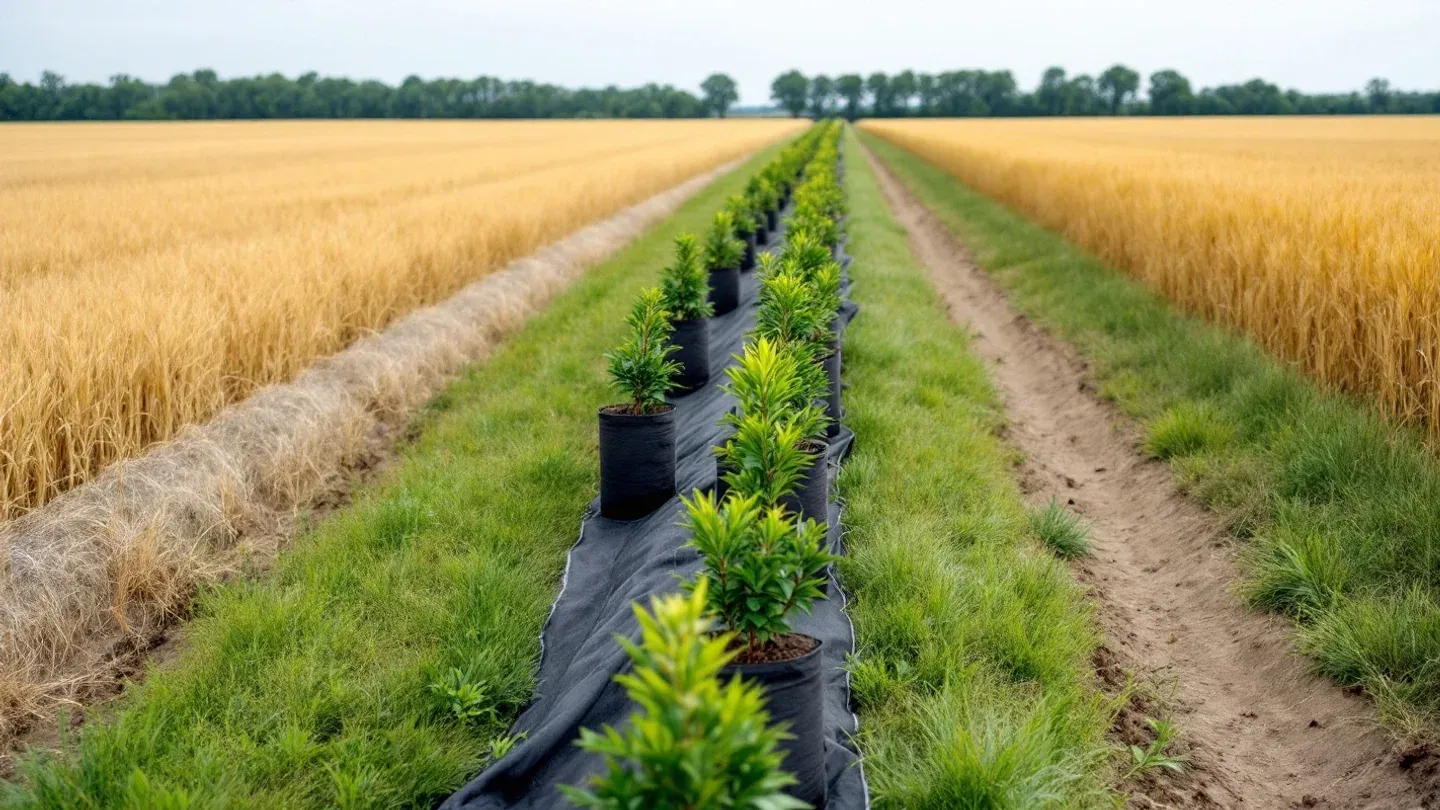
Older Plains shelterbelts ran five to ten rows. The modern field windbreak is one or two rows and takes far less land out of production. Run it as close to perpendicular to the problem wind as you can, which for a summer crop may be a different direction than the winter wind. Extend it well past the area you want protected, at least 100 feet beyond in the Kansas guidance, because wind eddies curl around the ends. If a lane must cross it, angle the opening.
Within the row, Windbreaks for Kansas gives these planting distances: shrubs 3 to 6 feet, eastern redcedar and Rocky Mountain juniper 6 to 10 feet, pines 8 to 16 feet, short deciduous trees 6 to 12 feet and tall deciduous trees 8 to 18 feet, using the close end in the windward row and in two-row plantings and the wide end in the interior and lee rows of a multi-row belt, with wider row spacing in the dry west of the state. Missouri's form gives 5 to 12 feet for windbreak seedlings. Between rows, leave at least 4 feet more than the width of your cultivation equipment; the Kansas foresters trace most problems in old windbreaks to trees planted too close. Keep a maintenance strip of at least 16 feet between the outside row and a property line or a different land use, the figure in the Illinois standard, and remember that NRCS designs the protected zone as 10H at the height the trees will reach at age 20, 2H on the windward side.
A hedgerow can be as narrow as a single row 5 feet wide. Where wildlife cover is the purpose, California's standard asks for 15 feet at maturity, which may take more than one row, and it suggests renovating no more than a third of the length at a time so the habitat never disappears all at once.
The first three years
Establishment, not planting, is where field edge projects fail. Kansas State's Weed Control Options in Tree Plantings says a seedling takes at least three years to establish, longer on poor sites, and that weed competition can cut mature tree growth by as much as two thirds. The Illinois standard requires a weed-free circle of at least 2 feet around every plant for the first two years and control of grass in that radius until the woody plants are at least as tall as the grass. The options are cultivation no deeper than 4 inches and no closer than 9 inches to the stem, a 2 to 3 foot ring of mulch, polypropylene weed barrier fabric, which the Kansas publication says has been shown to raise survival, growth and soil moisture, or a labeled herbicide.
Water is the second failure point. K-State's watering guidance for new trees is a thorough soaking once or twice a week in the first month, then roughly 10 gallons a week through the first season when it does not rain, evergreens right up to freeze, with a warning that overwatering produces a "wet wilt" that looks like drought. Windbreaks for Kansas says to irrigate at planting and as needed for the first three growing seasons when soil moisture is short. Protect seedlings from rabbits, deer and mice with screens, wraps, tubes or repellents, fence livestock out of the planting, and replace losses: the Illinois standard expects dead plants replaced for two years and at least 90 percent survival with no two adjacent gaps. Hedgerows are the same story; the California standard requires competing vegetation controlled until the planting is established and the row protected from grazing for its whole life.
Who helps pay
Two NRCS practices cover this work. Hedgerow Planting, code 422, is the establishment of dense vegetation in a linear design for purposes that include wildlife habitat, pollen and nectar for pollinators, cover for the beneficial insects that do pest control, interception of dust, spray drift and odor, and living fences. Windbreak/Shelterbelt Establishment and Renovation, code 380, covers single or multiple rows of trees or shrubs to reduce wind erosion, protect plants from wind damage, manage snow, cut evaporation, shelter livestock and buildings and store carbon. NRCS designs a windbreak to be functional within 20 years, and the practice also pays for renovating an old belt that has stopped working. The Illinois standard notes one more use: a windbreak can serve as the buffer an organic certifier wants between your fields and a neighbor's sprayed ones.
EQIP pays a share of the installation; the California study assumed the usual 50 percent. CSP rewards a whole-farm conservation plan that can include these edges. Our guide to EQIP and CSP for a small farm explains how the two programs differ. The conservation title and the IRA money covers the extra funding behind them this year. Applications go through your USDA service center, where staff check eligibility and rank offers against local resource concerns before a contract is signed. Ask this month when your state's next ranking date falls, so a spring planting is not waiting on a contract. For land you want out of production altogether, the Farm Service Agency's continuous CRP sign-up takes certain practices without competitive bidding whenever it is open, on 10 to 15 year contracts with an annual rental payment; ask the FSA office when this year's sign-up opens and whether a windbreak or shelterbelt practice is available in your county.
Where the trees come from
State conservation nurseries sell bare-root seedlings by the bundle for a fraction of retail, and this is the season. Missouri's George O. White State Forest Nursery takes orders from September 1, 2023 through April 15, 2024 at 34 cents to $1.00 a seedling, ships from late February to early May, and sells out of popular species early; it turns 90 this year and is holding an open house on April 6, 2024. Iowa's State Forest Nursery in Ames, set up by the Civilian Conservation Corps in 1937, takes orders from September through May and distributes spring orders from April. The Kansas Forest Service sells conservation seedlings for windbreaks, wildlife plantings and streambanks for plantings in Kansas and surrounding states, and its foresters will help plan a planting. Most other states run something similar through their forestry agency or conservation districts. Our service providers directory lists suppliers of fabric mulch and tree tubes.
A January list
- Walk the field edge with last year's problem in mind: blowing soil in April, sandblasted transplants, a drift line from the neighbor, a field that never has enough bees. The problem picks the practice, and the practice picks the plants.
- Sketch it: the wind direction in the season that matters, the protected zone at 10H, the 16-foot strip, the lanes at the ends.
- Call the NRCS office about 380 or 422 and the ranking date, and the district forester about species for your soil.
- Order seedlings now, before the species you want sell out, and order a few extra for the replacements you will make in years one and two.
- Prepare the strip this spring: kill the sod, and have the fabric or mulch on hand before the trees arrive.
- Put the watering and the weeding on the calendar for three summers, not one. It belongs in the same winter plan as the crop rotation.
A windbreak planted this spring will not reach its design height for twenty years, and the hedgerow will not flower properly for three. That is the honest timeline, and it is also the point. The edge of the field is the one place on the farm where a single week's work in April keeps paying for the rest of a working life.