
Every fall the carbon arrives for free. Leaves pile up along the fence lines, corn stalks and straw come off the fields, and the bedding packs get cleaned out before winter. Put that carbon next to the manure pile and you have the two halves of a compost recipe. This guide covers how to build and turn a windrow on a working farm, what the numbers mean, what the organic and food safety rules require, and when a state permit comes into play. It is the farm-scale version of the loop we described in What is Circular Farming?
Why compost instead of spreading raw
Raw manure spread straight onto the field is cheaper and keeps more of its nitrogen. Composting costs time, space and fuel, and some nutrients leave during the process. A three-year Nebraska study cited by University of Nebraska Extension found that as much as 40 percent of the nitrogen and 60 percent of the carbon in beef feedlot manure went into the air during composting, and that raising the carbon to nitrogen ratio with high carbon materials such as leaves, plant residue and sawdust reduces the nitrogen loss.
What you get in return is a product that is lighter, easier to spread, nearly odorless, and low in viable weed seeds and pathogens. For a farm that sells vegetables, runs a farm stand or wants to bag a product, those four things matter more than the lost nitrogen. Finished compost also builds organic matter steadily, which is the whole point of healing the soil. It pairs well with the practices in our older piece on building better soil.
The recipe: carbon to nitrogen
Microbes eat carbon for energy and nitrogen for protein. The composting guide from Oregon State University Extension puts the reasonable range for a starting mix at 20 to 40 parts carbon per part nitrogen and the preferred range at 25:1 to 30:1. Too little carbon and the surplus nitrogen leaves as ammonia, which is the smell neighbors complain about. Too much carbon and the pile sits cold for months.
Nebraska's tables of manures and bulking materials give the numbers you need to balance a mix: leaves run 40:1 to 80:1 with an average near 54:1, straw averages about 80:1, corn stalks 60:1 to 73:1, and sawdust 200:1 to 750:1. On the nitrogen side, beef feedlot manure runs 10:1 to 20:1, dairy manure 8:1 to 30:1, and chicken manure 4:1 to 18:1. Fall leaves sit in the sweet spot: enough carbon to balance manure, but not so much that the pile stalls the way a sawdust-heavy mix does.
You do not need a laboratory to get close. Estimate the weight or volume of each material, look up its ratio and moisture, and use one of the compost mix calculators that NRCS refers to in its Composting Facility practice standard. Then check the result by what the pile does: a windrow that heats to 130°F within a few days and holds there was mixed about right.
Moisture, air and particle size
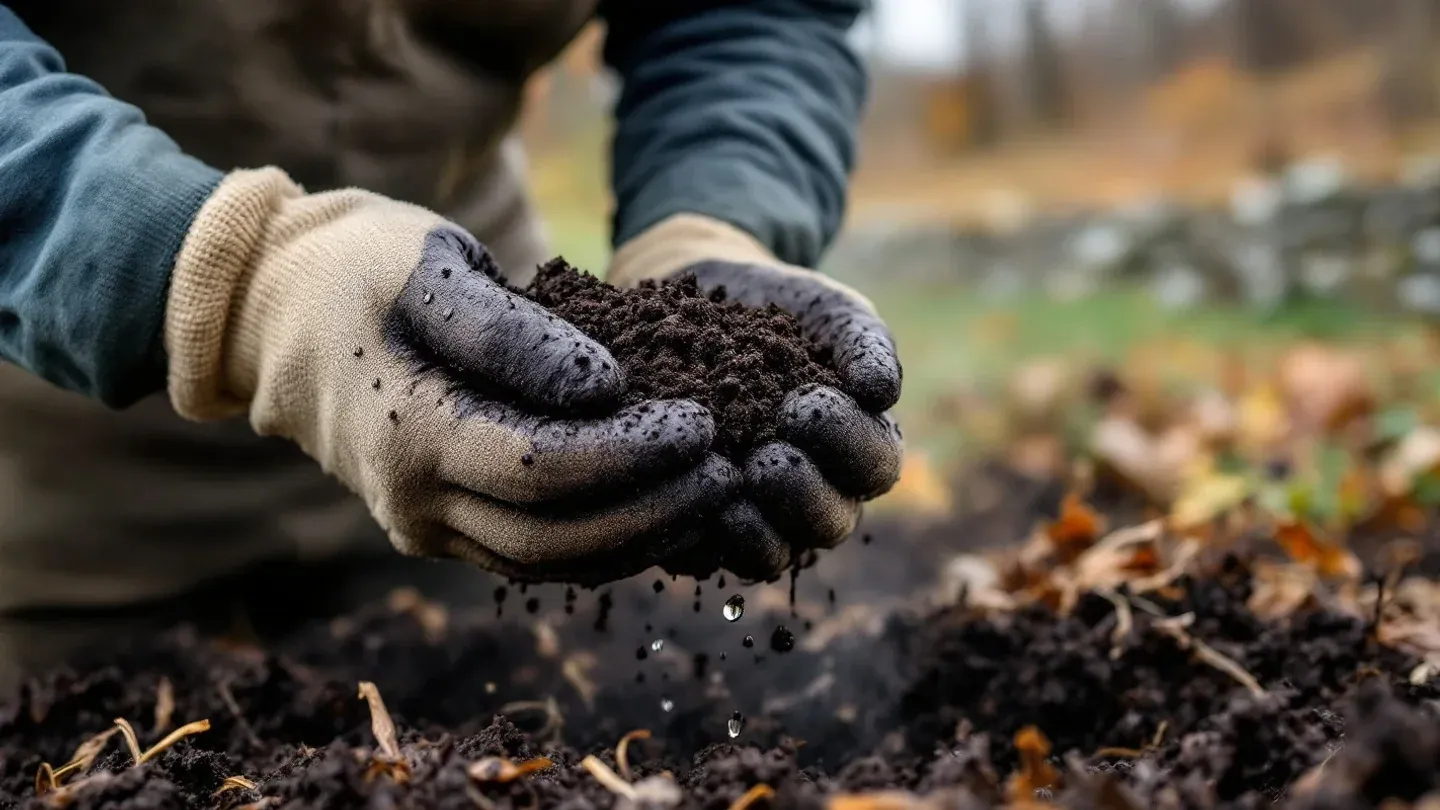
The Oregon State guide lists 50 to 60 percent moisture as preferred, with 40 to 65 percent workable. The field test is the squeeze: a handful at 50 percent feels damp and gives up no more than a few drops. Above 60 percent, water fills the pore space, air cannot move, and the pile goes anaerobic and sour. Below 40 percent, decomposition slows sharply, which is the usual problem with a leaf pile that never got wet.
Air is the other half. Composting is aerobic, and turning restores the pore space and mixes the cool outer layer into the hot core. Oregon State suggests turning when the pile temperature drops below 110°F. Particle size matters too: shredded leaves and chopped stalks offer more surface to microbes than whole ones, but chop too fine and the pile packs down and loses its airflow.
Building the windrow
Site first. The NRCS standard tells planners to locate the facility at least 50 feet from wells, streams and other water features, outside the 100-year floodplain, with the floor two feet or more above the seasonal high ground water table, and to redirect upslope runoff around the site. Those are sound rules even where nobody requires them: a windrow sitting in a wet swale leaches nutrients toward the creek and turns into mud by March.
Size the windrow to your loader. Nebraska's guidance for feedlot manure windrows is 3 to 6 feet high and 8 to 12 feet wide, turned with a windrow turner or a front-end loader. Oregon State names the two failure modes: an oversized windrow develops an anaerobic center that releases odors when turned, and an undersized one loses heat too fast to kill pathogens and weed seeds.
Build in layers or premix in the bucket, water as you go, and leave room between rows to turn. Time depends on the materials and the weather. Oregon State says dairy windrows commonly take about eight weeks with at least five turns, and Nebraska gives 60 to 120 days for feedlot manure. After active composting, let the pile cure. Oregon State recommends four to six weeks of curing for compost headed to gardens, bedding or bagged sale, and says compost going straight onto fields as fertilizer needs no curing at all. The food safety rule below is stricter: it requires curing.
The temperature log
A long-stem compost thermometer is the most important tool on the site. Push it into the core at several points along the row and write the readings down. The NRCS standard asks for a record of, at minimum, the date, the amounts and types of material added, the compost temperature, the weather and the actions taken. It also sets the practical limits: the pile must reach 145°F to kill weed seeds, temperatures above 165°F start to destroy the thermophilic bacteria that do the work, and a pile above 185°F must be watered and mixed at once to prevent combustion.
Keep the log in a notebook or a spreadsheet, dated, in the same format every time. It is the kind of unglamorous, consistent habit that pays off twice: once when you learn how your own mix behaves, and again when an organic inspector or a produce safety auditor asks for proof. The ATTRA compost tipsheet hosted by USDA's Agricultural Marketing Service says it plainly: accurate temperature records are needed to satisfy the organic standard.
The organic rules
If any ground on the farm is certified organic, the compost rules live in 7 CFR 205.203, the soil fertility standard of the National Organic Program. Raw manure must be composted unless it goes onto a crop not intended for human consumption, or is incorporated at least 120 days before harvest of a crop whose edible part touches the soil, or 90 days before harvest of a crop whose edible part does not.
To count as compost rather than raw manure, the process must have started with a carbon to nitrogen ratio between 25:1 and 40:1 and then held a temperature between 131°F and 170°F. In a windrow that window must be maintained for 15 days, during which the material is turned at least five times. In an in-vessel or static aerated pile system, three days is enough. The same section bans sewage sludge and any compost that contains a synthetic substance not on the National List.
Two practical points follow. First, the 25:1 floor for organic compost is higher than the 20:1 extension minimum, so an organic grower should err toward more carbon. Second, the process belongs in your organic system plan, with the feedstock sources and the temperature log, so the inspector can verify it. If you are weighing certification, our planned article on organic certification and the cost-share program walks through the paperwork.
The food safety rules
Farms covered by the FDA Produce Safety Rule face a second, similar set of numbers for any soil amendment of animal origin. Under 21 CFR 112.54, turned composting must keep the pile aerobic at a minimum of 131°F for 15 days, which do not have to be consecutive, with at least five turnings, followed by adequate curing. Static composting must hold 131°F for three consecutive days, again followed by curing. The rule defines curing as the cooler final stage that further reduces pathogens and stabilizes the product.
The payoff is in 21 CFR 112.56: compost treated by one of those processes has a zero-day application interval, provided it is applied in a way that minimizes contact with the covered produce. And 21 CFR 112.60 requires a farm that treats its own amendment to keep documentation that the process controls, for example time, temperature and turnings, were achieved. That is your log again.
The two rules overlap but are not identical. The organic rule sets a ceiling of 170°F and says nothing about curing. The FDA rule sets only a floor and requires curing. A farm under both should run the windrow to satisfy both: 15 days between 131°F and 170°F, five turns, then a curing period, all written down. Our planned piece on designing a wash and pack shed that meets FSMA covers the rest of the produce rule.
When a state permit is needed
Composting your own manure and crop residue for your own fields is, in most states, an ordinary farm activity. The questions start when materials come from off the farm, especially food scraps, or when compost leaves the farm for sale. The EPA puts it simply: operations that handle large volumes of material and certain feedstocks such as biosolids or manures may have additional permitting or zoning requirements, depending on state and local regulations. The NRCS standard makes the landowner responsible for obtaining all necessary permits before anything is built.
Washington's rule is a useful model because it is written as a table. Under WAC 173-350-220, up to 25 cubic yards of material on site at any one time needs no notification at all. A farm composting only its own agricultural wastes for its own use faces no upper volume limit and no notification. Add yard debris and the farm may hold up to 1,000 cubic yards at a time, of which up to half may be yard debris, but more than 25 cubic yards of imported yard debris on site triggers a notice of intent 30 days before operating. Distribute compost off the farm, and the operation must meet pathogen limits, test the compost and file an annual report.
Maryland shows the direction of travel. The General Assembly passed House Bill 253, approved by the Governor on May 8, 2023 as Chapter 521, which takes effect on October 1, 2023. It directs the state's Department of the Environment to exempt from permitting an on-farm composting facility that uses 10,000 square feet or less for active food scrap composting, composts only listed feedstocks, mixes off-farm food scraps with carbon and incorporates them into active composting within 24 hours of arrival, keeps records of amounts, sources and arrival times for five years, and gives the department written notice first. According to the fiscal note, the existing regulations already let a farm composting only its own materials use up to 40,000 square feet without a permit, while a facility in the lower two tiers of the state's composting rules, Tier 1 or Tier 2, which are defined by the lower-risk feedstocks they accept, could use only 5,000 square feet without one.
The pattern across states is consistent: on-farm materials for on-farm use are easy, imported food scraps and sales off the farm add conditions, and the line is drawn in cubic yards or square feet. Call your state environmental agency before the first load of restaurant scraps arrives, not after.
Paying for it
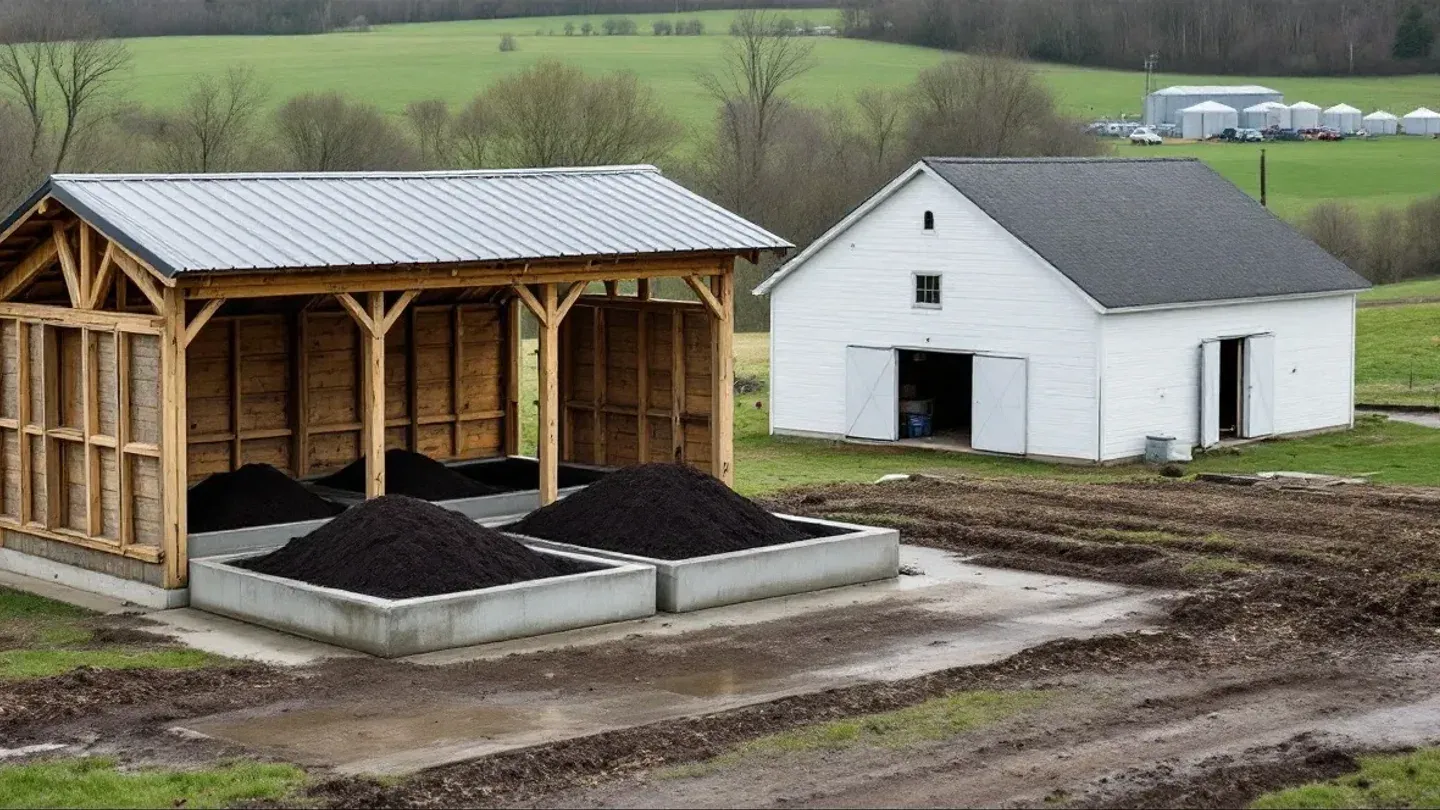
Two federal doors are open this year. The first is the NRCS Composting Facility practice, Code 317, which NRCS can cost-share through its conservation programs. The Vermont practice overview describes it as a structure or device to contain an aerobic microbial ecosystem for the decomposition of manure and other organic material, with a minimum expected life of 15 years, commonly applied with Roofs and Covers (Code 367) and Heavy Use Area Protection (Code 561), with the finished compost spread under Nutrient Management (Code 590). Our earlier article on how EQIP and CSP payments work explains the application cycle.
The second door is indirect. In February 2023 USDA announced more than $9.4 million in 45 Compost and Food Waste Reduction cooperative agreements in 27 states and one territory, funded by the American Rescue Plan Act and running from 2023 to 2025. USDA says it prioritized projects with plans to make compost easily accessible to farmers, including community gardeners; the Louisville project, for one, will make its finished compost available to the region at no cost. If your county or city won one, a phone call may get you finished compost, or a steady supply of leaves and food scraps as feedstock. The full recipient list is on USDA's urban agriculture page, and we will return to the food scrap side of the loop in a planned piece on turning farm seconds and surplus into food.
A fall checklist
- Pick the site now, before the ground freezes: 50 feet from water, out of the floodplain, runoff diverted, room for the loader.
- Stockpile carbon while it is free. Ask the town where its leaves go, bale the straw, chop the stalks, and keep it dry under a tarp.
- Mix toward 25:1 to 30:1 and 50 to 60 percent moisture. Check with the squeeze test.
- Build windrows 3 to 6 feet high and 8 to 12 feet wide, sized to your equipment.
- Take core temperatures daily during the first weeks and log them with the date, the weather and every turn.
- Hold 131°F or more for 15 days with five turns if you are organic, selling produce under the FDA rule, or both. Stay under 170°F.
- Cure for four to six weeks before using the compost on beds or bagging it.
- Call the state agency before accepting any material from off the farm or selling compost off it.
Compost rewards patience and record keeping more than equipment. Start with one windrow this fall, learn how your materials behave, and you will have a product on the ground by spring. For suppliers of thermometers, turners and compost testing, see our service providers and manufacturers directory. For the simpler, garden-scale version of this subject, our 2019 tips on making your own compost still hold.