
The catalogs arrive in March, and every one of them has a tool that promises to give you back your weekends. Some of them will. On a farm of two, five or ten acres, though, the margin for a wrong purchase is thin, and the shed already holds a few things that seemed like a good idea in a different March. This is a plain look at five tools that small vegetable and mixed farms buy most often, with the numbers that extension trials have put on them, and a way to tell before you order whether a tool will work for you or just sit there.
Start with the hour, not the tool
A tool earns its keep by replacing hours, so the first number to know is what an hour costs. USDA's November 2024 Farm Labor report put the average gross wage for hired farm workers at $19.11 per hour during the October 2024 reference week, with field workers at $18.57 (USDA NASS, Farm Labor, November 2024). Your own hour is worth at least that, and in June it is worth more, because June hours are the ones you do not have.
The arithmetic is short. Take the price of the tool, add a year of consumables and upkeep, and divide by what one saved hour is worth. That is the number of hours the tool has to give back before it is paid for. Then be honest about how many hours of that exact job you actually do in a season. A $3,000 tool that saves twenty hours a year pays back in about eight seasons at field worker wages. One that saves 150 hours is paid for in about a season.
Two more things belong in the sum. A tool that lets you do a job in a window you could not otherwise hit, such as planting a bed the day the previous crop comes out, is worth more than its hours. And the tax side is real: the section 179 deduction lets a farm business write off the cost of qualifying equipment in the year it is placed in service, within limits that change from year to year (IRS Publication 225, Farmer's Tax Guide). That lowers the price without making the tool any more useful. Knowing your real numbers is the same discipline we urged in winter planning for a small farm: the plan is where tool decisions should start, not the catalog.
The walk-behind tractor: one engine, many jobs
The two-wheel tractor is the workhorse of the American market garden for a simple reason: one engine drives a rotary plow, a tiller or power harrow, a flail mower, a snow blower and more, and it fits down a 30 inch bed with 18 inch paths. In the case studies collected for the Northeast tarping guide by extension researchers in Maine, New Hampshire and at Cornell, a one acre farm in Troy, New York breaks paths and builds beds with a rotary plow and a precision depth roller on a walk-behind, and keeps a 40 horsepower tractor with a bucket for the heavy lifting. A four acre Vermont farm runs a 45 horsepower tractor for field work and uses its walk-behind with a power harrow mostly inside the high tunnels. A third farm calls its walk-behind the primary tool for the growing areas, with a flail mower and rotary plow for opening fields and raising beds, and keeps a 35 horsepower tractor to load wheelbarrows and mow the edges (Tarping in the Northeast: A Guide for Small Farms, UMaine Extension Bulletin 1075).
That pattern is the honest sizing guide. At about an acre of beds, a walk-behind with two or three implements does all the bed work, and a four-wheel tractor, if there is one, is there for its bucket. Up to four or five acres the walk-behind still owns the beds while something bigger moves compost and mows the edges. Beyond that, the four-wheel tractor takes over the field work and the walk-behind migrates into the tunnels.
Price one at the dealer before you decide, with the implements you would actually use, and set that figure next to the $5,000 to $20,000 that Cornell's Rich Taber gave for a good used four-wheel tractor of 45 to 75 horsepower with a three-point hitch, live PTO and rollover protection (Cornell Small Farms, Selecting a Tractor for the Small Farm). The two are not substitutes. If your list includes hay, a loader, a brush hog on ten acres of pasture or hauling anything heavy, the used tractor is the tool and the walk-behind is a second purchase. If your list is beds, paths, cover crops and tunnels, the walk-behind comes first.
When is it a toy? When the beds are few enough to prepare with a broadfork and a rake in an afternoon, and when it would spend most of the year under a tarp of its own. An engine that runs thirty hours a season is a storage problem with a carburetor.
The flail mower: the implement that makes the others work
A flail mower chops a cover crop or a finished crop into fine, evenly spread residue, and leaves it on the bed. That is what makes no-till and tarping possible on a small scale. The tarping guide notes that flail mowing the previous crop can finely chop and evenly distribute cash crop or cover crop biomass before tarping, with the caution that tough stems can persist and may need pulling by hand so they do not poke holes in the plastic (Tarping in the Northeast, UMaine Bulletin 1075). On the Food Farm in northern Minnesota, which grows about 13 acres of vegetables with as much land again in cover crops, a 7 foot flail mower handles the cover crops and the ryegrass and clover pathways in the tomatoes get mowed three or four times a season (Cornell Small Farms, Efficient Use of Cover Crops at the Food Farm).
For a four-wheel tractor the decision is flail versus rotary cutter. A brush hog is cheaper and tougher: Taber puts a lightweight model for a small tractor at $2,000 to $4,000 and recommends buying it new because of the abuse it takes, with the warning that blade tips exceed 150 miles per hour and thrown debris can travel more than 300 feet (Cornell Small Farms, Brush Hogs and Rotary Cutters). The rotary cutter wins for pasture, edges and rough ground. The flail wins where the residue has to lie flat and fine so a tarp, a seeder or a transplanter can follow it. Most small farms end up with one of each; a farm that only mows pasture never needs the flail.
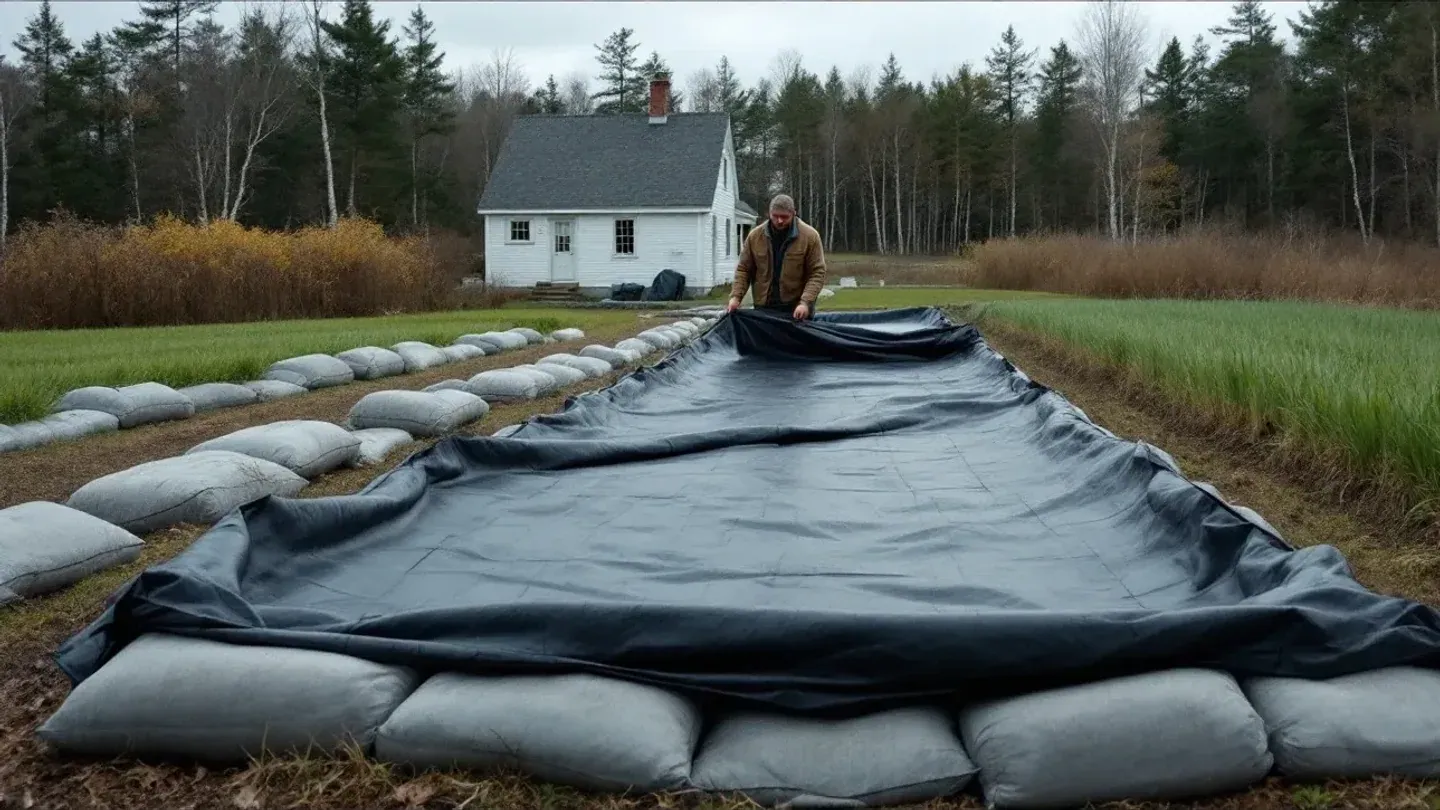
Tarps: the cheapest tool on this list
Nothing else here costs so little and changes so much. A reusable black silage tarp laid over a bed between crops kills the weeds and residue beneath it without tillage. The UMaine and Cornell guide prices a 5 to 6 mil silage tarp to cover a 32 by 100 foot block at $130 to $202 new, lasting three to five seasons, which works out to $26 to $67 a year (Tarping in the Northeast, UMaine Bulletin 1075). Two people need about 20 minutes to lay a 24 by 100 foot tarp with sandbags ready and about 25 minutes to pick it up and fold it. At the NASS wage that is roughly $13 of labor to lay it and $16 to pick it up.
What you get for it is well documented. Black tarps left down for three weeks killed all or more than 95 percent of emerged winter and summer annual weeds in the trials behind the guide, and in continuous no-till the ability to kill established weeds before planting cut labor for the system by 40 percent. Cornell's long-term trial in Freeville found no-till beds managed with tarps carried 66 to 80 percent fewer weeds than conventionally tilled soil (Cornell Small Farms, Tarps, Mulch, and Timing). Tarps also terminate cereal rye in about three weeks between late April and mid May, which means a cover crop can be killed in spring without a tractor. Seeds of Solidarity Farm in Orange, Massachusetts, which grows its vegetables without tillage, scythes residue down after harvest and leaves silage tarps on for about six weeks outdoors, or two to three weeks inside a hoophouse (Cornell Small Farms, Small Scale No-Till Vegetables at Seeds of Solidarity Farm).
The honest caveat is in the same guide: in a four year continuous no-till trial it reports, cabbage and winter squash yields matched conventional tillage, but the tarp system needed 25 percent more labor, because the labor is shifted into handling tarps rather than removed. Some of that handling can be moved out of the busy months: the Troy farm preps its beds and lays its tarps in the fall mainly to relieve the spring workload. A 50 by 100 foot tarp weighs 150 pounds clean and dry, so size tarps to the people who will carry them. The full guide has a price table, a sandbag spacing rule and six farm case studies, and it is free.
One more trial is worth reading before you buy. A Caroline, New York farm grew reduced-tillage potatoes on an old hayfield with no history of vegetables, three ways: tarped, mulched, or both. Tarping alone yielded 544 pounds of marketable potatoes against 524 for mulch alone, but at 13 pounds per labor hour against 17, so the tarp by itself did not pay. Tarp plus mulch gave 736 pounds at the same 17 pounds per labor hour. The two tarps for the trial cost about $500 and can be used for several seasons (Cornell Small Farms, To Tarp, to Mulch or to Do Both). The lesson is not that tarps fail. It is that they are one part of a system, which is the whole argument of healing the soil: no single purchase does it. For the longer case against turning the ground over at all, see our earlier piece on six reasons to reduce tillage and the no-till explainer from 2023.
The paper pot transplanter: honest numbers
The paper chain pot system, a Japanese tool, lets one person walk a bed and set a chain of seedlings at 2, 4 or 6 inch spacing in the time it takes to pull the transplanter down the row. The appeal is obvious. The data are more mixed than the videos.
The most careful public trial is still the two season study a two person farm in Hector, New York ran with a SARE farmer grant. For head lettuce, the only crop with a direct comparison to hand transplanting, the paper pot earned $1.44 per minute of labor against $1.39 by hand, which the author called no significant difference, and the paper pot lettuce bolted more. For salad mix the tool paid: $631 per bed against $308 for direct seeding, though it took more time. Beets yielded more but came out tapered and less attractive. Beans were a loss, 154 pounds against 196 direct seeded. Trays ran $2.40 to $3.80 each, the soil had to be dry, well prepared and nearly free of stones, and in-row cultivation was impossible because of the close spacing and the paper chains (Cornell Small Farms, Investigating the Profitability of the Paper Pot Transplanter). Her conclusion was that it pays on cut-and-come-again greens and on farms that already transplant closely spaced crops like alliums, and not otherwise.
The organic question that hung over the tool for years is settled. Since December 14, 2022, paper-based crop planting aids, including chain pots, have been on the National List as an allowed synthetic for organic crop production, provided they are virgin or recycled paper without glossy paper or colored inks (USDA AMS, final rule of November 14, 2022; 7 CFR 205.601(o)(2)). Check the specific product with your certifier, but the rule itself no longer stands in the way.
So: if scallions, salad mix, spinach and beets at tight spacing are a big share of your beds, the transplanter is a working tool. If you grow a little of everything, it is a very good tool for three crops and a tray system you have to keep buying.
Small no-till drills: rent before you buy
A no-till drill places seed through residue at a set depth and closes the slot, and it is the fastest way to a dense cover crop or a renovated pasture on five to twenty acres. It is also a three-point implement that needs a real tractor, and it is the tool on this list most often bought and least often used. SARE's cover crop economics bulletin estimates the operating cost of a small 10 foot drill at over $10 per acre once labor is counted, and finds that cover crop seed plus seeding can be had for as little as $10 to $15 per acre with the right equipment (SARE, Cover Crop Economics). Those are row crop figures, but the logic holds: on a few acres the drill's hours per year are so few that the purchase price never gets spread thin.
Before you buy, call your county conservation district and your extension office and ask whether a drill can be rented locally, and ask a neighbor with one what a custom seeding would cost. On vegetable beds a drill is rarely the answer anyway. The permanent-bed farms in the tarping guide broadcast their rye by hand or sow it with a push seeder, roll or rake it in, and kill it with a mower, a roller or a tarp (Tarping in the Northeast, UMaine Bulletin 1075). Our guide to choosing a cover crop mix covers the seeding side, and if the drill is for a conservation practice, EQIP and CSP may share the seed cost even when they do not buy the iron.
Spring 2025: what the tariff news does to the price tag
This spring the price of imported iron is a moving target. On February 1, the President ordered an additional 25 percent tariff on imports from Canada and Mexico and 10 percent on imports from China under emergency economic powers (White House fact sheet, February 1, 2025). On March 3 the White House confirmed that the Canada and Mexico tariffs would go ahead (White House fact sheet, March 3, 2025), and on March 6 goods that qualify for USMCA preference were exempted (White House fact sheet, March 6, 2025). Separately, Proclamation 10896 restored a full 25 percent tariff on steel from every country as of March 12, ending the exemptions that Canada, Mexico, the European Union, Japan and others had held, and extended the tariff to derivative steel products (Proclamation 10896, February 10, 2025; White House fact sheet, February 11, 2025).
What that means for a walk-behind or a transplanter built overseas, or a drill assembled across the border, depends on the tariff code each falls under and on what the dealer paid for the stock already on the floor. Nobody can tell you from here. Ask the dealer in writing whether the quote holds for sixty days and whether the unit is in the country. Farmers are watching this closely: in Purdue's February survey, 44 percent named trade policy the most important policy for their farm over the next five years and 48 percent thought a trade war that cuts US farm exports likely, even as the farm capital investment index rose to its most positive reading since May 2021 (Purdue Ag Economy Barometer, March 4, 2025).
When a tool is a toy
Run every candidate through five questions. Which job does it do, in hours per season, on this farm as it is now, not as the five year plan imagines it? What does the hour cost, and how many hours until payback? What else has to be true for it to work, such as stone-free soil, a flail to go ahead of it, a tractor with the right hitch? Can it be rented, borrowed or shared for the first season? And can you fix it yourself, or at least get parts, which is the question we asked in where right to repair stands?
A toy fails at least two of those. It does a job you do thirty hours a year, it needs three other purchases to work, and it will be the only one of its kind within a hundred miles when it breaks.
Several of the farms in the tarping guide's case studies share a pattern: tarps and a walk-behind or hand tools do most of the bed work, the tractor is kept for its loader or for opening ground, and one Massachusetts farm has started breaking new ground with nothing but a tarp left on old hay sod for a year, then a rye cover crop seeded straight through it. That order is simplicity as a purchasing policy, and it is what thinking long term looks like in a tool shed. If a purchase is the right one but the cash is not there this spring, we looked two weeks ago at USDA grants worth a small farm's time. Earlier we covered FSA microloans, which were written for exactly this size of purchase. And before you buy anything, visit a farm your size that owns it. Our farms and ranches directory and the dealers in our service providers and manufacturers directory are a place to start, and a farmer who has used a tool for three seasons will tell you in five minutes what no catalog will.