
It is Labor Day, the tomatoes are still coming in, and the year has four months left. For a farm organized as an LLC or a corporation, one of those months holds a federal filing deadline that most farmers have never heard of. For a farm that is still a sole proprietorship, the same deadline is a good reason to ask whether that is still the right shape for the business. This article walks through the three structures small farms actually use, what each does for liability, taxes and succession, what a lender will ask, when to change, and the paperwork that has to stay current afterward.
Most farms start as a sole proprietorship
By USDA's count, 97 percent of US farms are family farms. The Census of Agriculture sorts farms by legal status for tax purposes, and the Farm Credit Administration's reading of the 2022 Census puts family-held operations, meaning individuals and families plus family-held corporations, at 90.4 percent of all farms, a touch lower than in 2017 as partnerships and non-family corporations grew. A large share of those family farms are sole proprietorships: one person, or a married couple, farming under their own name with no filing at all.
The IRS defines a sole proprietor as someone who owns an unincorporated business alone. You report farm income and expenses on Schedule F, pay income tax on the profit at your own rate, and pay self-employment tax of 15.3 percent on net earnings of $400 or more. Publication 225, the Farmer's Tax Guide, holds the farm-specific rules, and our March article on Schedule F, depreciation and records walks through them. If you farm under a name other than your own, expect a "doing business as" filing: Cornell's guide notes that New York requires one for a sole proprietorship using a farm name without the owner's real name.
The appeal is simplicity, and we rate simplicity highly: see Always Simplify. The cost is exposure. Penn State Extension puts it plainly: a sole proprietorship has no legal framework that shields the owner's personal assets. If a customer is hurt at your u-pick, a delivery van hits someone on the way to market, or a wholesale account goes bad, the claim reaches your house, your savings and your land. The other weakness is continuity. The University of Delaware's April 2024 fact sheet notes that the life of a sole proprietorship is tied to the owner's death, insolvency or illness. It cannot be handed to the next generation; it ends, and something new begins.
For a first-year farm selling at one market with a good liability policy, that may be fine for a while. Insurance is the first line of defense whatever the structure, and our guide to what types of insurance a farmer needs still holds. The entity question usually arrives with growth.
The LLC: a wall between the farm and the house
An LLC is formed by filing paperwork with the state. The Small Business Administration notes that most states register it through the Secretary of State's office, that you need a registered agent in the state before filing, and that the total cost is usually under $300. What you get is the thing in the name: Cornell describes it as protection for the members' personal property from business liabilities, in many circumstances.
Those three words matter. The wall holds only if you treat the LLC as a real, separate business: its own bank account, its own leases and contracts, its own books. Cornell strongly recommends a separate business checking account, and Delaware adds that courts are still working out how LLC protection will be judged case by case. An LLC that pays the family grocery bill from the farm account is a thin wall.
On taxes, nothing has to change. The IRS treats a single-member LLC as a disregarded entity and a multi-member LLC as a partnership by default, so a one-family farm LLC still files Schedule F and its members still pay self-employment tax. An LLC can elect to be taxed as a corporation on Form 8832, or as an S corporation on Form 2553, which passes income through to shareholders without a corporate-level tax. Delaware's fact sheet explains the draw: S corporation profit is not subject to self-employment tax, but a working owner must first take a reasonable salary that is. For most farms with modest profit, that election is a conversation with an accountant, not a default.
Succession is where the LLC earns its keep. A sole proprietorship ends with its owner; an LLC is divisible. Membership units can be sold or given to the next generation over years while the farm keeps running under the same name, tax number and accounts. For 2024, the IRS set the annual gift exclusion at $18,000 per recipient and the estate tax basic exclusion at $13,610,000. For most family farms the estate tax is not the issue; the orderly handover is, and that takes an operating agreement written before anyone needs it. The SBA warns that some states require an LLC to be dissolved and re-formed when a member joins or leaves unless the agreement covers transfers. We believe in thinking long term; the operating agreement is where that belief gets written down.
The cooperative: owned by the people who use it
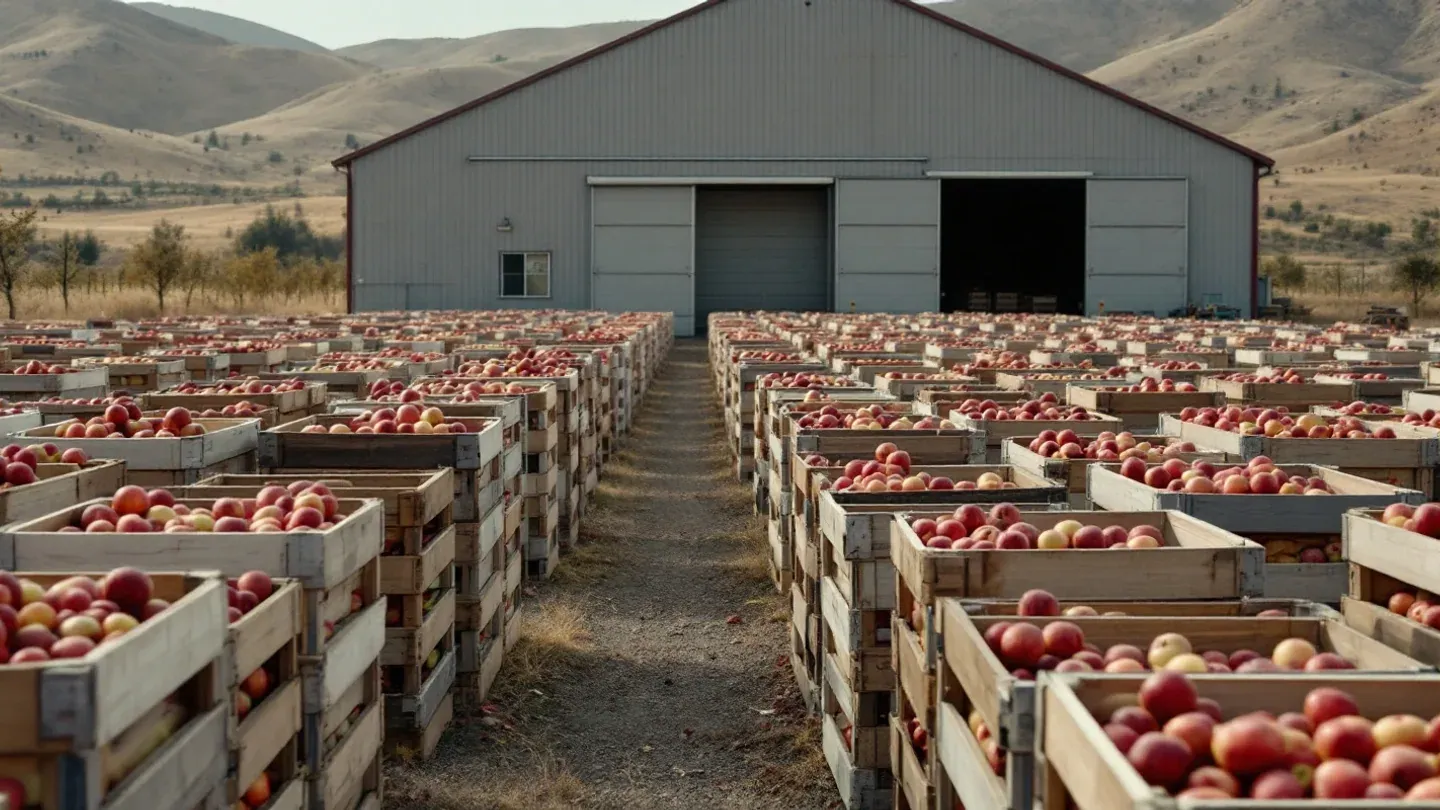
A cooperative answers a different question. Not "how do I protect my farm" but "how do a dozen farms do together what none can do alone": a packing line, a shared delivery route, a cut-and-wrap plant, a joint brand. Penn State notes that cooperatives are common in agriculture precisely because packing, storage, trucks and processing facilities are expensive and can be owned collectively.
A co-op is formed by filing with the state and governed much like a corporation, with a board and bylaws. Cornell notes that voting is either one vote per member or in proportion to patronage, and that members have limited liability. The University of Wisconsin Center for Cooperatives lists the principles behind the model: open membership, democratic member control, and returns that go to members in proportion to the business they do with the co-op, not the capital they put in.
The tax treatment follows that logic. Subchapter T of the tax code applies to any corporation operating on a cooperative basis, and under it the patronage dividends a co-op pays its members within eight and a half months after year end are left out of the co-op's taxable income. The member pays tax on the patronage once, which is what Penn State means when it says co-op profit is taxed once rather than at the corporate level.
What a co-op costs is governance: a board, meetings, bylaws, proper books, and the patience to let the majority decide. It is also a structure you join or found alongside your farm, not instead of it. Your own farm still needs its own shape. We will devote a full article to producer cooperatives; our piece on food hubs covers the aggregation side.
What a lender looks at
An entity does not change who repays the loan, and lenders write their rules accordingly. For a Farm Service Agency direct loan, the regulation requires that the entity and every one of its members be unable to get sufficient credit elsewhere, and that anyone who signs the note meet the citizenship, legal capacity and federal debt tests. If the members holding a majority interest are related by blood or marriage, at least one must be the operator of a family farm; if they are not related, members holding at least half the interest must be operators. Where an LLC is owned in part by another entity, at least 75 percent of that inner entity must belong to members actively involved in managing or operating the farm. In short, FSA lends to farmers who happen to use an LLC, not to investment vehicles. Our guide to FSA microloans and beginning farmer loans covers the rest of the program.
With a bank or Farm Credit lender, ask three questions before you file: will existing loans and vehicle registrations have to be redone in the LLC's name (Delaware's fact sheet says they will), will the owners be asked to sign personally regardless, and does your operating agreement let the farm pledge its assets. Whatever the structure, the lender will want a plan; our guide to farm and agriculture business plans covers what goes in it.
This year's federal filing: the beneficial ownership report
Now the deadline. The Corporate Transparency Act of 2021 asked the Treasury's Financial Crimes Enforcement Network to build a registry of who really owns small companies, aimed at the shell companies used for money laundering. FinCEN's final rule of September 2022 makes any corporation, LLC or similar entity created by a filing with a secretary of state a "reporting company" unless an exemption applies, and the exemptions are built for big and already-regulated businesses. The large operating company exemption requires more than 20 full-time US employees, more than $5 million in gross receipts on last year's federal return, and a physical office. A family farm LLC with three employees is not exempt. A sole proprietorship, which filed nothing with the state, is not a reporting company and files nothing.
The report lists each beneficial owner's name, date of birth, address and an identification number with an image of the document. A beneficial owner is anyone who exercises substantial control or owns at least 25 percent of the entity, which on a family farm usually means the parents and any child who runs the operation day to day. The deadlines, as the rules stand this fall: an entity created before January 1, 2024 must file by January 1, 2025; an entity created during 2024 has 90 calendar days from notice of its formation; from 2025 the window shrinks to 30 days; and any change to the reported information must be updated within 30 days. Filing is done online at FinCEN's BOI portal, and the Virginia Farm Bureau reminded its members in June that there is no filing fee. The penalties are not small: the statute allows a civil penalty of up to $500 for each day a willful violation continues, adjusted for inflation to $591, plus criminal fines of up to $10,000 and up to two years in prison.
The law is being fought in court, and some farmers have heard that and stopped there. The facts: on March 1, 2024, the federal district court for the Northern District of Alabama held in National Small Business United v. Yellen that the act "exceeds the Constitution's limits on the legislative branch." But the judgment reaches only the plaintiffs. FinCEN's notice on the case says it will not enforce the requirement against the National Small Business Association and its members, that every other reporting company is still required to file, and that the government filed its appeal on March 11. Lawyers quoted by the Journal of Accountancy expected the case to end up at the Supreme Court whoever wins the appeal. The Virginia Farm Bureau told its members the same thing in June: relief was limited to that association's members. Unless your farm belongs to it, the deadline applies to your LLC. Our advice: do not plan around the courts. Set aside an hour this fall, gather the ID images, and file. Four months is plenty; four days in late December is not.

When to change structure
A farm rarely needs an LLC on day one and rarely stays a sole proprietorship forever. The signals are concrete. You hire your first employee. You open the gate to the public for u-pick or farm stays. You sign a wholesale contract or put a van on the road every week. A child or a non-family partner wants in, and you want their share on paper. You buy land, or start a value-added product with its own recall exposure. Each of these raises the size of the claim that could reach you, or the number of people with a stake in the business, and those are the two things an entity is for. If the farm began as a sideline, our older piece on turning a hobby farm into a business is the step before this one.
Delaware's fact sheet and Penn State's guide agree on the last step: entity choice turns on tax and legal details that differ by state and by farm, so consult both an accountant and an attorney before you file. Extension offices often run farm business courses in the off season, and our service providers directory and organizations directory list people and groups who work with farms. An hour of advice at the start is cheaper than fixing a badly drawn operating agreement after a death or a divorce.
The paperwork that has to stay current
An LLC is not a one-time filing. The SBA's compliance list is the one to pin above the desk: most states require an annual report or biennial statement, often with a fee that can exceed $300; some charge a franchise tax on top; the operating agreement should be kept current; membership transfers recorded; an annual meeting with minutes held even for a two-member farm; and a change of name, address or ownership filed with articles of amendment. Add the Cornell basics, a federal employer identification number and a separate bank account, plus a "doing business as" filing for every brand name the LLC sells under. And from now on, add the beneficial ownership report and its 30-day update rule.
None of this is hard. All of it is easy to forget in June. Put the dates on the farm calendar next to the planting plan and treat them the way you treat soil tests: small, regular, and the reason the bigger things work. That is what we mean by Be Consistent.
A practical close
If you take one thing from this article, take a short list. First, if your farm is already an LLC or corporation and existed before this year, file the beneficial ownership report with FinCEN before January 1, 2025, and set a reminder for updates. Second, if you are a sole proprietor, check your liability policy limits today, and put the entity question on the winter agenda if any of the signals above apply. Third, if you form an LLC, open its bank account the same week, write the operating agreement before the first harvest under the new name, and ask your lender what has to be re-signed. Fourth, if your real problem is scale rather than risk, look at your neighbors before you look at the law: a cooperative may be the structure that reaches a buyer none of you could reach alone. And whichever path you take, keep the farm's paperwork as current as its fences.