
Where it started
Singing Frogs Farm sits on an 8.8-acre property in the Atascadero valley bottom of the Russian River watershed, near Sebastopol in Sonoma County, about 12 miles east of the Pacific. The farm acknowledges the land as the traditional territory of the Kashaya Pomo and Coastal Miwok peoples.
Its founders, Elizabeth and Paul Kaiser, met in the Peace Corps in Gambia in 2003, according to Peace Corps Worldwide. Paul's background is in agroforestry and sustainable land management, Elizabeth's in nursing and public health. They have farmed together in Sebastopol since 2007, where they have raised two children.
The system they are known for grew out of experience on the ground. "Singing Frogs Farm began as a living ecological experiment," Elizabeth told Patch in 2016, and as they learned more about soil science they came to see no-till soil management as central to a healthy and profitable farm. The farm says that offering year-round work and keeping its crew was a large part of what made the move to permanent, intensive no-till management possible.
What they changed
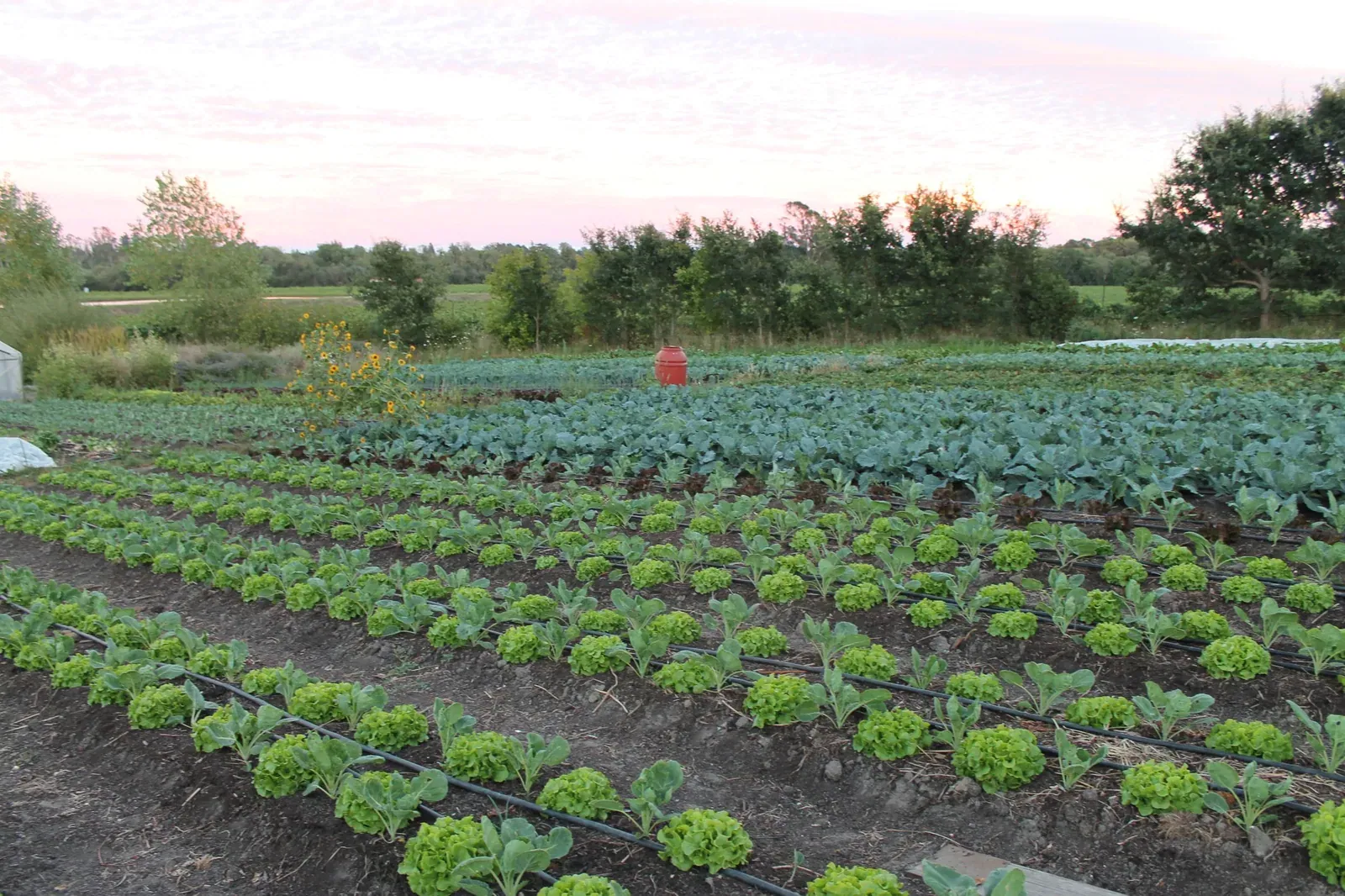
The farm stopped disturbing its soil. Its stated principles are short: disturb the soil as little as possible, keep living plants in the ground as often as possible, grow as many different species as practical, keep the soil covered all the time, and incorporate animals.
In practice that means beds that are almost never empty. Writing for Resilience.org in 2015, the permaculture author Toby Hemenway described how most crops go in as transplants: as one crop matures, the crew sets young starts beneath it, and spent plants are cut at the stem so the roots rot in place. Paul Kaiser gave Sunset the same advice for home gardeners, warning against leaving beds bare for two weeks between crops.
The second change was compost in large amounts. Hemenway reported about 60 tons per acre per year, far more than organic standards recommend, made from farm waste and material from the county composting program. Some extension agents warned Paul Kaiser that so much compost must be leaching nitrates and phosphates; he measured the water entering and leaving the farm and, by his account, found the water leaving cleaner. Our guide to farm-scale composting covers the carbon ratios and rules behind that kind of volume.
The third was no sprays of any kind, not even those allowed in organic farming. The farm relies instead on thousands of perennial plantings, including hedgerows, that shelter beneficial insects. Hemenway counted over 3,000 native plants in hedgerows and edge plantings in 2015. The farm received a National Pollinator Conservation Award in 2010, and our article on pollinator habitat on a working farm explains how such strips work.
The farm also works without machinery. It describes itself as non-mechanized and year-round, and it says many crew members leave to start their own no-till market farms, from Sonoma County to Australia and Japan.
How it works today
The cultivated area is small. A 2020 project summary published on a Washington State University site described intensive no-till production on 2.5 acres of the property; other profiles say about three cultivated acres. A Community Alliance with Family Farmers listing, written in the farm's own voice, mentions over 80 vegetable varieties, 20 fruits and 70 flowers.
Most of the harvest goes straight to households. The vegetable CSA, which the farm calls the heart of the business, delivers boxes on Wednesdays year-round to nine pickup sites in Santa Rosa and West Sonoma County: weekly from May through November, every other week in winter. The 2026 CSA is full, with a waitlist for an April 2027 start. A flower CSA runs from February to October. The farm sells at the Santa Rosa Original, Sebastopol and Occidental farmers markets, through a local organic grocer in Sebastopol and to the restaurant partners named on its site. The model fits the case for farm-to-door CSAs.
The CSA is open to lower-income buyers too. The farm has accepted EBT since 2014 and, with Petaluma Bounty and the Ecology Center, uses Market Match funds to halve the cost of boxes for CalFresh members, with a goal of sending 10 percent of its boxes to them. Our piece on SNAP at the farmers market explains how these programs work.
The crew is year-round, with no seasonal positions, ranging from about four full-time equivalents in January to seven or eight in late summer. Education is a second line of work: the farm says it has hosted over 200 farmers in hands-on workshops since 2016 and runs tours, talks and consultations. In the project behind that summary, run by the Multinational Exchange for Sustainable Agriculture, the Kaisers served as mentor producers, and the program educated over 64 producers on whole-farm planning for climate change adaptation. The farm lists eight ecological farming awards, most recently a 2026 Slow Food Snail of Approval.
The farm's own figures are striking. It reports soil organic matter up more than fivefold, nearly four times the microbial life, and roughly $170,000 in vegetable sales per crop acre per year, with over 75 percent of revenue paying year-round salaries.
What it shows
Singing Frogs is the clearest case in this collection that intensity can stand in for acreage. A few acres, planted continuously and sold directly, support a year-round crew; Hemenway noted in 2015 that nearly every other CSA in the county did not grow year-round. Our Farms & Ranches directory lists the farm with other working examples.
The numbers deserve a careful reading. The revenue figures have risen over time: Hemenway reported about $100,000 per acre on three acres in 2015, the 2020 project summary $125,000 per acre in 2020, more than ten times the national average it cites for vegetable farms of that size, and the farm now reports $160,000 to $170,000. The soil results are reported the same way. All of these come from the farm, repeated by others; none of the sources reviewed here is an independent field trial.
The trade-offs are real. The system leans on heavy compost imports, some of them from the county program, which raised nutrient concerns that the farm answered with its own measurements. It is labor-intensive by design: when three-quarters of revenue goes to wages, the crew is the main cost as well as the main asset, and keeping people year-round is the strategy, as our guide to finding and keeping farm employees discusses. And it depends on a nearby customer base willing to commit to a CSA, which the full 2026 CSA and its waitlist suggest Sonoma County provides.
What transfers is the method rather than the numbers: keep the soil covered and planted, stop tilling, feed it with organic matter, and sell close to home. That approach to healing the soil is what the Kaisers now teach.