
Where it started
Tablas Creek Vineyard began as a partnership between two wine families. The Perrin family owns Château de Beaucastel in Châteauneuf-du-Pape, in the southern Rhône, and Robert Haas ran the American import business Vineyard Brands. According to the winery, the partners spent four years looking for a site in California and founded Tablas Creek in 1989 in the hills west of Paso Robles. They chose the area for its likeness to the southern Rhône: calcareous clay soils, a Mediterranean climate and elevations of 1,400 to 1,600 feet in what is now the Adelaida District, about 11 miles from the Pacific. Jason Haas, Robert's son, who has run the estate since the mid-2000s, told the public radio station KCBX in 2020 that his father's idea was that the right California site could grow the grapes of Châteauneuf-du-Pape.
Rather than buy local plant material, the partners imported vine cuttings from Beaucastel. The imported vines spent three years in USDA quarantine, and the winery built its own grapevine nursery to propagate them. Planting of the estate began in 1994. The winery's history puts the imports at 18 grape varieties, nine of them new to California. The estate has been farmed organically from the start.
What they changed
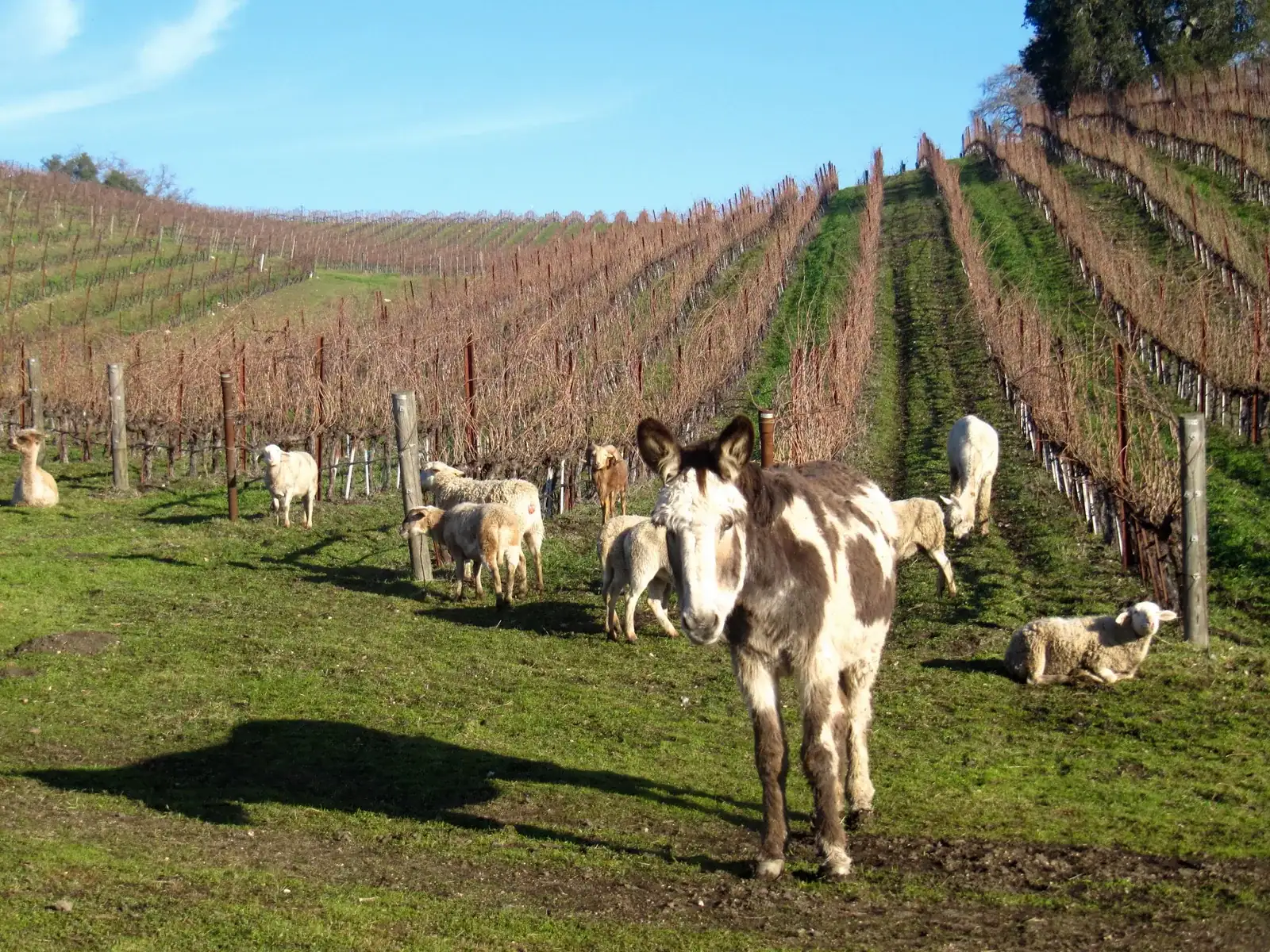
The change at Tablas Creek was not a rescue from industrial farming but a series of steps built on an organic base. The vineyard was certified organic in 2003. In 2010 the team began farming it with Biodynamic methods, a system Ashfount describes in what is Biodynamic agriculture, and it received Biodynamic certification in 2017. In 2012 the winery added a mixed grazing herd of sheep, alpacas and donkeys. Wine & Spirits reported in 2020 that the herd numbered about 200 sheep and that Nathan Stuart had worked as the property's full-time shepherd and animal steward since 2016.
The next step was Regenerative Organic Certification. In February 2019 the Regenerative Organic Alliance, backed by the Rodale Institute, Patagonia and Dr. Bronner's, invited Tablas Creek into a pilot of its new standard. Viticulturist Jordan Lonborg wrote on the winery's blog that Tablas Creek was the only winery in the pilot and that its Biodynamic work meant few practices had to change. The standard rests on three pillars: soil health, animal welfare and fairness for farmworkers. For the social pillar, the vineyard crew and management went through a week of training with the Equitable Food Initiative.
The hardest part was tillage. According to Wine & Spirits, Lonborg named no-till farming as the biggest obstacle, because the semi-arid Paso Robles climate and pests such as gophers and star thistle make it harder than in wetter regions. The final standard allows exceptions to no-till. Tablas Creek became the world's first Regenerative Organic Certified vineyard in 2020 and, in 2022, the first at the Gold level. For how this label sits next to organic and other schemes, see regenerative certifications compared.
How it works today
The estate covers 270 acres. The vineyard page describes two kinds of planting. The older blocks are close-spaced at 1,600 to 1,800 vines per acre. The newer blocks are spaced at 350 to 600 vines per acre and are dry-farmed with no irrigation lines at all, which forces the roots deep into the bedrock. It is a working example of the ideas in how farms can conserve water.
No chemical herbicides, pesticides or fertilizers are used in the vineyard. Fertility comes from compost, cover crops that limit erosion and return nitrogen, and the grazing herd, a vineyard version of multi-species grazing. The winery uses compost tea against mildew to reduce sulfur use, keeps beehives, plants flowers for insects, leaves native vegetation and interplants fruit trees. Jason Haas told KCBX in 2020 that the property had 39 owl boxes, so that owls rather than poison control the gophers. Grapes are picked by hand, with most blocks harvested in several passes, and every wine is fermented with native yeasts.
The winery sells through its tasting room on Adelaida Road, which runs tastings and a daily vineyard and cellar tour, through several wine clubs, an online shop, and retailers and restaurants. It also reaches beyond its own fence. The nursery has sold nearly five million cuttings to more than 600 vineyards and wineries. For its Patelin de Tablas wines, the winery buys fruit from 8 to 12 Paso Robles growers each year, many of them planted with its cuttings, and it says that after about fifteen years of long-term contracts that helped those growers convert, the Patelin fruit has come only from organic vineyards since the 2024 vintage. In January 2026 the winery announced a planned change in the cellar: Chelsea Franchi became Director of Winemaking, Craig Hamm became Winemaker and longtime winemaker Neil Collins moved to Director of Production.
What it shows
Tablas Creek shows that regenerative practice in a perennial crop looks different from regenerative grazing on a ranch. There is no herd to move across thousands of acres of grass, so the animals serve the vines: they graze the cover crops between the rows and fertilize the soil as they go. The case answers a question Ashfount asks in is winemaking sustainable with a working example, and it belongs in the farms and ranches directory for that reason.
It also shows certification as a ladder rather than a single leap. Organic came first, then Biodynamic, then Regenerative Organic, and each step built on the one before. The Regenerative Organic step added something most farm labels leave out, farmworker fairness, with audits of wages and working conditions. That matters for anyone who reads who harvests America's food and wonders how a label could account for the people in the field.
The trade-offs are named by the people doing the work. No-till is hard in a dry climate, and the standard had to make room for that. Jason Haas told KCBX that he and Lonborg were not sure the practices make the wine taste better, only that they believed customers would value the effort. The herd needs a full-time shepherd. And the winery's own history describes a slow build: a three-year quarantine before the first imported vines could be planted, then decades of steps. That patience is what Ashfount means by thinking long-term.
Finally, the example shows how one estate can move a region. Through its nursery and its contracts with Paso Robles growers, Tablas Creek has spread both its grape varieties and organic farming well beyond its own 270 acres.