
Labor Day is next Monday, September 7. It is the one holiday built around the people who do the work, which makes it a fair moment to ask a plain question about the peaches, tomatoes and apples coming in right now: who picked them, on what terms, and what does a decent farm owe the people who did?
This is not a policy essay. It is the basic arithmetic of farm labor in the United States as it stands at the end of August 2026, with every number linked to where it comes from, and a short list of what a fair small farm does whether or not anyone is checking.
How many hands, and whose
Hired farmworkers are a small slice of the US workforce, under 1 percent of wage and salary workers, but they are the whole game in the crops people eat fresh. USDA's Economic Research Service counts about 1.18 million wage and salary jobs in agriculture in 2024, up from 1.07 million in 2010, a figure that includes the farm labor contractors who supply crews. On fruit and tree nut operations, wages, salaries and contract labor were 40 percent of production expenses in the 2022 Census of Agriculture; on greenhouse and nursery operations, 42 percent. For all farms the figure is 12 percent. If you grow something picked by hand, labor is your largest cost and your largest risk.
Who are these workers? The best data come from the Labor Department's National Agricultural Workers Survey, which interviews crop workers face to face at their jobs and which ERS summarizes on the same page. In 2020 to 2022, 32 percent of crop workers in manual jobs were born in the United States, 7 percent were naturalized citizens, 19 percent were other authorized immigrants, mostly green card holders, and 42 percent had no work authorization. That last share peaked near 55 percent around 2000 and has drifted down since.
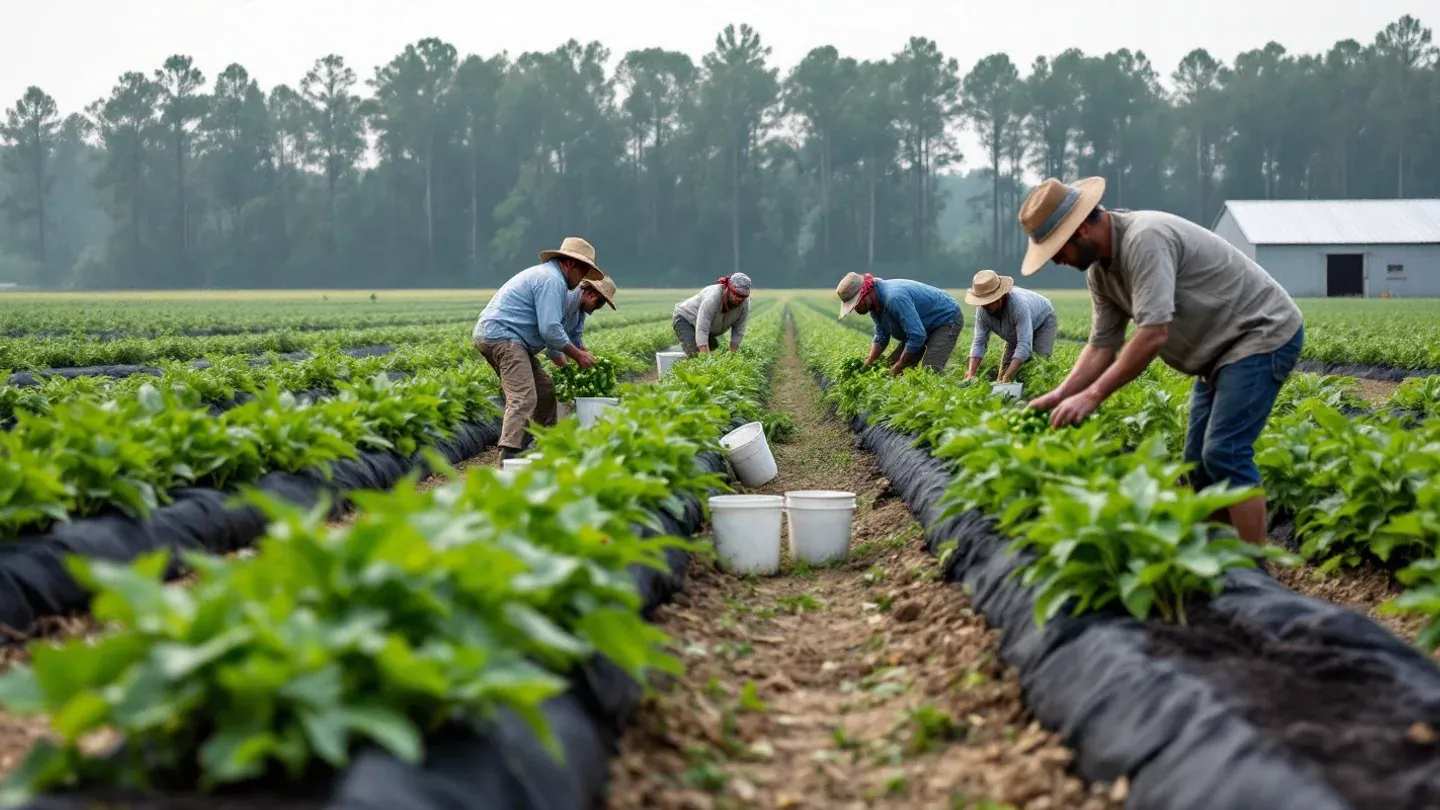
Two more facts change the picture most people carry in their heads. First, the migrant following the harvest north is now rare: 4 percent of crop workers. Eighty-three percent are settled, working within 75 miles of home, up from 41 percent in the late 1990s. The person in your orchard probably lives in your county and has for years. Second, the workforce is aging. ERS reports that the average age of foreign-born farmworkers rose by close to seven years between 2006 and 2022, because fewer young people are arriving to replace them.
The survey leaves out livestock workers and H-2A guest workers, so the dairy parlor and the guest-worker crew are counted elsewhere. What it does show is a workforce poorer and less protected than most: KFF's reading of the 2022 survey finds 53 percent of crop workers uninsured and 19 percent in households below the poverty line.
The H-2A program in plain terms
H-2A is the seasonal guest worker visa. ERS describes it plainly: a farm may bring in foreign workers for up to ten months of seasonal work if it can show the Labor Department that it tried and failed to recruit US workers, pays at least a government-set wage floor, provides housing and pays for transportation. Because the work must be seasonal, most dairies, hog and poultry operations cannot use it for year-round jobs; sheep and goat outfits grazing the open range are the exception.
The program's growth is the clearest sign of how short farm labor has become. ERS counts just over 48,000 positions certified in fiscal year 2005 and around 385,000 in fiscal 2024. The American Farm Bureau Federation puts fiscal 2025 at 398,258 and reports 254,688 positions certified in the first half of fiscal 2026 (October 2025 through March 2026), 16.9 percent more than a year earlier and on pace for a record near 435,000. Florida, Georgia and Washington lead; Washington's first-half certifications rose 67 percent in a year. The same analysis notes that in fiscal 2025 only 182 of nearly 415,000 advertised seasonal positions were filled by a domestic applicant.
The obligations are written into 20 CFR 655.122, and they are worth knowing even if you never file a petition, because they describe what a fair deal for a seasonal worker looks like. The employer provides housing at no cost to any worker who cannot reasonably get home the same day, and transport between that housing and the field at no cost. The employer reimburses inbound travel once the worker has completed half the contract and pays the trip home at the end. The employer guarantees to offer work for at least three-fourths of the contract's workdays, carries workers' compensation, and keeps daily records of hours offered and hours worked.
One structural fact matters for the ethics: a growing share of H-2A jobs are held not by farms but by farm labor contractors. UC Davis's Rural Migration News reports that 44 percent of H-2A jobs certified in fiscal 2025 went to contractors, and 58 percent in the top five states. The contractor hires, houses and pays; the farm pays an hourly rate and may never learn a worker's name.
The wage fight of 2026, briefly
The H-2A wage floor is called the Adverse Effect Wage Rate, the AEWR, and its whole purpose is to stop guest workers from undercutting local wages. For decades it was set from USDA's own Farm Labor Survey of farm employers. In August 2025 USDA ended that survey; the Federal Register notice of September 3, 2025 listed it among collections deemed duplicative or no longer necessary. On October 2, 2025 the Labor Department issued an interim final rule that rebuilt the AEWR on the Bureau of Labor Statistics' employer wage survey, split every state's rate into an entry-level Skill Level I and an experienced Skill Level II, and added a downward housing adjustment that applies only to H-2A workers, on the theory that free housing is part of their pay.
The effect was large. UC Davis reports that AEWRs fell by 15 to 25 percent in 2026 compared with 2025; the most common rate on first-quarter applications dropped from $17 to $14 an hour, and the department's own projection was that 92 percent of jobs would be classed entry level and employers would save over $2 billion a year on a $7 billion H-2A wage bill. The August 3, 2026 update kept the method and put the average AEWR at $15.96. In the department's 2026 to 2027 rate table, published on its AEWR page, Texas lists $12.27 at Skill Level I and $16.24 at Skill Level II for US workers, and $10.40 and $14.37 for H-2A workers after a $1.87 housing adjustment. Florida's entry-level H-2A rate is $10.87; California's is $13.52.
Then, on August 26, five days before this article, a federal court in California ruled in the United Farm Workers' challenge that the methodology is unlawful. The National Agricultural Law Center's summary lists the court's findings: the two-tier system does not reflect market wages, the housing adjustment conflicts with the rule that housing be provided at no cost, the contractor-heavy BLS data can understate farm wages, and the "greater than 50 percent" rule for mixed jobs invites employers to spread the better-paid work thin. The court did not vacate the rule. It ordered the department to promptly produce a new methodology and report back within two weeks, left back pay for later, and told the department to warn employers that they may owe wage adjustments once new rates exist. So the lower rates stand on this harvest's job orders, with a question mark over what they will eventually cost.
For a farm, the practical reading is simple: the legal floor just dropped, the floor is being rebuilt, and the floor was never the point.
Fear empties fields faster than raids
The second story of this summer is enforcement. In June 2025 NPR reported federal agents sweeping farms in California and, the month before, stopping a bus of farmworkers in upstate New York; the United Farm Workers' president described workers as "terrified" and still showing up because the rent was due, and the president himself posted that the policy was taking good long-time workers away from farmers. Going into 2026, Harvest Public Media relayed the White House border czar's promise that arrests would "explode greatly" this year and would reach workplaces, and quoted a New Jersey blueberry grower who had filled only a third of the 600 harvest jobs he needed.
What has that done on the ground? The most careful measurement comes from a Michigan State University survey run with the California Farm Bureau, fielded in late 2025 and early 2026 among more than 500 farmers in 50 of California's 58 counties. Fewer than 1 percent had lost workers directly to an enforcement action. About 15 percent had lost workers to fear of enforcement, about 14 percent had cut production, including crops left in the field, and a quarter reported at least one negative outcome. The lead researcher, Zachariah Rutledge, called the losses "not trivial." In Massachusetts, GBH News found small farms scaling back planting, one western Massachusetts farm that usually runs about fifteen seasonal workers having filled only about ten last year, and dairies pointing out that no visa program fits year-round work.
Put the two data sets together. Most of the people picking are settled neighbors, a large minority of them without papers, and it is the fear rather than the knock on the door that keeps them home. A farm cannot fix immigration law. It can decide what kind of employer it is while the law is argued over.
What the law asks of a farm with a crew
The federal floor for a small farm is low. Under the Fair Labor Standards Act, a farm that used no more than 500 man-days of farm labor in any calendar quarter of the previous year is exempt from the federal minimum wage altogether, and agriculture of any size is exempt from federal overtime. States have moved on their own: in California, farmworkers earn overtime after 8 hours a day and 40 a week, since 2022 on farms with 26 or more employees and since January 2025 on smaller ones, with double time after 12 hours.
The Migrant and Seasonal Agricultural Worker Protection Act requires anyone recruiting seasonal workers to put the terms in writing on request, in Spanish where needed: the place of work, the wage, the crops and tasks, the period of employment, any transport or other benefits on offer and what they cost, and whether workers' compensation applies. If the farm houses workers, the federal temporary labor camp standard sets minimums most people would call basic: 50 square feet of floor per sleeper, a 7-foot ceiling, 35 gallons of water per person per day, screened cooking shelters and heat in cold weather. Field water, toilets and shade have their own rules and their own article on protecting farmworkers from heat.
What a fair small farm does
Most farms that read this site have a crew of two to twenty, not two hundred, and sit under those exemptions. That is exactly why the owner's standards are the only standards. Here is what we think they should be.
Pay above the floor and say so. The AEWR is a legal minimum for guest workers, not a wage. Know your cost of production, price so that a real wage fits inside it, and if you use H-2A, pay the US-worker rate to everyone and skip the housing deduction. A court has just explained in plain words why that deduction fails the "no cost" test.
Write the deal down for everyone. The MSPA disclosure is a good template whether or not it applies to you: where, when, how much, how paid, what is provided and what it costs. Hand it over in the worker's language at hiring and give a pay stub every pay day. A worker who can read the terms can hold you to them, which is what being consistent means in practice.
Guarantee the hours. The three-fourths guarantee exists because a seasonal worker who traveled for the job cannot absorb a rained-out fortnight. A small farm can make the same promise in writing and plan the week's work to keep it.
Hire people, not a line item. Nearly half of guest-worker jobs now run through contractors. If you use one, visit the housing, read the pay records and meet the crew. The farm's name is on the fruit.
Build year-round work. The structural fix for a settled, aging workforce is a job that lasts: a packhouse, a winter market, a second line of income that keeps two people busy in February. A farm that thinks long term about its soil can think the same way about its crew.
Give people a way to complain and a reason to stay. The Fair Food Program, which the Coalition of Immokalee Workers built in Florida's tomato industry and which the Fair Food Standards Council has overseen since 2011, rests on a buyer-paid premium that shows up as a separate line on the pay stub, a code of conduct, worker-to-worker education paid by the farm, and a toll-free complaint line answered around the clock, with real consequences for retaliation; the Fair Food Standards Council reports the program in 22 states as of 2025. The Equitable Food Initiative certification passes 87 percent of a retailer-funded premium straight to workers. The Regenerative Organic Certified standard in our organizations directory carries a farmworker fairness pillar alongside soil and animal welfare. A five-acre farm will not certify, but it can copy the parts that matter: a premium tied to the harvest, a stated code, a phone number that is answered, and no retaliation. That is the farm end of nurturing families. It is also what being involved means in the community that supplies your crew.
Know your people. Finding and keeping good farm employees was hard before 2025 and is harder now. The farms keeping their crews this year are the ones where the crew knows the owner will show up, at a courthouse or a hospital or a school office, when something goes wrong. The same goes for the interns and apprentices who are paid in experience. Who gets to work the land is as much an ethics question as who gets to farm it. The cheap meal on the holiday table is cheap partly because of what this workforce is paid.
Before Monday
A short list for the week before Labor Day:
- Read August's pay records against the state minimum, any overtime rule that applies to you, and your own promise. Fix anything short before the holiday, not after.
- Put the terms in writing for anyone who has none, in the language they read.
- Walk the housing with the labor camp numbers in hand: floor space, water, screens, heat.
- Tell the crew who to call, day or night, and make sure that person answers.
- Give Monday off with pay to the people the day is named for, or pay a holiday rate if the fruit will not wait. Then eat something they picked, and know whose hands it passed through.