
The November grocery numbers landed on 18 December, eight days late, and they looked almost calm. The Bureau of Labor Statistics put food prices 2.6 percent above a year earlier, with groceries up 1.9 percent and restaurant meals up 3.7 percent. The October reading is missing altogether, because the fall shutdown stopped the price survey, and USDA's Economic Research Service has not issued a new Food Price Outlook since that gap opened.
So the year ends with food inflation under 3 percent, a long way from the 9.9 percent jump of 2022. And still almost nobody feels that food is cheap. That instinct is right, just aimed at the wrong number. The price on the shelf was never the cost of the meal. True cost accounting is the discipline of counting the rest. This is a plain guide to what it counts, what the published US estimates say, why local food looks expensive by comparison, and how a farm can talk about its prices without preaching.
What a price leaves out
Every sale pushes some costs onto people who were not at the register. The nitrogen that leaves a field, the hospital bill behind a diet of refined calories, the wage a crew did not get: economists call these externalities, and the ordinary price ignores them. True cost accounting puts them into the same ledger as the price. The published studies sort the impacts into a few buckets: the environment (soil, water, climate, wildlife), human health, and livelihoods (wages, safety, fairness). Some also count the public money that props the price up.
The biggest attempt at a global number is the FAO's State of Food and Agriculture 2023, which worked through 154 countries and put the hidden costs of the world's agrifood systems at at least $10 trillion a year. More than 70 percent of that total comes from unhealthy diets and the disease and lost productivity that follow; about a fifth is environmental. In high-income countries the hidden costs run below 8 percent of GDP, which sounds modest until you remember the size of the US economy.
The US estimates everyone quotes
The standard US reference is the Rockefeller Foundation's True Cost of Food report of July 2021. It starts from the roughly $1.1 trillion Americans spent on food in 2019 and adds up fourteen quantified metrics across its impact areas. The hidden costs come to about $2.1 trillion, so the true cost of the US food system is at least $3.2 trillion a year, three times what shoppers pay.
The breakdown is worth knowing by heart, because it tells you where the money hides. Human health is the largest column at close to $1.1 trillion, of which $604 billion is health care for diet-related diseases such as hypertension, cancer and diabetes; the rest is workplace injury, food insecurity, pollution and the added costs of obesity. Environment and biodiversity add almost $900 billion: around $400 billion for greenhouse gases and around $500 billion for biodiversity, most of it the cost of land turned into cropland (close to $180 billion) and grazing land (close to $160 billion). Livelihoods, meaning child labor, wages too low to live on, missing benefits and unsafe work, add about $100 billion. Farm subsidies, which the price does not show either, run about $20 billion a year.
The Foundation calls the work "a critical, but limited, first step" and published the model so that others can argue with the assumptions. Argue with them, by all means. A narrower, peer-reviewed estimate shows how much depends on scope: a 2019 microsimulation study in PLOS Medicine found that poor diet alone accounts for about $50.4 billion a year in cardiometabolic disease costs in the United States, about $301 per person and 18 percent of all such costs. Fifty billion and $1.1 trillion are not a contradiction. One counts a slice of heart disease, stroke and diabetes; the other counts most of the health system's diet-related bill plus lost productivity. Whenever you hear a true cost number, ask what it counts.
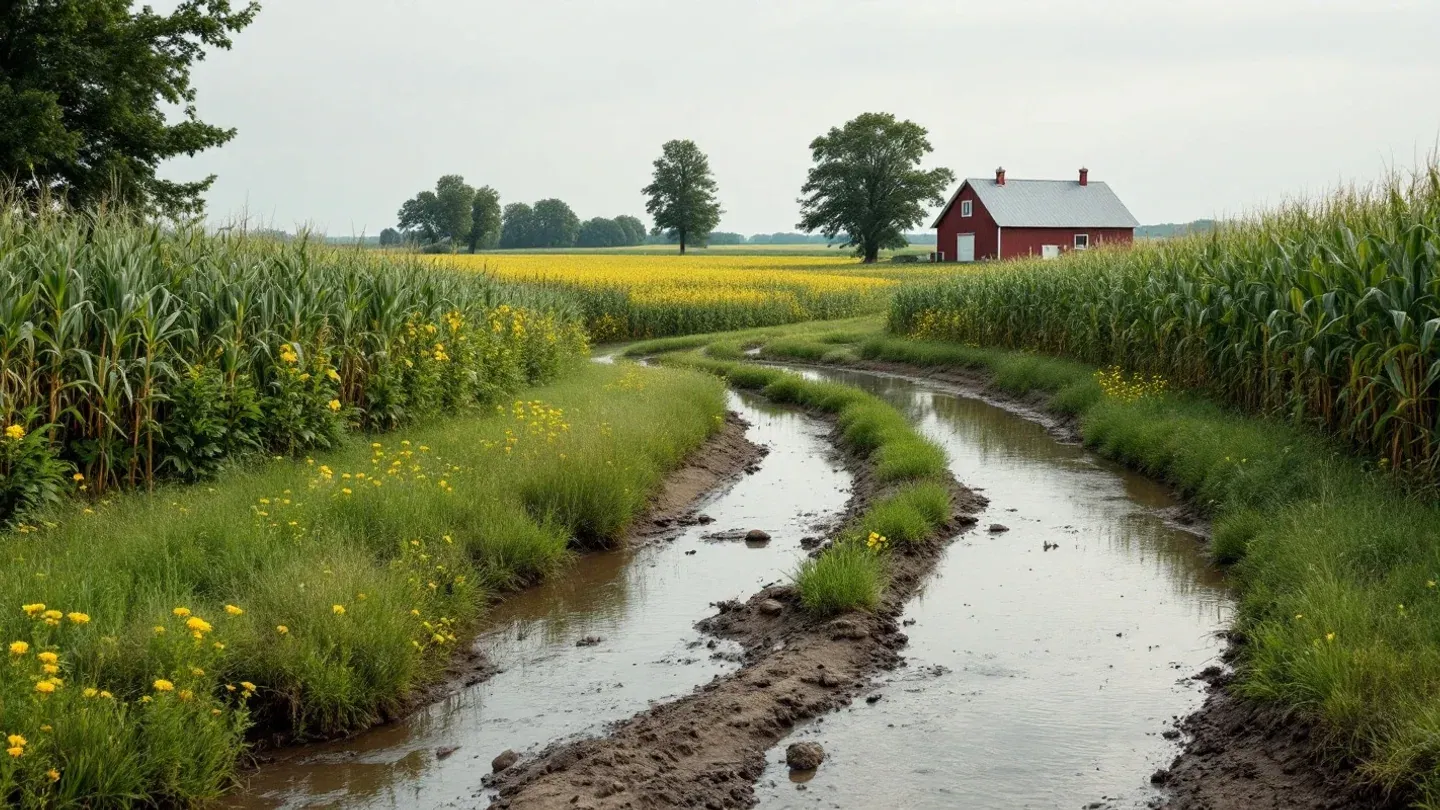
Soil, water, health, labor: the four columns on a farm
Soil is the column a farm feels first. Erosion, lost organic matter and compaction never appear on a feed bill, but they show up as more fertilizer, more irrigation and less margin in a dry year. The climate piece of it is measurable. EPA's inventory puts agriculture at 11 percent of US greenhouse gas emissions in 2022, and management of agricultural soils, largely nitrous oxide from fertilizer, makes up just over half of the sector's total. A farm that is building soil instead of mining it is doing work the price never paid for; our page on healing the soil explains why we treat that as the first job. Our guide to a soil carbon baseline shows how to measure it.
Water carries the second column downstream. Nitrogen and phosphorus that the crop does not take up wash off the field, ride the Mississippi to the Gulf, feed algae, and leave behind a low-oxygen zone that harms the fish and kills whatever cannot move away. The state and federal Hypoxia Task Force keeps a standing goal of shrinking that zone's five-year average to under 5,000 square kilometers by 2035, with an interim target of a 20 percent cut in nitrogen and phosphorus loading by 2025. A fishing boat out of Louisiana pays for a fertilizer decision in Iowa. The price of the corn never did.
Health is the biggest column and the one a single farm can least control, but it is where the national bill lives. The cheapest calories on the shelf are the ones that cost the most later, and families on tight budgets carry that cost twice: at the clinic and in the lost workdays. That is one reason we put nurturing families among our beliefs rather than treating nutrition as somebody else's department.
Labor is the column most farms would rather not discuss. USDA's Economic Research Service reports that the average nonsupervisory farmworker earned $18.12 an hour in 2024 against $30.13 outside agriculture, about 60 percent of the nonfarm wage, and that 42 percent of hired crop workers surveyed from 2020 to 2022 held no work authorization. A cheap tomato is partly a wage somebody did not receive and a protection somebody could not claim. We wrote about the duty side of this in protecting farmworkers from heat.
Why local food looks expensive
Put the four columns next to the food dollar and the mystery of the pricey farmers market dissolves. In ERS's accounting, farms receive well under 20 cents of each dollar Americans spend on domestically produced food, a bigger slice for groceries than for restaurant meals, and the rest pays for processing, storage, transport, wholesale, retail and food service. Yet households still give only about a tenth of disposable income to food, down from 10.4 percent in 1997. By that measure American food is cheaper than it was a generation ago.
It is cheap because a large part of the bill is paid somewhere else: in subsidies, which we have weighed from both sides, in soil and water nobody invoices, in health budgets, and in wages. A farm that pays its crew a living wage, grazes animals instead of confining them, keeps its nitrogen on the field and sells within a day's drive has pulled some of those hidden costs back inside its own price. The ticket at the stall is not inflated. It is closer to complete.
Be honest about the other half, though. Small scale also means higher unit costs, with no fleet discounts and no million-case contracts, and that is a cost, not a virtue. A fair pitch separates the two: this much of our price is scale, this much is the cost we refuse to push onto someone else. You cannot make that pitch until you know your numbers, which is why we keep pointing farms to cost of production before pricing. It is also the practical case for acting local and the reason we still argue that we need small farms.
How a farm talks about price without preaching
Nobody buying a dozen eggs wants a lecture on the three-trillion-dollar food system. They want a reason to feel good about the four dollars. A few rules that work at the stall, in the newsletter and on the website:
Say what the price pays for, in one sentence. "This pays a crew sixteen dollars an hour and keeps our creek clear." Pick the two or three things you can show, and only those. The same discipline we ask for in honest labels applies to price talk: a claim you cannot back up costs more than it earns.
Show instead of scolding. Invite people to the pasture, the compost pile, the wash shed. A customer who has seen the work rarely argues about the price again. Open days and work mornings are the cheapest marketing a farm has, and they fit our belief in being involved.
Never shame the cheap-food shopper. Many of the people buying the bargain are the ones carrying its hidden costs. Acknowledge budgets out loud, and offer entry points: seconds, bulk pricing, a market incentive program, a standing order that lets you discount.
Sell on the customer's terms. Taste, freshness, knowing who grew it, a kid who will eat carrots. The ethics are the quiet backdrop, not the headline. The economic case for farming this way, which we laid out in beyond regulations, is strongest when it is told as a story about one farm.
Use one number, and use it carefully. "Three times" is the number worth remembering: the true cost of US food is at least three times what we pay for it. Quote it with its source and its date, and let the customer draw the conclusion. The rest of the stall work is covered in our guide to a market stall that sells.
A short list for the winter
True cost accounting is a national ledger, but the useful version fits on one page. Between now and the first market of spring:
- Write a one-page "what our price pays for" sheet with three lines you can prove, and put a copy in the stall box and on the website.
- Price from your cost of production, then add the margin a farm needs to last. That margin is not greed; it is the part of the plan that lets you think long term.
- Pick one hidden cost to measure on your own farm next year: a soil organic matter baseline, a simple nitrogen budget, or a wage ledger that shows what you actually pay per hour. Conservation payments through EQIP and CSP exist because part of that work is a public benefit, so let the public help pay for it.
- Read one of the books and reports in our books, films and magazines directory on how food systems are costed, and look up the groups in our organizations directory that are pushing true cost thinking into policy.
- When the Economic Research Service resumes its monthly outlook, read it with the four columns in mind. The forecast will tell you what the shelf price does next. It will not tell you what the meal costs. That part is your story to tell.