
Mid-October is a good week to think about soil carbon. The corn harvest is under way, the ground is cool, and the field operations that scramble a soil sample are behind you for the year. It is also a week when the federal side of this subject is quiet for the wrong reasons: the government has been shut down since October 1, 2025, and the climate-smart grant program that paid for practices and measurement on partner farms was remade in April. More on that at the end. The main point is simpler and older than any of it: a soil carbon baseline is for your own management first, and the way you take it decides whether it will tell you anything in five years.
Why the baseline is for you, not the buyer
A baseline is a measurement of where your soil stands before you change something: before the cover crop goes in every fall, before the move to no-till, before the cattle come onto the cropland. It gives you a reference point in your own records that no contract, program or market can take away. If a carbon buyer, a certifier or a grant project later wants a number, you have one. If none of them ever shows up, you still know whether the practices you pay for are doing what you hoped, which is the heart of the heal the soil idea.
Soil organic matter is the thing you are really tracking. Carbon makes up roughly half of it by weight; the SARE handbook on soil organic matter uses 58 percent, and Cornell's soil health lab gives 48 to 58 percent. The same SARE chapter is honest about scale: sands often hold less than 1 percent organic matter, loams 2 to 3 percent, clays 4 percent and up, and the highest concentrations sit in the top foot. Texture sets the ceiling, so compare your field to itself and not to the neighbor's. And a change worth seeing will be small, so the sampling has to be careful enough to catch it.
If you have never tested at all, start with our six easy soil tests; a carbon baseline is the next step up.
Depth: go to a foot, in layers
A fertility sample is shallow. Purdue's soil sampling guidelines put a standard nutrient sample at 0 to 8 inches, and Oregon State's sampling guide says 6 inches or the depth of tillage. A carbon baseline needs to go deeper and it needs layers, because management moves carbon around in the profile as much as it adds to it. Reduced tillage concentrates organic matter near the surface while the layer below may stay flat, which is one reason the arguments in our piece on reasons to reduce tillage need a measurement, not a hope.
The USDA Agricultural Research Service's GRACEnet soil sampling protocol, part of the sampling protocols its GRACEnet research network published in 2010, recommends depth increments of 0 to 5, 5 to 10, 10 to 20, 20 to 30, 30 to 60 and 60 to 100 centimeters, and says 10-centimeter layers in the top 30 centimeters are adequate where there is no sharp surface stratification. The sampled layers should at least cover the depth of tillage. The FAO's soil carbon measurement protocol sets the floor at two layers, 0 to 10 and 10 to 30 centimeters, and reports the stock for the top 30 centimeters.
In plain terms for a working farm: sample to 12 inches, split into a 0 to 4 inch layer and a 4 to 12 inch layer at minimum, and keep the layers separate all the way to the lab. A 0 to 4, 4 to 8, 8 to 12 split is better and costs one more bag per point. Whatever you choose, write it down, because the same depths have to come up again in year four or five.
How many cores, and where
Soil varies over a few steps. The remedy in every extension guide is the composite sample: many small cores from one area mixed into one bag per depth. Purdue suggests 10 to 20 subsamples per composite, at least one composite per 20 acres, cores at least 20 to 30 feet apart, walked in a zigzag. Oregon State says 15 to 20 subsamples per area. Cornell's soil health sampling protocol uses 10 representative locations and tells you to avoid borders and odd spots, unless the odd spot is the question. The places Purdue and Oregon State say to skip are worth taping to the bucket: within 100 feet of a road, where lime was piled, old manure piles, fertilizer bands, fence lines.
For a carbon baseline you want one more layer of structure. Divide each field into zones that are honestly different, by soil type, slope, drainage or past management, and treat each as its own sampling unit. The FAO protocol calls this stratified random sampling: at least three strata per area, one core location drawn at random inside each stratum, the cores combined into a composite. It recommends at least five composites per area and five to fifteen cores in each. It also suggests a small pre-sampling of five to ten cores to see how variable the field is before you decide how many composites you can afford. A field with a wide spread between cores needs more composites, not more cores in the same bag.
Record every point with GPS. In later rounds the FAO protocol lets you offset the original sampling locations by a small distance or draw new random ones, and either way the baseline points have to be on record. The ARS protocol recommends at least 500 grams, a bit over a pound, from each depth increment the first time, so there is enough soil to analyze and to archive. Keep a dried, sealed portion of every baseline composite in a cool, dry place. If a lab method changes in ten years, that archived soil is the only way to run the old and new methods side by side.
Bulk density: the number most people skip
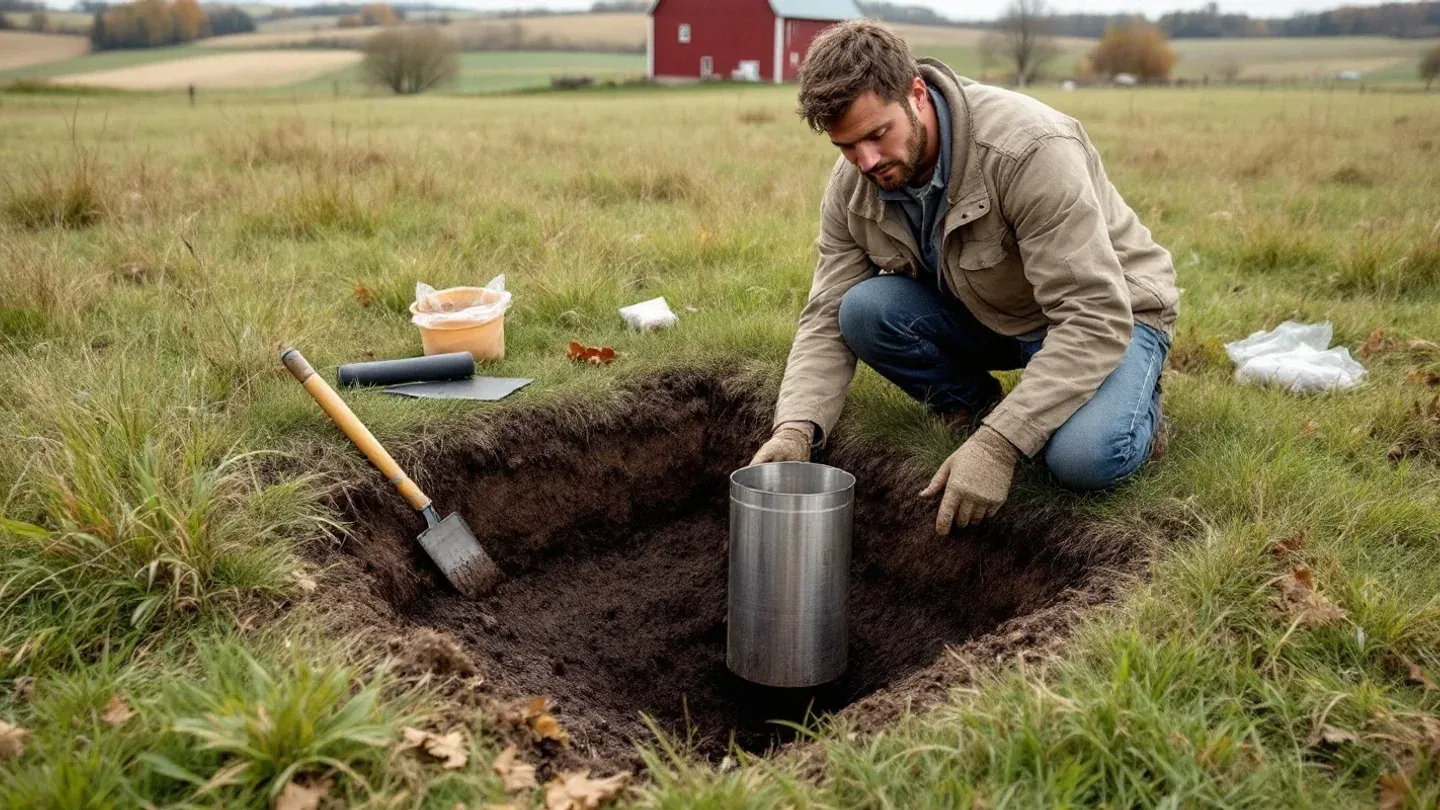
A lab reports carbon as a percentage of dry soil. A percentage alone cannot tell you how much carbon is in the field, because the same percentage in a loose soil and a compacted soil means different amounts per acre. You need bulk density, the weight of dry soil in a known volume, for each layer. Cornell's bulk density fact sheet describes the field method: drive a cylinder of known volume into the soil over the depth of interest, bag the whole core, note the volume, and let the lab dry it at 105 degrees Celsius and weigh it. Compositing several cylinders into one bag improves the estimate. The FAO protocol requires a direct method, this intact core method or excavation for stony ground, and notes that the core works best in moist soil without coarse fragments.
Cornell's worked example shows why the number matters. The top 6 inches of an acre at a bulk density of 1.4 grams per cubic centimeter weigh about 1.9 million pounds. At 2.6 percent soil organic carbon, that is roughly 49,000 pounds, or about 24.7 tons of carbon per acre in the top 6 inches. A denser soil after a wet harvest makes the same percentage look like a gain that is not there.
That trap has a name. Comparing fixed depths over time, the FAO protocol says, systematically overstates carbon in treatments that raise bulk density, such as minimum tillage, and it asks for stocks to be reported on an equivalent soil mass basis as well. You do not need to do that math yourself. You need to collect bulk density at every layer, every time, so that someone can.
Timing: the same month, every time
Soil organic carbon moves within a season, so the FAO protocol asks for sampling at the same time each year, no more than a month apart between rounds, and preferably when biological activity is low. Cornell wants samples at field capacity and before field operations. Purdue says the same from the fertility side, spring before planting or fall after harvest and do not switch, and Oregon State's rule is simply the same time of year every time. The SARE chapter on analyzing your soil adds the other half of consistency, which is to use the same laboratory each time.
For most of the country, late October into November, after harvest and before the ground freezes, is the natural window, which is why this is a good week to plan it. Put the date in the farm calendar as a standing appointment. Being consistent is the whole method here; a baseline taken in a wet April and resampled in a dry October measures the weather, not the management.
Once the cores are in the bucket, treat them like produce. Cornell's storage and shipping guidance is to keep samples out of sunlight, in a cooler in the field, in a refrigerator afterward, double bagged and shipped fast with ice packs in warm weather.
The lab method to ask for
There are two common ways a lab reports organic matter or carbon, and they are not interchangeable. Loss on ignition burns a sample in a furnace and converts the weight lost into percent organic matter; Cornell's organic matter fact sheet explains the method, and it is usually the organic matter number on a fertility report. Dry combustion burns the sample at high temperature and measures the carbon dioxide directly; Cornell's lab runs it at 1,100 degrees Celsius and says plainly that it is subject to less error than the loss on ignition procedure. The ARS protocol lists dry combustion as the required method for soil organic carbon, and the Soil Health Institute, after a three-year evaluation of more than 30 indicators at 124 long-term research sites across North America, recommends soil organic carbon by dry combustion as one of its three core measurements.
One detail matters in the drier half of the country. Dry combustion measures all carbon, including carbonate minerals. Cornell notes that above pH 7.2 a significant share of total carbon can be inorganic, so it measures inorganic carbon separately on any sample above pH 6.5 and subtracts it; the Soil Health Institute states the same rule for calcareous soils. If your soil fizzes with vinegar, ask the lab in writing whether it is reporting organic carbon or total carbon.
Ask for dry combustion soil organic carbon by layer, bulk density by layer, and texture once. Texture does not change with management, and knowing it lets the lab interpret your carbon against the right ceiling. A loss on ignition number is still useful for the fertility side, but do not build a five-year comparison on it. Labs that run these methods are listed under service providers.
What five years can and cannot show
Here is the honest part. The change you are trying to measure is small against a large and variable background, and one of the most useful studies of that problem for Corn Belt farms used 13 long-term sites across Iowa, Illinois, Ohio, Michigan, Wisconsin, Missouri and Minnesota. Necpálová and colleagues, writing in the Journal of Soil and Water Conservation in 2014, calculated the minimum detectable difference in soil carbon at each site. For a change over time under no-till in the top 10 centimeters, with five replicate samples, the smallest change the data could reliably see ranged from 3 to 13 percent of the carbon already there, and the time needed to see it ranged from 11 to 71 years. More replicates shortened that. Fine-textured soils, higher crop productivity and more residue left on the field shortened it too.
Read that the right way. It does not mean carbon is not building; it means a single field with a handful of composites, resampled after five years, will usually produce a difference that sits inside the noise. The FAO protocol resamples every four years and says the way to improve detection is more composite samples and more strata. Cornell's organic matter fact sheet says the same thing in farmer language: a single green manure is unlikely to move the percentage noticeably, and rebuilding organic matter takes dedication, patience and time. That is the case for thinking long term in its most literal form.
Our earlier piece on grassland and carbon dioxide made the biological case for perennial cover; the baseline is how you check it on your own ground, and the reason to over-sample a little now rather than regret it later.
The federal backdrop this fall
Two things changed in 2025 that touch anyone who was sampling for a program rather than for themselves. On April 14, USDA announced it was ending the Partnerships for Climate-Smart Commodities program in its existing form and reframing it as the Advancing Markets for Producers initiative. The National Sustainable Agriculture Coalition's response that day summarizes the new terms: USDA would review each existing project for how much of its money reached producers and whether at least one producer had been enrolled and paid by December 31, 2024, and would honor eligible expenses incurred before April 13, 2025. A project that did not meet the test would not be continued, and the measurement work built into it would stop with it.
Then on October 1 the government shut down after Congress failed to reach a funding agreement, with nearly half of USDA staff furloughed. NSAC's analysis of October 10, based on USDA's own lapse plan, reports that about 96 percent of the Natural Resources Conservation Service's remaining 9,237 employees are furloughed, that nearly one in four NRCS staff had already left the agency this year, that Advancing Markets for Producers amendments in the signing queue are further delayed, and that Farm Service Agency county offices are left with one loan employee and one farm program employee on call after ten days. The extension that kept the 2018 Farm Bill alive had already run out on September 30. We covered that in what happens when the farm bill lapses.
The practical lesson is the one this article started with. If your sampling plan depended on a project coordinator, a cost-share contract or a county office this month, it is stalled. Your soil is not. Sample on your own calendar, pay for the baseline yourself if you have to, and keep the records in a form any future program can use. When offices reopen, ask whether NRCS's soil health testing activity, CEMA 216, which Cornell's lab describes with its list of approved analyses including soil organic carbon by dry combustion, can be written into an EQIP or CSP contract. And before signing anything that pays per ton, read our piece on what carbon contracts actually pay with the detectability numbers above in mind.
A sampling plan you can run this month
Pick the fields where you are changing management, not every field. Split each into zones that are truly different and give each zone a name that will still make sense in 2030. Walk ten to twenty points per zone, logged by GPS, and pull cores in at least two layers to 12 inches, bagged separately by layer. Take a bulk density core at every layer at three or more points per zone. Keep everything cool, ship fast, and ask the lab for dry combustion soil organic carbon by layer, bulk density by layer, and texture.
Archive a dried portion of every composite. Write one page describing the date, the moisture, the crop, the last tillage, the probe and the depths, and file it with the lab report. Put the resampling date four years out in the calendar: same month, same points, same depths, same lab.
Then go plant the cover crop from our guide to choosing a mix for your region, and let the soil do the slow part. The baseline is not a scorecard for this year. It is the first line of a record that will outlast the programs, which is the only kind of record worth keeping.