
Where it started
Uplands Cheese sits on Pleasant Ridge near Dodgeville, in the Driftless region of southwest Wisconsin, the one corner of the state that the retreating glaciers did not scrape flat. The farm describes rolling hills, some forty inches of rain a year and soils near the northern edge of the original Midwestern prairie, well suited to a mix of grasses, legumes and wildflowers. Cows have been milked on this farm for more than a hundred years.
The cheese business began with two neighboring families. According to the farm's own history, the Gingriches and the Patenaudes had farmed separately as neighbors until 1994, when they bought this farm together to join their small herds and run them in a seasonal, pasture-based system. Dan and Jeanne Patenaude had been, in the early 1980s, among the earliest people in the United States to feed cows by rotational grazing, helped by the work of Jeanne's brother, Bill Murphy, then an agronomist at the University of Vermont and the author of Greener Pastures on Your Side of the Fence.
The milk from the new farm had unusual flavor, and the founders did not want to see it pooled with milk from other farms at the local cheese factory. In 2000 Mike Gingrich and Dan Patenaude began working with local cheesemakers and with the Center for Dairy Research at the University of Wisconsin-Madison. Andy Hatch later told the center that the founders asked what the best expression of their grazed milk would be, and that its staff coached them toward an Alpine-style cheese. The result was Pleasant Ridge Reserve, modeled on the summer mountain cheeses of France and Switzerland.
The next generation arrived as apprentices. Hatch studied dairy science at UW-Madison and apprenticed there under Master Cheesemaker Gary Grossen; Scott Mericka studied agronomy and grass-based dairy farming at Warren Wilson College in North Carolina. Hatch came to Uplands in 2007 and Mericka in 2010. In 2014 Andy and Caitlin Hatch and Scott and Liana Mericka bought the farm, with Mericka taking over the barn and Hatch the creamery. It is a working example of farm succession in which the buyers were former apprentices.
What they changed
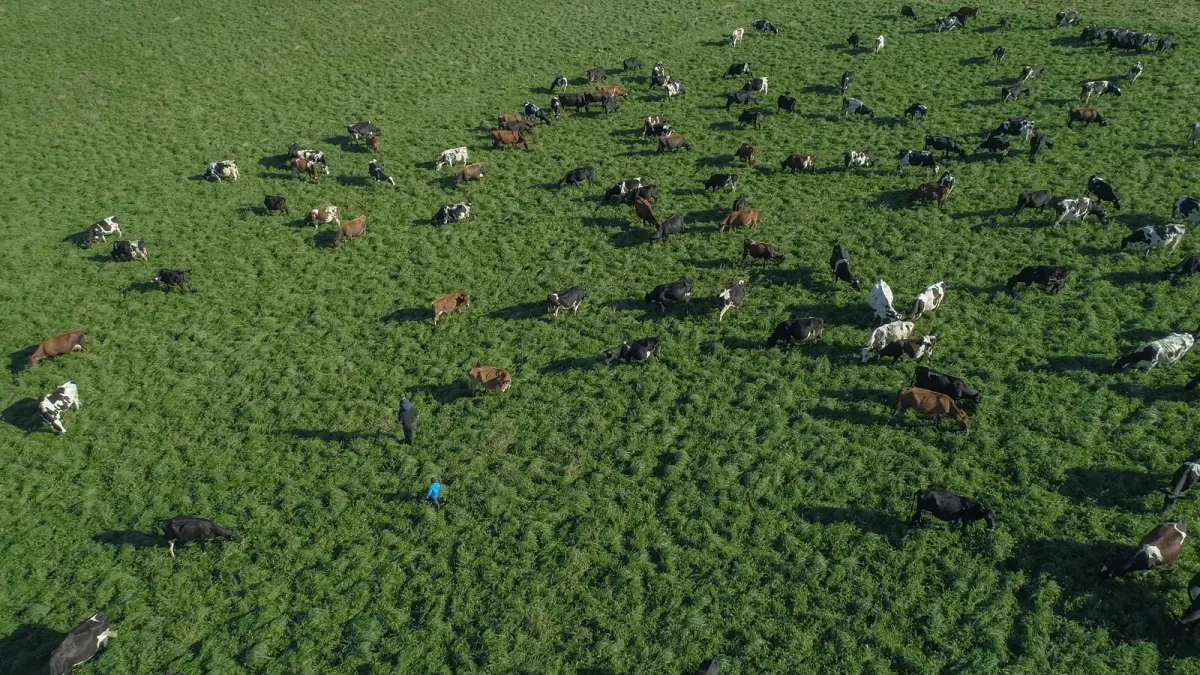
The central decision at Uplands is to let the grass set the calendar. The farm is divided into small paddocks, and the cows move to a different one each day. The farm gives two reasons on its Our Farm page: the cows always eat fresh grass, and no paddock is overgrazed, so it regrows before the next grazing. That is the core of rotational grazing as most graziers describe it. Apart from a small amount of grain while they are being milked, the cows eat only fresh pasture from spring through fall. According to culture magazine, the founders began by sowing new varieties of grasses, clovers, herbs and wildflowers.
The milking year follows the pasture. Calves are born from late March, when the pastures emerge, the herd is milked until Christmas, and then the whole herd is dried off and not milked through the winter. It is a textbook case of timing calving to the grass. The farm lists its reasons for a pasture diet in plain terms: less erosion and fewer chemical inputs than cropped land, fresh air and exercise for the animals, less barn work for the farmer, and what it calls the suggested health benefits of grass-fed products.
The herd itself was rebuilt for this system. Uplands runs a closed herd: it uses its own bulls and raises its own calves without buying outside cows. Over decades it has crossbred nine different types of cows, pairing larger breeds such as Holstein and Brown Swiss with smaller ones such as Jersey and Tarentaise. The farm says it breeds less for size than for mobility and for efficiency in turning grass into milk, and for a balance of fat and protein suited to its cheese. That reasoning matches the case for choosing genetics that fit the pasture rather than the barn.
A second cheese followed. In the fall of 2010, culture reports, Hatch launched Rush Creek Reserve, a soft raw-milk cheese wrapped in spruce bark and inspired by Vacherin Mont d'Or. It is made in the fall, when the cows move from pasture to hay and the milk turns richer.
How it works today
The herd numbers about 150 cows. Wisconsin Public Radio reported that figure in July 2024, and an Uplands job listing posted in July 2026 on Good Food Jobs describes rotationally grazing 150 cows from May through November and making two cheeses.
Pleasant Ridge Reserve is made only from fresh, raw milk while the cows are grazing. In midsummer, when the herd is at peak production, a batch can yield up to 78 ten-pound wheels a day. The weather largely decides how many batches are made in a year: when pasture conditions are not right, the farm sells the milk instead of making cheese with it. Wheels age in ripening rooms built into the creamery and are washed several times a week in brine; a small share is aged more than a year and sold as Extra Aged in the fall and early winter. The farm says Pleasant Ridge won Best of Show at the American Cheese Society competition in 2001, 2005 and 2010, and the US Cheese Championships in 2003. In 2024 Hatch completed the Wisconsin Master Cheesemaker program, certified for Pleasant Ridge Reserve.
The work is seasonal for people too. The farm keeps several year-round employees and occasionally takes a seasonal apprentice through the Dairy Grazing Apprenticeship program. The creamery hires a few people each May for the six-month season and another one or two in the fall for Rush Creek, and the farm says nearly all of its permanent staff started in seasonal jobs. The July 2026 listing offered 35 to 45 hours a week at $20 or more an hour, with help finding rental housing, which is relevant to anyone weighing fair pay for apprentices and seasonal crews.
Uplands sells through its own online shop, which ships, and through retailers listed on a store map on its site. Its website lists no organic, grass-fed or regenerative certification; the case rests on its described practices and its cheese.
What it shows
Uplands is a clear example of turning grazed milk into a premium product on the farm. Hatch told Wisconsin Public Radio that this style of cheesemaking lets small producers compete with commercial operations because the cheese tastes of its land and animals, in contrast to factories blending milk from hundreds of farms. The farm does not have to sell into a commodity milk pool when it can turn its own milk into an aged cheese with a national reputation. That is the logic of value-added production, applied to a dairy.
The model also shows what a grass-based dairy gives up. There is no winter milk at all. Cheese volume depends on the weather, and in seasons or weeks when the pasture is not good enough, milk leaves the farm as plain milk rather than cheese. Labor swings with the season, so the business depends on hiring and training new people every spring. None of those constraints is hidden; the farm describes each of them on its own pages.
On soil, the evidence is thinner than the story. The farm's case for pasture over cropland, less erosion and fewer chemical inputs, is consistent with the aims of healing the soil, but no published soil or carbon measurements for Uplands turned up in the sources reviewed for this article. Readers should treat the environmental benefits as the farm's stated reasons, not as measured results.
What the example does document well is continuity. A grazing system that started with two families in 1994 has passed to two former apprentices, and the same closed herd has been bred for the same pastures for decades. For other grazing operations that sell directly, see Ashfount's farms and ranches directory.