
Where it started
Elmwood Stock Farm sits just outside Georgetown, Kentucky, in Scott County, on the banks of the Elkhorn. The family that runs it counts six generations of farmers on the land. According to a 2018 profile by the Organic Farming Research Foundation, the farm began as a producer of Black Angus breeding stock, and cattle remain part of the business today.
Siblings Ann and John Bell grew up farming there with their parents, Cecil and Kay Bell, and took the farm over from them in the 1990s, the farm says. Ann married Mac Stone, whom she met at a farming conference around the time the farm was changing course. John and his wife, Melissa Bell, live on the farm and are raising a seventh generation. The family has sold produce, meat and eggs directly to consumers since 1994, first at farmers markets and then through CSA memberships.
The rotation that underpins the farm today is older than its organic certificate. The foundation's 2023 report notes that John Bell's parents and grandparents grew tobacco in a similar pattern, keeping fields in hay and cattle for four or more years before switching them to tobacco for a few seasons. Decades ago the family also used the Soil Conservation Service, the agency that became the NRCS, to turn a spring on the farm into a gravity-fed water system for livestock, which is still in use.
What they changed
The big change was going organic. In the 2018 profile, Mac Stone said the shift had two roots. John disliked wearing a respirator to spray his fields and came to see spraying as a band aid, so he looked to rotations and cover crops instead. Meanwhile Ann was hearing from market customers who asked about pesticides. The family began the transition around 2000 and, according to that profile, took about 12 years to move the whole operation over. The farm's own account says the conversion ran over roughly 15 years.
The fertility system they built rests on crop-livestock integration. In 2023 the foundation described it this way: land stays in perennial pasture under multi-species grazing for four to five years, then opens for three years of intensive vegetable or grain production. The farm describes the full cycle as an eight-year rotation. John Bell put the logic plainly in that report: "Long-term, it's the fertility program that usually determines whether somebody is successful with organic." For the principles behind the approach, see Ashfount's guide on adding animals to a crop rotation.
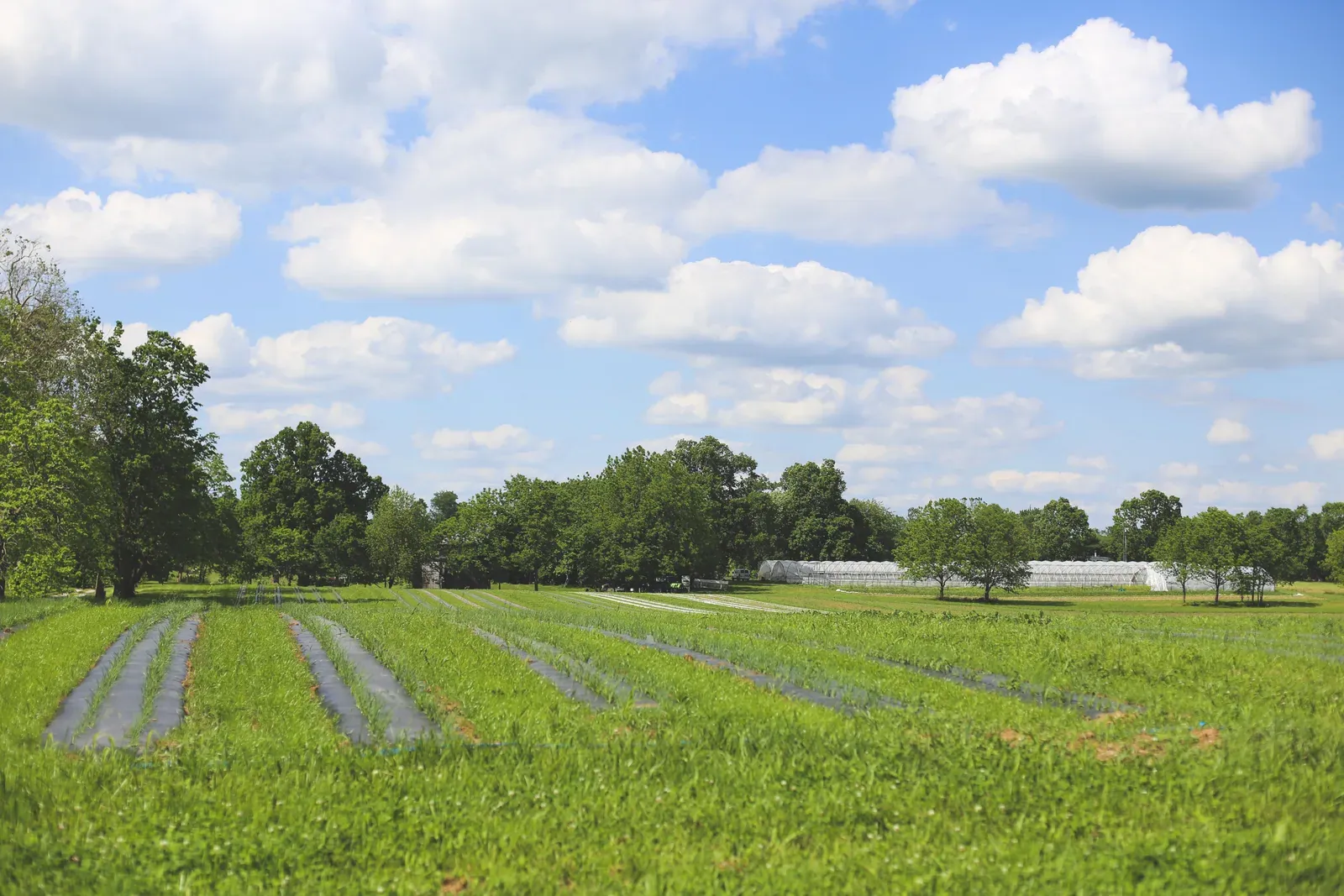
Federal conservation programs helped. Bell used EQIP to plant overwintering cover crops and to establish diverse pasture when fields rotate out of crops. The farm has also used the NRCS High Tunnel Initiative three times. It already had three 300-foot tunnels but needed rest periods for them, because continuous production builds up salt and nematodes. With the new tunnels, at least one is now rested each year with the plastic off so rain and weather reach the soil, and the farm was working toward a fifth tunnel so that two can rest each year. Ashfount explains what that program covers in high tunnels and the NRCS initiative.
In the 2018 profile, Mac Stone also described a University of Kentucky soil scientist studying microbial health across the eight-year rotation. He said her data showed the farm was keeping pace, building soil and sequestering carbon. That is Stone's account of work that was still in progress at the time.
How it works today
Elmwood describes itself as nearly 400 acres, all of it a USDA certified organic operation. It is also listed in the directory of the Real Organic Project, an add-on label that, as the farm describes it, verifies soil-grown crops and real pasture access on top of the USDA standard. The farm says cover crops, rotation and grazing are how it restores the soil, which it treats as a living habitat rather than a medium to extract from, an idea at the center of heal the soil.
The livestock page lists Wagyu-Angus cattle that are born on the farm, fed only grass and hay and rotationally grazed for more than 850 days. A small flock of Dorset and Katahdin sheep, Berkshire pigs, pastured chickens kept in chicken tractors inside electric fencing, and laying hens complete the herd. The farm uses electric netting to keep coyotes off its sweet corn and chickens rather than removing them.
Turkeys are a signature. The farm keeps its own breeding flock of heritage breeds, hatches the poults on the farm and raises them on pasture alongside broad-breasted birds. LEX 18 reported in 2024 that the turkeys go to families in more than 40 states at prices up to $299. A 2025 LEX 18 report said Mac Stone had raised heritage turkeys for 18 years, part of the case for heritage breeds on pasture.
Sales are direct. The CSA runs in seasonal blocks through the year, with vegetable, meat, egg and flower shares delivered or picked up across Central and Northern Kentucky, Louisville and Cincinnati. Members pay up front and share the season's risk, and the farm matches member donations to give shares to families facing food insecurity. There is an on-farm store, public farm tours are due to return in 2027 after a pause, private tours run on weekdays, and the Real Organic Project directory lists stalls at the Lexington, Hyde Park and Scott County farmers markets. The farm accepts EBT, WIC and Senior Farmers Market Nutrition Program checks, and it is one of the partner farms in the University of Kentucky's CSA voucher program for employees, which UKNow described in February 2026.
Spectrum News 1 visited the Hyde Park booth in Cincinnati in June 2026. Stone, who has been part of the farm for 30 years, told the reporter, "We're now feeding the grandkids of the original customers that we started with back in the day."
What it shows
Elmwood shows that the line between a vegetable farm and a livestock farm can be an artificial one. Here the cattle, sheep and poultry are not a side business; they are the fertility program. Years of grazed pasture rebuild the ground that three years of vegetables draw down, which is the case for integrating livestock and plant growing in working form.
It also shows continuity rather than rupture. The long rotation grew out of the hay, cattle and tobacco pattern of earlier generations, and the family has used federal conservation programs for decades. The 2023 report is a reminder that NRCS programs can work on an organic farm, provided every practice they fund is allowed under the National Organic Program.
The farm's own pages name the costs. Growing organically and regeneratively, it says, "is not easy or cheap", and a wide variety of crops takes more planning and more time. Prices reflect that. LEX 18 noted in 2025 that an average 15-pound supermarket turkey would cost about $31 that year, while an Elmwood heritage bird can cost up to $300. Labor is part of it too. In 2018 the farm employed 11 workers through the H-2A guest worker program, plus 12 to 15 more for markets and delivery, according to the foundation. The farm also notes that keeping developers at bay is not always easy, and credits its members and customers for making it possible.
That last point is the business model. A farm that sells almost everything directly depends on people who understand why its food costs more. Elmwood invests in that understanding through tours, market conversations and newsletters, which fits the case Ashfount makes for CSAs as a local food system and for the farms and ranches that build one.