
Where it started
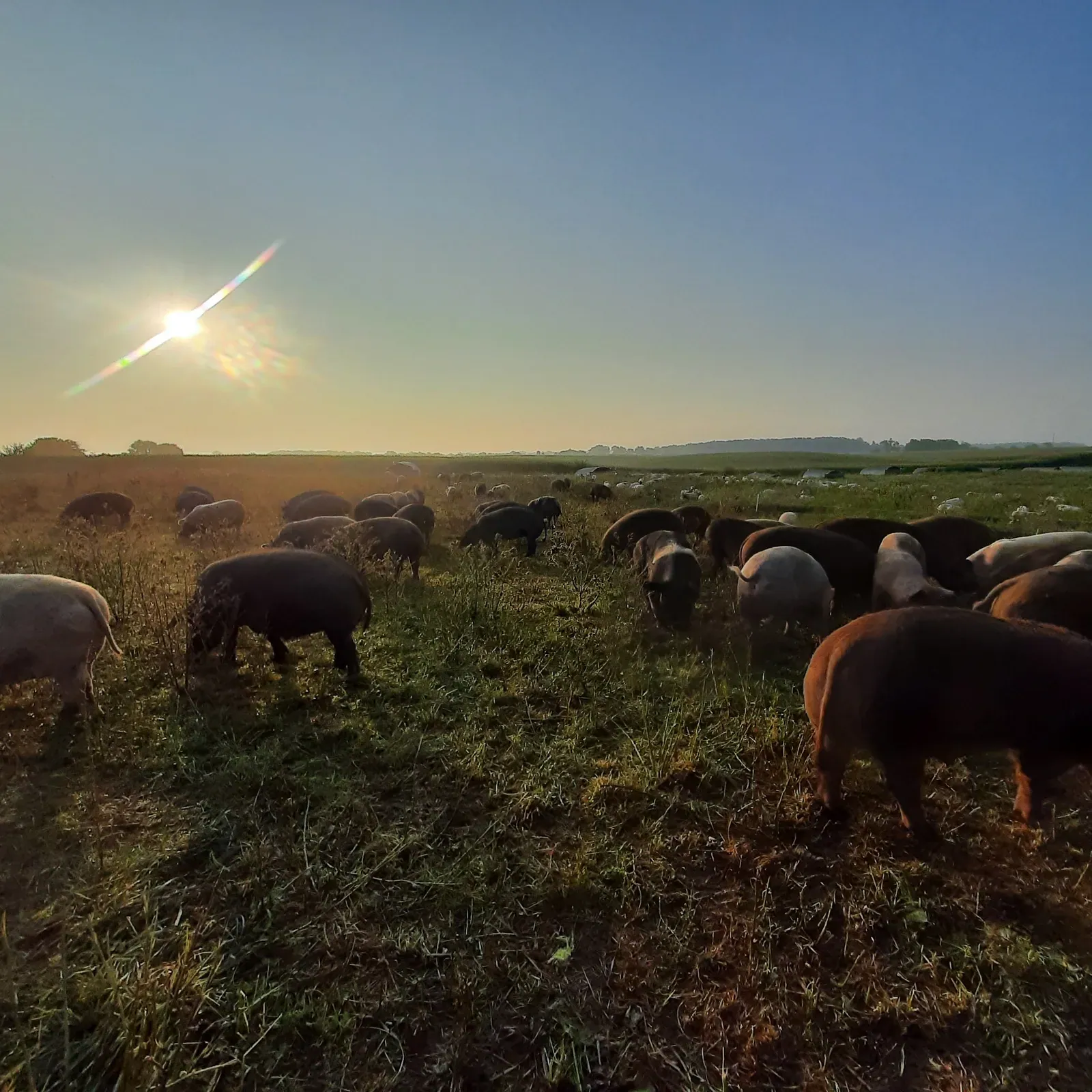
By the 1990s the Gunthorp family had raised pigs on pasture in LaGrange County, in the northeast corner of Indiana, for four generations. A 2008 Chicago Tribune profile describes the family farm Greg Gunthorp grew up on: about 600 acres of corn and soybeans, with some 40 acres of woods and 100 acres of grass and clover pasture, where pigs roamed, rooted for acorns and harvested corn in the fall. The farm's own history says the pigs were used as a tool to clean up grain left after harvest and to prepare hay fields to be turned back into crop ground.
Greg studied agricultural economics at Purdue but, according to the Tribune, went home after two years with an associate's degree because the "get big or get out" message did not fit how he had been raised. In 1994 his father, Theodore, told him that business was over for the independent hog farmer. Greg bought his father's sow herd anyway and started out on 65 acres he had bought just down the road.
Four years later the market proved his father right. In 1998 hog prices crashed, falling to eight cents a pound in some places by December, the Tribune reported, and the farm says Greg was selling pigs for less than his great-grandfather had during the Great Depression. The way out came by chance. After a talk he gave at a sustainable agriculture conference in Missouri, a man in the audience told him that a friend who supplied pigs to a Chicago restaurant was getting out of the business. The restaurant was Charlie Trotter's. Greg called, the chef de cuisine asked him to bring a pig, and Greg and his wife, Lei, drove it into downtown Chicago packed in ice in the back of a small hatchback. Within months, the Tribune reported, he was delivering to other Chicago restaurants, with one chef leading to the next, an early example of what chefs look for in a farm supplier.
What they changed
Restaurant customers pulled the farm into new species. The Tribune recounts that Frontera Grill wanted chickens rather than pork, and Greg learned to raise them. The farm's timeline lists pastured chickens around 2000, ducks in 2002 and turkeys in 2007. Processing was the hard part. To sell meat outside Indiana he needed a USDA-inspected plant, and the plants available would not cut and pack the way his chef customers wanted. After a processing partnership in Michigan failed, Greg and Lei converted their old garage into an on-farm processing plant, which became USDA inspected in 2004. The farm says it is one of just a handful of farms that process red meat and poultry on the farm under USDA inspection, a rare answer to the small-plant processing bottleneck. By 2008 the Tribune counted about 20,000 chickens and 6,000 ducks a year going to Frontera Grill and Topolobampo. The farm also built its own smokehouse beside the plant, which uses hickory logs and eight or more hours of smoke rather than liquid smoke or wood chips.
On the land, the Gunthorps kept the old idea of animals as tools to shape the landscape, placing them to limit damage to the soil and minimize costly inputs, in the spirit of holistic management. What changed was the equipment: modern fence chargers and poly pipe let the family contain and water animals at higher densities and move them more often than earlier generations could. The farm also draws a hard line on zero use of pesticides, herbicides, fungicides and synthetic fertilizer on its land. It added a property half a mile east of the main farm in 2011, another half a mile south in 2016, and sheep in 2021.
Not every change lasted. In a 2021 interview with Pastured Poultry Talk, Greg explained why the farm ended its pastured chicken business after 2020. The chickens had been sold almost entirely wholesale to restaurants, a market the pandemic upended, and processing chickens through an inspected plant cost twice as much per pound as pigs. Competition in pasture-raised chicken had been rising since 2015, and staying competitive would have meant running more birds, which the family did not want. Turkeys carried on for a time: in 2022 Hoosier Ag Today reported the farm raising as many as 14,000 turkeys.
How it works today
Greg, Lei and their son Evan work full time on the farm, which the farm says runs on 240 acres with about 15 employees and help from family and friends, including Greg's father. The farm now says it raises pigs and sheep. It processes and sells the pork directly and sells the lambs live.
The pigs are purebred and crossbred Durocs raised farrow to finish on pasture. The farm uses no crates and no artificial insemination: sows breed and give birth naturally and build their own nests. While on pasture the pigs also get a vegetarian ration of corn, soybeans and a vitamin and mineral mix, and the farm grows some of its own non-GMO corn for the pigs to harvest, a working version of pigs on pasture. The farm says it uses no steroids or growth hormones, minimizes dewormers and treats antibiotics as a last resort; as of 2024 it had never given antibiotics to poultry and had not treated a pig in several years.
The plant is now a business in its own right. Gunthorp Farms processes pigs for other farmers and offers white-label production, raising or processing animals to another brand's specifications and packing them case-ready under that brand's name. Its own pork sells through an online store that ships frozen orders with dry ice on the first Tuesday of each month, by UPS Ground to 26 states and by second-day air to the rest of the continental United States, with pickup at the farm. Wholesale customers get weekly delivery to Fort Wayne, Indianapolis and Chicago, and the farm works with Piazza Produce to deliver beyond those areas.
The newest enterprise sits off the farm. According to the American Solar Grazing Association, Greg and Evan Gunthorp also run Traditional Grazing Solutions, a solar grazing company based in LaGrange, and graze sheep on about 1,000 acres of a utility-scale solar site near South Bend, managed the same way as on the home farm. It is a practical example of agrivoltaics giving a livestock farm more ground. Greg is also active in policy: in June 2023 he testified before a House Judiciary subcommittee hearing on regulatory barriers to competition in meat processing.
What it shows
Gunthorp Farms shows how much owning the processing step can matter for a pasture livestock farm. The plant let the family meet chef specifications, sell across state lines, add smoked products and, later, earn from processing for other farms. It also shows the ceiling that remains. In a 2023 Investigate Midwest report on small processors, the reporter noted that selling in grocery stores was not an option for him, as the largest meatpackers often hold those contracts, and Greg said that in an extremely concentrated marketplace it is difficult for a small plant that slaughters to find a long-term place. That is the structural backdrop described in consolidation in meatpacking.
The chicken story is the clearest trade-off. A small inspected plant gave the farm control, but chicken processing cost more per pound than pork, demand was concentrated in restaurants, and competing on price would have required a scale the family chose not to reach. Diversification cut both ways too. Speaking to Hoosier Ag Today in 2022, Greg said several species require more management and different equipment, but that when the market for one animal is down, another enterprise may carry the farm, the logic behind diversifying farm income.
The farm is also a useful reminder of what pasture-raised pork means in practice. The pigs live and breed outdoors, but they still eat corn and soybeans; pasture describes how they are raised, not a grass-only diet. Finally, the solar grazing work points at a constraint every young livestock farmer meets. The ASGA profile frames it around land access and land affordability, the biggest hurdles to becoming a farmer, and grazing a solar site has given the Gunthorps many more acres for their flock. After more than three decades of adapting, the farm's through line is the one it started with: pigs on pasture, raised in much the same way as the four generations before, now sold under the family's own name.