
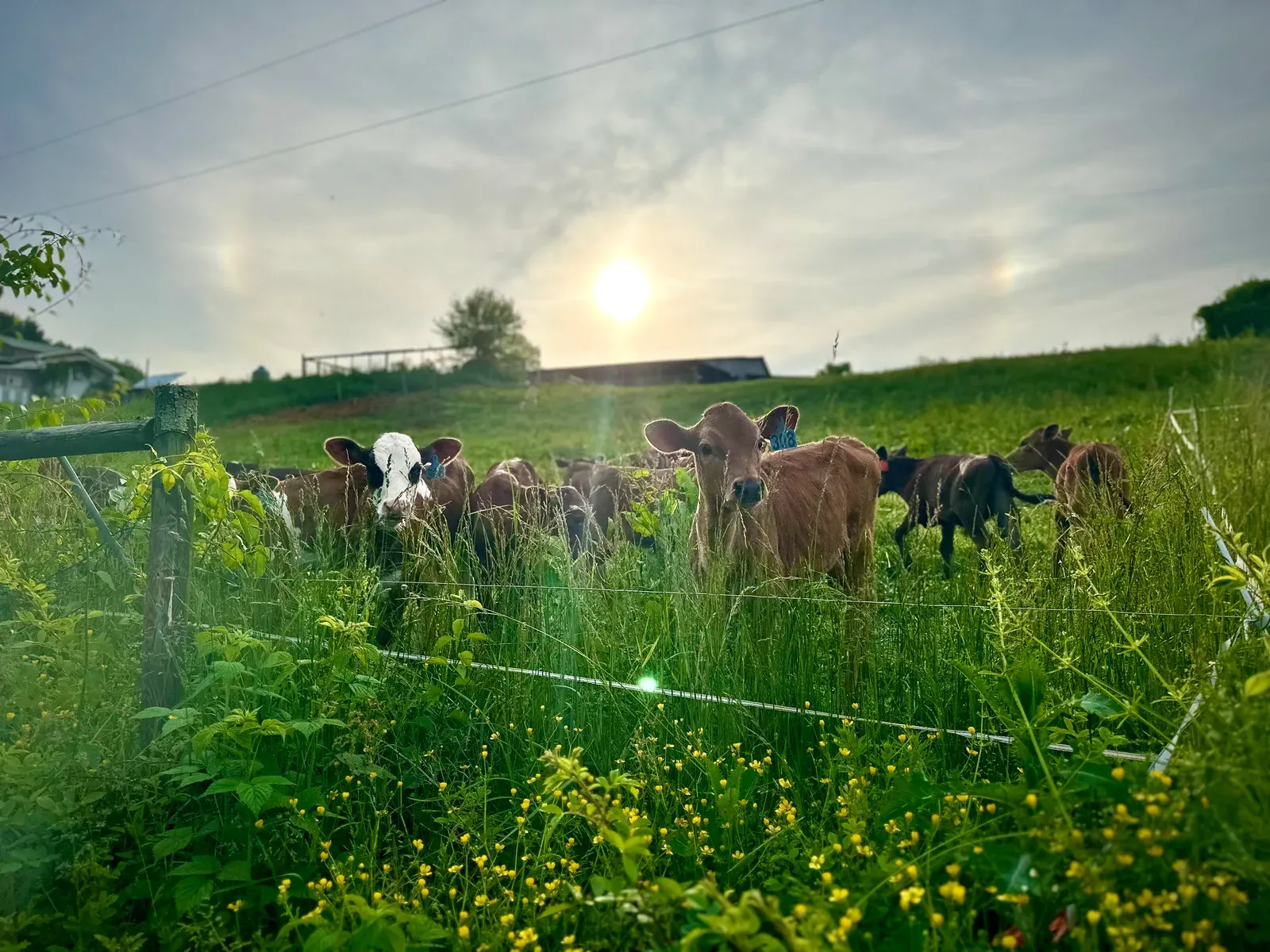
Where it started
Meadow Creek Dairy sits where Grayson County meets the city of Galax, in the Blue Ridge Mountains of southwest Virginia. Its founders, Helen and Rick Feete, came to the area from Northern Virginia and Maryland. Cardinal News reported in 2024 that she had been an office worker and he a carpenter, and that they chose Grayson County in 1987 because land prices were good and they liked the local music. The farm dates its founding to 1988.
The land shaped everything that followed. On its own land page, the farm describes mountain ground where soil, crops and tractors tend to slide off the rolling hillsides, and where pasture is what stays and thrives. The first herd was purebred Jerseys, chosen because they are aggressive grazers and less highly bred for production than the typical Holstein.
Cheese came about a decade later. In March 2026 the farm marked its 38th year of dairy farming and its 28th season of cheesemaking. According to culture magazine, a trip to Wales and Ireland in 2000 inspired Grayson, the washed-rind cheese that became one of the farm's best known. The Feetes' children, Kat and Jim, were raised locally, and both now work on the farm: Heritage Foods names Kat as general manager. That makes it a working example of a family enterprise of the kind described in Nurture Families.
What they changed
The core practice is Management Intensive Grazing. Cows are allowed on a given paddock for only a short time, and the farm's milk page says they change fields every 12 hours. The farm says this keeps the grass young and nutrient-rich and drives deeper roots, and it claims less erosion, more organic matter and carbon stored in the pasture as a result. Those are the farm's own claims. The approach follows familiar grazing management principles: short grazing periods and time for regrowth.
Diversity is part of the design. Unpredictable mountain weather means the pastures need grasses that tolerate heat, cold, wet and drought, and the farm lists ryegrass, clover, plantain, chicory and brassicas among the species in its perennial pastures. It uses fertilizer sparingly, relying instead on management and on the cows' own manure.
The milking year follows the grass. All the cows are bred together in summer so they calve together in spring, when the grass breaks dormancy, and milking stops in early winter as growth slows. That is a deliberate case of timing calving to the grass.
Then the Feetes rebuilt the herd. To get more strength than the Jerseys offered, they crossed them with New Zealand Friesians, which handled the long walks to steep pastures and, according to the herd page, let the farm double its herd in under five years because of their longevity. Jersey milk had too much fat relative to protein for cheese, so they added French breeds, mainly Montbeliarde, used for Gruyere and Comte, and experimented with Tarentaise and Normande. The farm calls the result its own "Meadow Creek" breed, an example of the reasoning in why genetics matter on pasture. Heritage Foods reports that Jim Feete's time studying grass-fed farming in New Zealand influenced the farm's approach.
How it works today
The herd is closed, made up only of cows the farm has raised. Cardinal News counted 135 in late 2024; Kat Feete said the herd contracted in 2020, when some cows had to be sold, and that the farm was working to rebuild it to about 150. Heritage Foods counted 140 in a profile dated January 2025, with about 90 percent of the diet from grass; Cardinal News notes a grain supplement. The same profile says grass on a given field can grow back within three weeks and that a twelve-person team runs the farm from breeding to sales.
Raw-milk cheese puts the weight on milk quality. The swing-twelve parlor milks 140 cows in under an hour, the milking system was designed in Ireland, and the farm says its own limit is a standard plate count of 10,000, ten times lower than the requirement for pasteurized milk. If a day's milk is in question, it is dumped.
The cheeses are Appalachian, a tomme-style cheese with a white mold rind and the first the farm made; Grayson, a pungent washed rind; Mountaineer, a dense cheese inspired by the Alpine cheeses of Valle d'Aosta and the Savoie and aged at least six months; and Galax, a milder cheese first made in 2021. They age from about two months to more than eight months in the farm's cellars, and their flavor changes with the season. In 2023 Appalachian won a Super Gold at the World Cheese Awards in Trondheim, Norway, one of 100 among 4,502 entries from 43 countries.
Sales run mostly through the trade. Heritage Foods reports that 5 percent of the wheels go direct to consumers, 46 percent to distributors and the rest to cheese shops and restaurants; Cardinal News names Murray's Cheese as a distributor. The farm also runs an online store and a list of shops and groceries that carry its cheese. More than half of the team lives on the farm, and for over 15 years it has hosted international students through the Ohio State University Agricultural Internship Program. The website lists no organic, grass-fed or regenerative certification.
What it shows
Meadow Creek shows how a grazing dairy can outlast a collapsing local dairy economy. Rick Feete recalls 80 or 90 dairies in Grayson County when the family arrived in 1988; by 2024 there were three, and Meadow Creek was one of them. Its route was to keep the milk and sell it as cheese, into shops and restaurants far from Galax.
The same route carries real exposure. The farm leaned on the restaurant market, and when the pandemic hit in 2020, Kat Feete told Cardinal News: "We lost 97% of our business that month." Business recovered partly, but the year ended about 30 percent down, milk was dumped, and the government programs for dumped milk applied only to farms selling into commodity markets. Aged cheese bought time that fresh cheesemakers did not have. After Hurricane Helene in 2024 the farm dumped five days of milk while a generator kept 50,000 pounds of cheese at the right conditions. It is a reminder to read the eligibility rules of USDA disaster programs before a crisis, since they can depend on how a farm sells.
On soil, the case is mostly told, not measured. The farm's account of deeper roots, less erosion and more organic matter fits the aims of healing the soil, but no published data on its pastures turned up in the sources reviewed.
Finally, seasonal grazing changes the product itself. Kat Feete explained that spring milk is plentiful but lighter and that fall milk is far denser, so the cheese shifts through the year. A grass-based dairy sells that variation as part of the cheese rather than standardizing it away. Comparable grazing operations are listed in Ashfount's farms and ranches directory.