
Where it started
ORIGIN Milk is a dairy brand based in Cleveland, Ohio, built on one premise: milk from heritage cow breeds whose milk carries only the A2 form of beta-casein protein. The company does not run its own dairy. It buys milk from small partner family farms, has it processed near those farms and sells it under its own label in grocery stores.
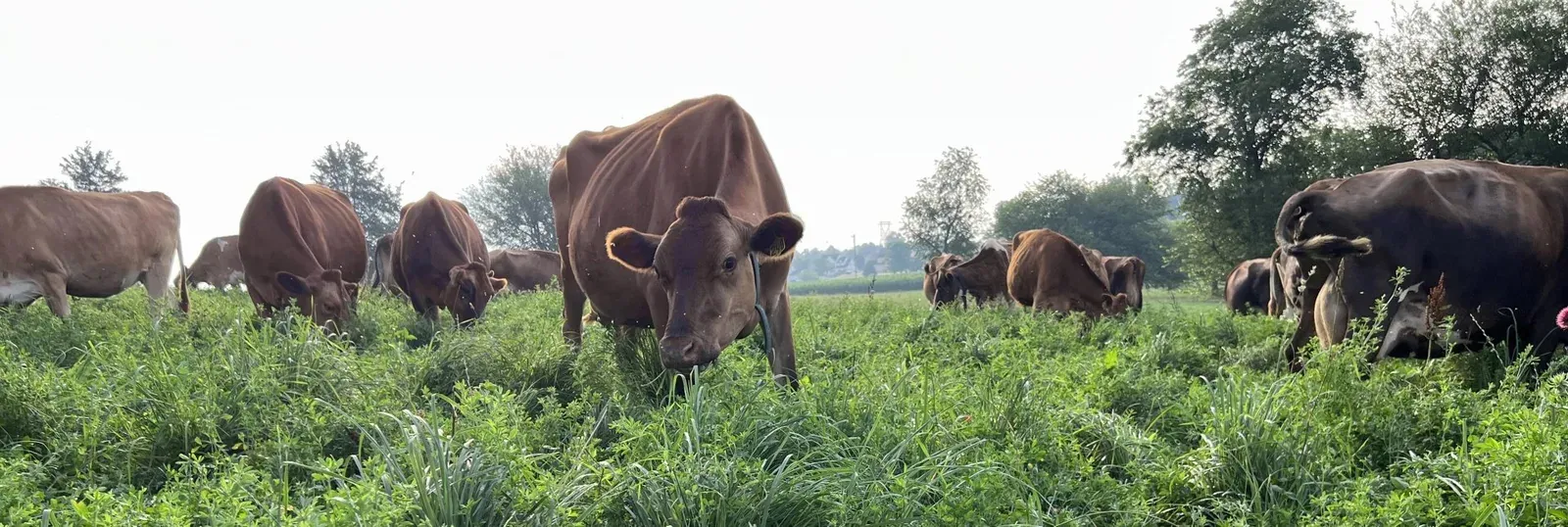
The brand's case begins with genetics. On its A2 heritage page, the company tells the story of the Guernsey, a breed from the Channel Island of the same name that became known for golden, cream-colored milk. It writes that the breed has fallen into numeric decline as the dairy industry rewarded the quantity of milk over its quality, and that roughly 14,000 of about 44,000 registered Guernseys worldwide are in the United States. Its fluid milk descriptions say the milk comes exclusively from pasture-raised Guernsey cows, while its FAQ names a wider group of heritage breeds: Guernsey, Jersey, Milking Shorthorn, Dutch Belted and Brown Swiss. Why breed choice matters on pasture is the subject of our piece on heritage breeds and genetics.
The people behind the brand appear mainly in trade and regional press. In August 2021, Farm and Dairy described Adrian Bota as one of the founders and reported that he saw Lancaster, Pennsylvania, as a future hub of regenerative dairy production. His pitch to farmers was not to leave dairy: "I'm just trying to convince you to buy different cows," he said. The Philadelphia Inquirer quoted John Suh as the company's chief operating officer the same year.
The economics were part of the idea from the start. Farm and Dairy reported that ORIGIN then worked with six partner farms in Ohio, Pennsylvania and Colorado and paid its farmers more than $40 per hundredweight, against an average conventional price of around $18. That model, a brand that pays small herds enough to stay in business, fits the case for acting local.
What they changed
In 2021 the brand tied itself to a certified regenerative standard. It became one of six partners in a program led by Pasa Sustainable Agriculture to build a regenerative organic dairy supply chain in southeast Pennsylvania, backed by a grant of nearly $1 million from the National Fish and Wildlife Foundation and the US Environmental Protection Agency. The other partners named were TeamAg, the Center for Dairy Excellence, Ephrata National Bank, Mad Agriculture and Rodale Institute, groups of the kind listed in our organizations directory. The program aimed to cut nitrogen runoff by more than 400,000 pounds a year, phosphorus by more than 9,000 pounds and sediment erosion by more than 23 million pounds, to improve water quality in the Chesapeake Bay watershed.
ORIGIN's role was to be the market. Farm and Dairy reported that at least 40 eligible farmers in the project could secure a five-year contract with the company. The Philadelphia Inquirer described the aim as paying 40 regenerative organic farmers $40 per hundredweight, more than twice the conventional price and about $10 above standard organic, and noted that not all of the extra money lands in the farmer's pocket. It reported that the grant ran through 2024.
The Inquirer also spelled out what the program asked of these farms: a strictly grass diet with hay in winter and no grain, and Regenerative Organic Certification, which requires USDA organic certification first, rules out traditional tie-stall barns and, at its highest level, requires bull calves to be raised to maturity on another pasture-based operation. Abner King, who milked 40 cows in Honey Brook, Chester County, had signed up with ORIGIN and had two years to move out of his tie-stall barn. Mahlon Weaver, a certified organic farmer in York County, agreed to ship through the company, and Oasis Creamery agreed to process milk for it. How these standards compare with other labels is covered in regenerative certifications compared, and the organic step that comes first is explained in our guide to organic certification cost and cost-share.
On its home page, ORIGIN lists the standards it farms to under three headings that mirror the certification: soil health (cover crops, crop rotations, conservation tillage, rotational grazing, no synthetic inputs), animal welfare (pasture-raised, limited transport, no confinement feeding operations) and social fairness (fair payments, living wages, long-term commitments). The soil side of that list is the ground covered by heal the soil.
How it works today
The company's farms page names its partners: the DeGroot family of Colorado Cow in the Rocky Mountain region, Edward and Aden with two small heritage family farms in Ohio's Amish Country, and the Souire and King families in eastern Pennsylvania. Its FAQ places the farms and processing in Holmes County, Ohio, Lancaster County, Pennsylvania and Boulder County, Colorado, and puts herd sizes at 35 to 85 cows. The farms page lists organic, pasture-focused nutrition with organic and non-GMO supplemented feed, footnoted as about 15 percent of the entire diet during lactation and winter months, and no growth hormones, antibiotics, chemicals or fertilizers. Cows graze as long as the weather permits and are housed in free-stall barns in winter. The company says it pays on average twice the going rate for conventional milk.
The range covers whole milk, chocolate milk, heavy cream, three kefirs, salted and unsalted butter and nine cheeses. The milk is vat pasteurized at 145 degrees for 30 minutes and not homogenized, and the company says this minimal processing means a shorter shelf life. Sales run through retailers: the store list includes Heinen's in the Cleveland area, Dorothy Lane Market in Dayton, MOM's Organic Market in Maryland, many independent shops in New York, and stores in Colorado, Texas, Utah, Oklahoma, Kansas and other states.
Certification needs a precise reading. In October 2026 the Regenerative Organic Alliance directory lists 25 ROC products under The Origin Milk Co.: whole, 2% and skim milk, chocolate milk, half and half, heavy cream, two butters and a range of cheeses, plus several beef items that do not appear on ORIGIN's own site. The company's FAQ says it produces 100% grassfed fluid dairy and cheeses and also supports farms in transition with a line of fluid dairy products that are on the road to organic, 100% grassfed and ROC. The Cornucopia Institute's scorecard, dated October 2025, says some ORIGIN products are ROC, that the brand sells both organic and conventional dairy products, and that the brand has not been rated yet (the scorecard lists it as in process, with no score). ORIGIN's own pages for whole milk, chocolate milk and heavy cream cite Non-GMO Project verification and do not mention organic or ROC. The accurate picture is a certified line plus a transition line, and the package seal tells a shopper which one is in hand, a point our piece on honest labels makes in general.
What it shows
ORIGIN shows how a brand can act as the market maker for regenerative dairy. The program asked small herds for organic status, a grass-only diet and, in some cases, new barns. A buyer that offers more than twice the conventional price and five-year contracts gives those farms a reason to make the change, and in the Pasa program it was the brand that offered those contracts. The same dependence is a risk: when one buyer sets the price, the farms rely on that buyer's sales.
It also shows that breed choice is a regenerative decision. ORIGIN's FAQ concedes that heritage cows produce less milk per day than production breeds, and its sustainability page claims they need 20 to 30 percent less feed per pound of milk. The brand turns lower volume into a premium product with richer milk and minimal processing, at the cost of a shorter shelf life.
The sources also name limits. The Inquirer noted that not every dollar of the premium reaches the farmer, and the ROC rules gave farmers like Abner King two years to move out of tie-stall barns. Independent press coverage is thin after 2021, and none of the sources reviewed here report results from the Pasa program. The brand's own pages are not fully consistent: Guernsey-only milk in one place, five breeds in another, and 100% grassfed products alongside supplemented feed. Its transition line is the most useful detail, because it shows a practical route for farms moving toward certification. It also means that a shopper looking for ROC milk, from this brand or any other in the food brands directory, should check the label.