
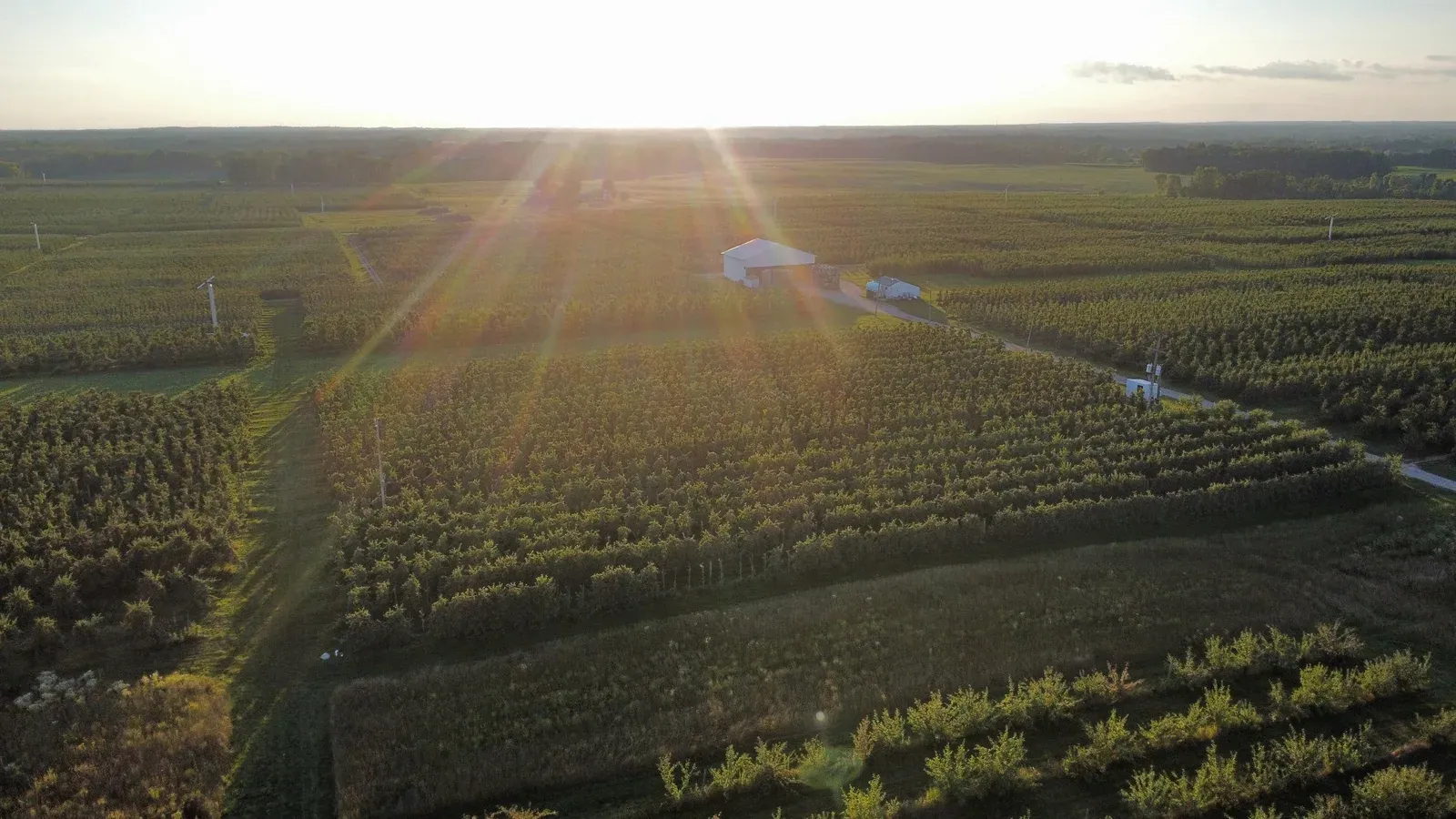
Where it started
Third Leaf Farm is a third-generation apple orchard in Greenville, Michigan, near Grand Rapids. The family business began more than 60 years ago as Tom Rasch and Son Orchards, according to a profile by the nonprofit Mad Agriculture, and for most of that time it was a conventional orchard. The orchard's certified legal entity still carries that name today.
The new name carries two meanings. The Michigan Apple Committee explains that "Third Leaf" nods to the third generation, and that in orchard language a tree's third leaf is the year it begins to bear fruit. Mad Agriculture adds that it also stands for the three brothers who were involved in running the farm.
The change came with the third generation. Kyle Rasch grew up working in the orchard alongside his father, grandfather and brothers and started formally at sixteen. After college he traveled and worked on farms abroad, including through WWOOF, and spent time in an apple-growing region of India trading notes with local growers. That exposure to organic and regenerative methods led him to take a leading role at home. The farm dates its regenerative practice to 2015, the year Kyle became involved, and the farm credits him as the linchpin of the transition. For anyone weighing how to start an orchard today, it is a reminder that an established orchard can change course too.
What they changed
The farm has been certified USDA Organic since 2015, but it did not convert all at once. According to its certifications page, it added organic acreage every year, with the entire 100 acres of production due to be certified organic as of the 2026 season; its About page now describes a 100-acre certified regenerative organic orchard. Along the way, Mad Agriculture reports, the family scaled apple production back from 180 to 110 acres and moved from chemical fertilizers toward building soil biology, with help from regenerative consultants. The profile records that nearly every year of the transition brought a new set of challenges, and that successes started to come about three years in.
The orchard floor changed most visibly. Third Leaf uses zero herbicide and lets the naturally occurring ground cover grow under the trees: grasses, clovers, dandelion, goldenrod, milkweed and many others, kept in check by a swing-arm mower. The farm's reasoning is that a diverse plant community supports diverse soil microbes, which in turn help the trees with disease and stress tolerance. On new plantings and sandier soils it lays down wood mulch and reports clear gains in organic matter and water retention.
Habitat is the other large investment. The farm has 50 acres of native pollinator and wildlife habitat plus 5 acres of planted wildflowers funded through an NRCS EQIP grant, placed between orchard blocks. Eric Rasch, the youngest brother, keeps about 100 hives on the farm year round for pollination. It is a working example of pollinator habitat on a working farm. Decisions are tied to data: soil tests for minerals, microbes and structure, leaf tissue and sap analysis during the season, moisture sensors for irrigation, and nutritional testing of the finished fruit. The Michigan Apple Committee adds drone monitoring of the fruit, high-density tree systems and disease-resistant varieties.
How it works today
Today Third Leaf farms about 100 acres of apples, growing 15 commercial varieties and more than 200 lesser-known experimental ones, including red-fleshed apples. A field day report from University of Minnesota Extension in August 2026 describes mostly high-density, trellised plantings with varieties such as Honeycrisp, SweeTango, Golden Delicious and Fuji, plus a red-fleshed Kissabel Rouge coated in kaolin clay as it ripened. The same report names Kyle Rasch as orchard director, working with his brothers Devin and Eric on tasks from trellis construction to beekeeping.
Extension staff saw the mechanics up close. An orchard mower with a tree sensor keeps vegetation down in the aisles and under the rows without disturbing the soil or using herbicides, and a front-mounted hedger handles summer pruning after the solstice and part of the dormant pruning. Because organic rules bar wooden posts treated with certain preservatives, the farm is trialing steel-reinforced concrete posts in a few rows.
The farm's certification has kept pace. Third Leaf reached the Bronze level of Regenerative Organic Certified in the 2025 season, and the ROC farm directory now lists it at Silver, under the legal name Tom Rasch and Son Orchards LLC, for apples, cherries and pumpkins. The farm says it focuses on ROC's soil health and social fairness pillars for now; Extension notes that the animal welfare pillar, which would bring livestock into orchards, is still being worked out in orchard settings around food safety. The comparison of regenerative certifications explains how those tiers differ. The farm also holds Primus GAP and USDA GAP food safety certification and is MAEAP certified.
Fruit reaches buyers several ways: u-pick from mid-August through October, a model covered in agritourism and u-pick basics, online ordering, farmers markets, and bulk orders for families, cider makers and retailers. Its partner list includes GoGo Squeez and Uncle John's Cider Mill. The farm also opens its gates to other growers: NCAT hosted an organic orchard tour there in October 2025, and the Organic Fruit Growers Association brought a field day in 2026.
What it shows
Third Leaf shows that converting an orchard is a decade, not a season. Trees stay in the ground for years, so the farm moved block by block, from first organic certification in 2015 toward a fully certified 100 acres for 2026, and from ROC Bronze to Silver. That pace is easier to sustain when a farm thinks long-term.
Mad Agriculture reports that the shift brought better fruit quality, larger yields and more resilience to volatile weather, and that the farm has seen financial as well as ecological benefits; a quote in the profile says that seeing financial benefits was the biggest shift in winning over the brothers' father. Those are the farm's own reported outcomes, not a controlled comparison, but they rest on the soil practices behind the belief to heal the soil.
The trade-offs are real. Third Leaf's FAQ says that in Michigan's disease and insect pressure, approved organic sprays are sometimes still the right tool, and the goal is to keep reducing them. The sensor mower has broken repeatedly over 100 acres, freight is one of the larger costs of concrete posts, and some older wooden posts remain. The Mad Agriculture profile also quotes the farm on seven once-in-500-year weather events in ten years. Third Leaf is a well-documented case of a commercial orchard taking regenerative organic standards seriously while still working through those limits.