
Every time a calf, a market hog, a tank of milk or a load of soybeans leaves a farm, a small deduction comes off the check before the farmer sees it. That deduction is the checkoff. It pays for the generic advertising you know from television, for research that ends up in feed company brochures, and for nutrition lessons in schools. It also pays for a long-running argument about who controls the money and whom it serves. Here is how the programs work, what the critics say, and what the Opportunities for Fairness in Farming Act, usually called the OFF Act, would change.
What a checkoff is
A checkoff is a mandatory assessment on a commodity, collected at the point of sale and paid to a board of producers and importers whom the Secretary of Agriculture appoints from industry nominations. The money funds generic promotion, research and consumer information "without reference to specific producers or brands," as the National Agricultural Law Center puts it. USDA's Agricultural Marketing Service oversees more than twenty of these boards, from beef, pork, dairy and soybeans down to honey, mangoes and Christmas trees, and the boards pay for that federal oversight out of their own assessments (USDA AMS).
The name comes from the early voluntary programs, when a producer marked a checkoff box to contribute (National Agricultural Law Center). The big programs stopped being voluntary long ago. The beef checkoff was written into the 1985 farm bill and became mandatory after 79 percent of the producers who voted approved it in a 1988 referendum (Cattlemen's Beef Board). If you want the wider picture of how farm law gets made, start with our farm bill explainer.
Who pays what
The rates sit in federal regulations, and a producer can read them:
- Beef: one dollar per head every time cattle change hands, with a comparable assessment on imported cattle, beef and beef products (AMS beef program). Up to 50 cents of that dollar stays with a qualified state beef council (7 CFR 1260.172). AMS says the national board receives about 42 million dollars of the roughly 75 million collected; the rest stays with the state councils.
- Pork: 35 cents per 100 dollars of market value since January 1, 2023, plus an equivalent charge on imported pigs and pork (AMS pork program). The order started at a quarter of a percent, and the rate moves on the recommendation of the producer delegate body (7 CFR 1230.71).
- Dairy: 15 cents per hundredweight on milk marketed for commercial use, 7.5 cents per hundredweight on imported dairy products, with a credit of up to 10 cents for a farmer who already supports a qualified state or regional program (AMS dairy program; 7 CFR 1150.152).
- Soybeans: one half of one percent of the net market price, collected by the first purchaser (7 CFR 1220.223).
One door out exists. Producers of certified organic and 100 percent organic products can apply for an exemption from the assessments, and the AMS page for each program explains how.
Where the money goes
Take beef, the program with the loudest argument. The Cattlemen's Beef Board does not run campaigns itself. Federal law requires it to contract with established national, nonprofit, industry-governed organizations, which are reimbursed at cost and may not profit from a checkoff contract (Beef Board contractors). Each September a committee of producers and importers drawn from the board and the state councils divides the coming year's budget among those contractors.
For fiscal 2024 that committee approved about 38 million dollars: 25,405,000 dollars to the National Cattlemen's Beef Association, 8,150,000 dollars to the U.S. Meat Export Federation, 1,800,000 dollars to the board's own programs, and smaller awards to the Meat Import Council of America and Northeast Beef Promotion Initiative, the American Farm Bureau Foundation for Agriculture, the Foundation for Meat and Poultry Research and Education, the North American Meat Institute and the National Institute for Animal Agriculture. Contractors had asked for about 49 million dollars, some 11 million more than was available (Beef Board, September 11, 2023).
Two of every three dollars the committee awarded for fiscal 2024 therefore pass through NCBA, a trade association that also lobbies, with separate money. The rule is plain: checkoff funds may not be used to influence government policy or action, including lobbying (Beef Board FAQ). The argument is about whether the wall between the two kinds of money is as solid from the inside as it looks from the outside.
The boards answer with returns. The program's commissioned evaluation for 2014 through 2018 estimated that each assessment dollar returned 11.91 dollars in added demand (AMS beef program), and a new study by Harry Kaiser of Cornell University, released in July 2024, put the figure for 2019 through 2023 at 13.41 dollars (Beef Board, July 9, 2024). Few dispute that generic advertising moves product. The question is whose product.
Why small and grass-fed producers object
Four complaints come up again and again.
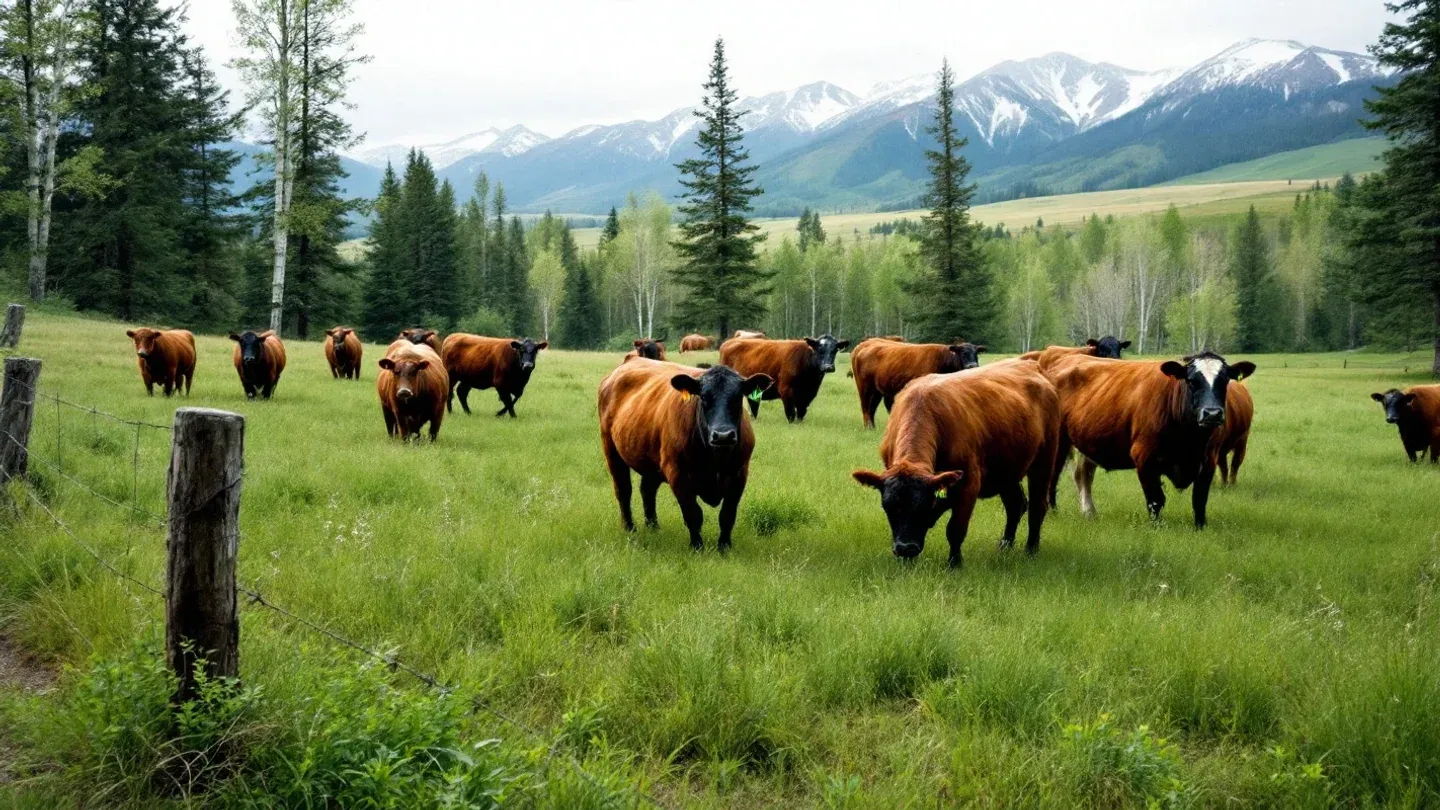
First, generic means generic. A checkoff campaign is not allowed to distinguish between production types, so it cannot say grass-fed or regeneratively raised, and the coalition behind the OFF Act argues that advertising built on the idea that all beef is equal works against premium product (Farm Action fact sheet). Imported beef pays a comparable assessment and importers sit on the board, so the campaign speaks for the commodity, not for where it was raised. A rancher who finishes cattle on grass and sells by the quarter pays the same dollar to advertise the commodity she is trying to stand apart from. Anyone who has set up a grass-fed beef farm knows the feeling, and our piece on honest labels explains why the words on the package matter so much.
Second, the contractor question. Critics see a trade association living largely on checkoff contracts while lobbying, with its other money, for positions on labeling, trade and packer regulation that many independent producers oppose. NCBA's answer, given to Agri-Pulse in June 2023, is that the checkoff is producer-led, that it employs a dedicated compliance director, and that the opponents' claims are disinformation.
Third, the state councils. Up to half of the beef dollar never reaches the federal board; it stays with a state beef council, a private body under state law. R-CALF USA sued in Montana in May 2016, arguing that the fifty cents the Montana Beef Council kept was a government-compelled subsidy of private speech. R-CALF won early rounds, USDA then signed memoranda of understanding with the councils that give the Secretary pre-approval of every promotion, advertising, research and consumer information plan and project, and in July 2021 the Ninth Circuit held that under those memoranda the promotion the councils fund, including through third parties, is government speech beyond First Amendment review (National Agricultural Law Center). R-CALF has since filed a second suit in federal court in the District of Columbia, arguing that the memoranda should have gone through notice-and-comment rulemaking.
The phrase government speech is the hinge of the whole debate. In 2005 the Supreme Court held in Johanns v. Livestock Marketing Association that the beef checkoff funds the government's own message, because the Secretary "has final approval authority over every word in every promotional campaign," and compelled funding of government speech does not offend the First Amendment. Four years earlier the Court had struck down the mushroom checkoff in United States v. United Foods as compelled subsidy of private advertising. The price of the beef program's legal armor is the premise behind it: the ad with the sizzling steak is, in law, the government talking.
Fourth, the exit. A referendum takes a petition from ten percent of producers. When a petition to end the beef order began in July 2020, AMS set the bar at 88,269 valid signatures, a tenth of the 882,692 farms with cattle in the 2017 census. The drive got a pandemic extension through October 2021 and still fell short, and USDA closed it that November (AMS beef program). There is no refund. The one lever is redirection: under a rule in force since June 2019, in states whose council is authorized or permitted to pay refunds, a producer who files a refund request does not get money back; the state's half is sent to the national board instead (National Agricultural Law Center).
What the OFF Act would change
The Senate bill, S. 557, was introduced on February 28, 2023 by Mike Lee of Utah with Cory Booker, Rand Paul, Elizabeth Warren and Kirsten Gillibrand, and referred to the Agriculture Committee. Nancy Mace and Dina Titus filed the House twin, H.R. 1249. The text is short, and it does five things:
- A board may not contract for checkoff work with any party that engages in activities to influence government policy or action relating to agriculture. The one exception is a contract with an institution of higher education for research, extension and education.
- Boards, their employees and their agents may not act on a conflict of interest, engage in anticompetitive activity or unfair and deceptive practices, or disparage another agricultural commodity.
- Boards may contract directly for promotion and research with the Secretary's approval, which is what they would have to do if their current contractors kept lobbying.
- Every budget and every disbursement must be published the moment the Secretary approves it, with the amount, the purpose, the recipient and any subcontractor.
- The USDA Inspector General must audit each program within two years and at least every five years after that, and the Government Accountability Office must assess compliance between the third and fifth year.
It abolishes no checkoff and changes no rate. What it would end is the arrangement in which a lobbying trade association is also the main checkoff contractor.
The opposition is organized. House Agriculture Chairman Glenn Thompson called the bill a "bad piece of legislation" and floated farm bill language affirming the programs; the American Soybean Association called it a hammer searching for a nail; eighteen trade groups signed a letter against it; and a lawyer who works with boards warned of higher costs and lawsuits. On the other side, a coalition of around 131 groups, among them R-CALF USA, the National Farmers Union, Farm Action Fund and several animal welfare organizations, wrote to the committee leaders in late March 2023 urging meaningful reforms. The last time the idea reached a vote, as a Lee and Booker amendment to the 2018 Senate farm bill, it drew 38 votes, with Debbie Stabenow, now the committee chair, urging her colleagues to vote no (Agri-Pulse).
Where it stands this September
Timing matters this month. The one-year extension Congress enacted in November 2023 keeps the 2018 farm bill alive only through September 30, 2024. The House Agriculture Committee ordered its bill, H.R. 8467, reported on May 23, 2024; the Senate committee had not released bill text as of mid-September (Congressional Research Service).
Neither chamber's draft carries the OFF Act. The text of H.R. 8467 does not mention checkoffs at all beyond dairy: it extends the dairy board's authority to spend on foreign markets to 2029 and requires USDA to send Congress an annual report on the dairy order with an accounting of receipts and disbursements and an independent analysis of effectiveness (CRS side-by-side). That is a small transparency step in the OFF Act's direction, confined to one program. The OFF Act itself sits where it was referred in February 2023.
One more thing worth knowing: the checkoffs do not lapse with the farm bill. The beef and pork programs rest on their own 1985 statutes (AMS beef program; AMS pork program) and the dairy program on the Dairy Production Stabilization Act of 1983 (AMS dairy program); of the big four, only the dairy board's authority to spend on foreign markets expires with the farm bill on September 30, 2024 (CRS side-by-side). Whatever happens on September 30, the dollar still comes off the check. For the same reason, the fights over the Inflation Reduction Act money and the PRIME Act run on separate tracks from this one.
What a producer can do now
You cannot opt out, but you are not powerless either.
- Know your line item. Find the checkoff on your sale settlement or milk check and ask the buyer where it is remitted. For beef it is a dollar a head; the state council gets up to half.
- If you are certified organic, file for the exemption. It is the only lawful way to stop paying.
- Read the authorization requests. The Beef Board publishes what each contractor asked for and what it got, and all of its meetings are open to producers (Beef Board FAQ). The board has 99 members, and each year the Secretary appoints one third of them from cattle producers and importers nominated by eligible organizations (AMS beef program), which means the seats turn over and someone has to fill them. This is the practical meaning of being involved.
- Ask your state council whether it is authorized or permitted to pay refunds. If it is, a refund request redirects your state half to the national board. It is not a refund, but it is a vote with your dollar.
- Tell your own story. A generic campaign will never say grass-fed, pastured or raised twenty miles from here; your label, your stall and your website can. Our guides on marketing a sustainable farm and on bringing meat supply chains home start there, and that work is acting local in its most literal form.
- Write to your senators and representative about the farm bill and the OFF Act, whichever side you take. The producer groups, trade associations and advocacy organizations on both sides are listed in our organizations directory, and the farms and ranches in ours show what a direct-market operation looks like once it owns its own brand.
The checkoff is a bargain nearly forty years old: every producer pays, the industry speaks with one voice, and the government holds the pen. Whether that bargain still serves a diversified, direct-market farm is a fair question, and it will outlast this farm bill cycle. Thinking long term means treating it as a question to keep asking rather than a fight to win this month.